
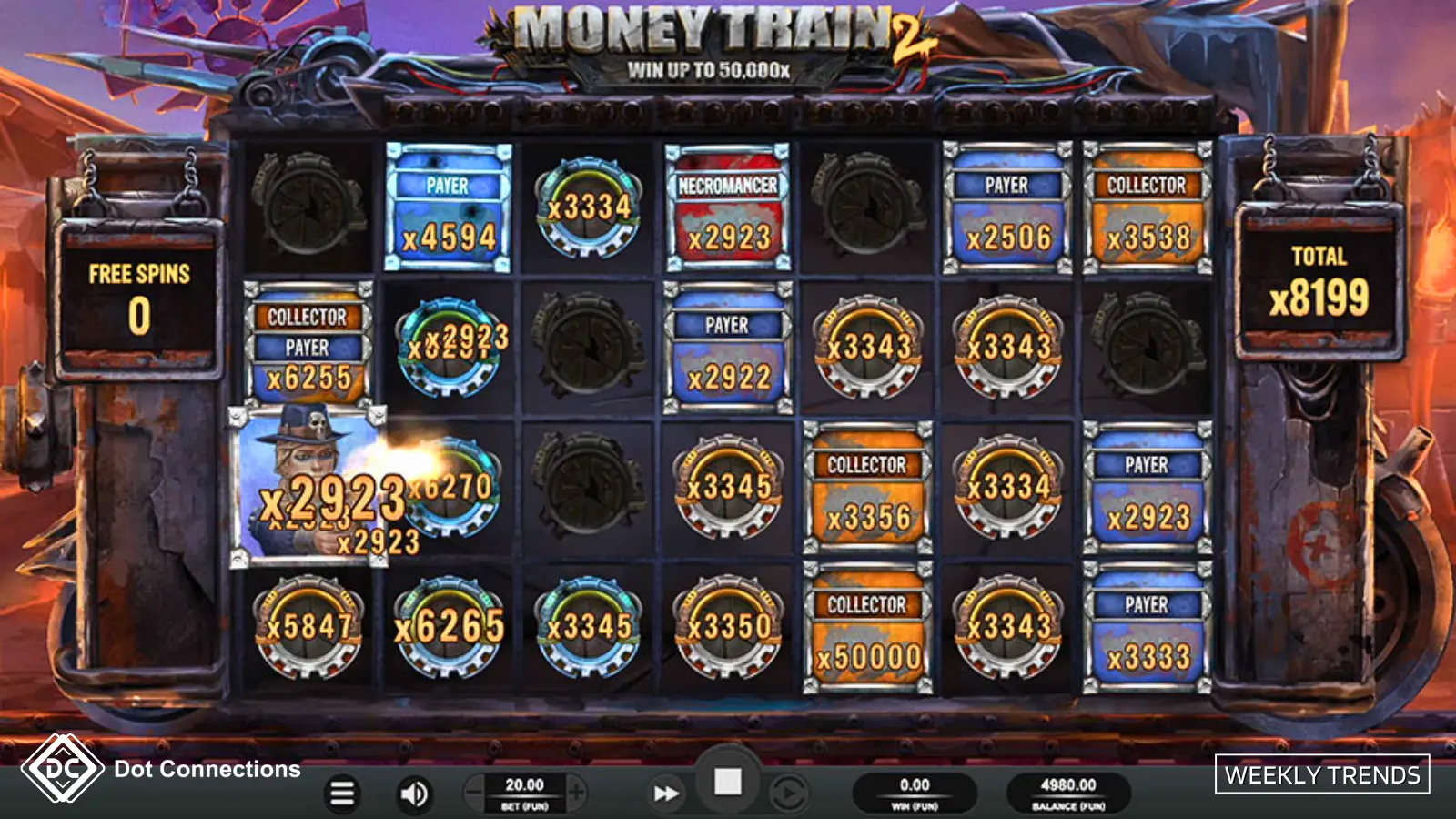

Money Train 2 slot gameplay with massive multipliers and bonus features showcased on screen.

Money Train 2 by Relax Gaming: Full Slot Review & Exclusive Campaign

Since its launch, Money Train 2 by Relax Gaming has become one of the most talked-about slots in the industry. From early August until now, it has consistently trended across operators worldwide, delivering strong engagement and impressive growth. One of our partners even recorded +99% growth and 50%+ new players in just 7 days.

Why Players Love Money Train 2

Money Train 2 builds on the success of the original with higher volatility, stunning visuals, and bigger win potential. Its steampunk Wild West setting combined with cinematic sound design makes every spin immersive and thrilling.

  • 50,000x max win potential
  • Money Cart Bonus Round with special modifiers (Collector, Sniper, Necromancer, etc.)
  • Respins feature with growing multipliers when 2 scatters land
  • 5 reels, 40 paylines, extremely high volatility
  • RTP up to 98% with Bonus Buy feature

Signature Features That Drive Engagement

Respins
Triggered when 2 scatters appear. Multipliers are revealed, then respins continue until a win lands, with the multiplier increasing after each losing spin.

Money Cart Bonus Round
The highlight of the game, unlocked with 3+ scatters. Special symbols like Payer, Collector, Sniper, and Necromancer can drastically boost multipliers. Fill a reel to unlock an extra reel, up to 2 additional reels for massive win potential.

Bonus Buy Option
For 100x the stake, players can jump directly into the Money Cart Bonus Round — a feature that attracts high-value sessions.

Performance Across Operators

Since early August, Money Train 2 has been a consistent top performer across our network. Its mix of volatility and excitement keeps players engaged while driving strong retention. The standout case is one operator achieving +99% overall growth and 50%+ unique players in just one week.

October Exclusive Campaign with Relax Gaming

This October, Dot Connections will launch the first-ever Exclusive Campaign with Relax Gaming. This milestone campaign will give operators exclusive promotional access to Money Train 2, ensuring they stay ahead of market trends.

  • Tailored strategies to match the right games with your market
  • Exclusive promotions to maximize player acquisition and retention
  • Early access benefits to strengthen your competitive edge

Expand Into the Asian Market with Viral Hits Like Money Train Series

At Dot Connections, we help operators choose the right games for their market, ensuring maximum growth and long-term engagement. With our expertise, trending hits like Money Train 2 become more than just games — they become growth drivers.

👉 Connect with us today to secure your advantage and join the upcoming exclusive campaign with Relax Gaming.


Tags: Money Train 2, Relax Gaming, Slot Review, Money Train 2 Bonus, Money Cart Bonus Round, 50,000x Max Win, iGaming, Casino Operators, Exclusive Campaign, Dot Connections

Night skyline of Macau integrated resorts and casinos, aerial view.

Macau’s US$19.3B Review – A Market-Signals Brief for Online Operators

December 1st, 2025

Recent reports indicate Macau may review whether six concessionaires fulfilled investment commitments made during the 2022 re-licensing. Specifically, reports put the totals near US$19.3 billion, and around US$16 billion is allocated to non-gaming projects. Therefore, because of the large non-gaming commitments and a public review, several market signals could emerge. For example, operators may wish to monitor possible timing shifts in procurement, episodic event-driven activity, and heightened documentation expectations.

Key takeaways

  • Importantly, the review concerns multi-year capital commitments from the 2022 licensing round and may aim to make progress on non-gaming projects more visible.
  • Market signals that could appear include timing shifts in procurement, episodic event-driven demand windows, and possibly higher documentation requests across supply chains.
  • Effects will likely be indirect for most online platforms. Nevertheless, tracking partner announcements, tender timelines and paid-media trends can surface early indicators.

What happened

• Public statements and media coverage in late 2025 reference a government review covering concessionaires’ investment projects and amounts for the 2023–2025 period. Reports commonly cite totals near US$19.3B. Moreover, many note that a large share would fund hotels, attractions, events and MICE (meetings, incentives, conferences and exhibitions).

• Meanwhile, industry data point to a solid recovery on gaming floors in 2025. Additionally, October 2025 recorded notably high gross gaming revenue compared with recent post-COVID months. Therefore, gaming demand and non-gaming commitments could coexist while the review proceeds.

Background & context

• The 2022 re-licensing process reportedly linked multi-year investment pledges to new concessions, and the public review appears consistent with policy aims to broaden Macau’s tourism and entertainment offer beyond gaming.

• Because the review covers large multi-year programmes and is public, it could trigger secondary market effects even if authorities do not announce sanctions. Consequently, for example, expect possible changes to buying schedules, shifts in marketing calendars tied to non-gaming events, or stricter reporting requirements across suppliers.

People discussing at a casino table in Macau — industry delegation observation.

Possible market signals from the Macau US$19.3B investment review

These possibilities are framed around the reported Macau US$19.3B investment review. In short, below are plausible signals market participants might observe as the review and any follow-up actions unfold.

    Timing shifts in procurement / spend cadence

    If concessionaires adjust the pace of capital deployment to meet contractual milestones, procurement schedules (RFP timing, project start/finish windows) could shift; some projects may accelerate while others might be deferred.

    Episodic event windows

    If operators increase focus on non-gaming attractions — concerts, family venues, esports activations or MICE — they may create occasional spikes in demand for marketing and promotions. Consequently, online channels could see short bursts of traffic tied to these events.

    Higher documentation & traceability expectations.

    A formal review or audit could lead to more frequent requests for documentation, milestone verification or clearer invoicing from vendors and partners.

    Near-term liquidity / payment timing pressure on some counterparties.

    If near-term capex priorities absorb cash, some counterparties might seek longer payment terms or prioritise CapEx suppliers, which could affect vendor cashflow dynamics.

    Relative priority shifts across procurement categories.

    In certain cases, emphasis on physical IR projects might temporarily shift procurement focus away from purely content buys toward services tied to non-gaming projects; conversely, demand for event-tie-in or experiential content could grow.

How this could relate to online operators

    Indirect demand effects.

    Online platforms do not carry physical capex. However, their acquisition and retention ecosystems could be affected if land-based partners alter promotional calendars or affiliate/referral flows. Event-driven on-shore activations may create windows of traffic that online platforms could observe.

    Downstream documentation expectations.

    If counterparties increase reporting or verification requirements, similar requests could cascade upstream to partners and vendors. This could potentially affect onboarding or contracting steps.

    Market signals to watch.

    Moreover, shifts in paid-media prices (CPM/CPA), affiliate flows, or traffic surges tied to public events can act as early indicators. Therefore, organisations should monitor these signals.

Considerations to monitor

These items are suggested as neutral monitoring topics — presented for reference rather than as specific instructions:

  • Public announcements and milestone updates from concessionaires and IR projects (press releases, government briefings).
  • RFP and procurement notices that indicate changes in project timing or vendor selection.
  • Paid-media and UA trendlines (CPM, CPA) in markets connected to Macau and adjacent regions as potential early signals.
  • Requests for documentation from counterparties (invoicing detail, milestone evidence, compliance materials).
  • Payment and credit patterns among major counterparties that might suggest liquidity or prioritisation shifts.

Illustrative options some market participants might consider

The short bullets below illustrate non-directive measures that some organisations may elect to prepare or monitor; they are included for reference and should not be read as prescriptive advice.

  • Some teams might consider assembling a concise verification pack (summary invoices, milestone notes, relevant certifications). They could keep it available should counterparties request further documentation.
  • Some groups may find it useful to prepare modular, short-lead promotional bundles (themed landing assets, limited-time creatives). These could be deployed quickly in the event of episodic demand.
  • Finance teams could consider stress-testing near-term cashflow scenarios. They could also review credit exposure to understand potential payment-timing risks.
  • Communications and account teams may draft neutral messaging templates to respond consistently. These templates could be used if partners inquire about event- or compliance-related support.

Things might consider to avoid

  • Do not over-interpret a single data point: a public review is a verification mechanism and not necessarily a sanction.
  • Avoid rapid, reactive price cuts or sweeping product pivots motivated by short-term headlines; some may prefer limited pilots or targeted approaches if exploring opportunities.
  • Recognise that effects may vary significantly across counterparties, regions and balance-sheet situations.

Suggested comms line — context for the Macau US$19.3B investment review

Stakeholders may read Macau’s announced review of concessionaire investment commitments — reported at roughly US$19.3B, with a substantial portion allocated to non-gaming projects — as a market signal. Organisations might monitor partner announcements, procurement timelines and paid-media trends for potential timing shifts or episodic event windows. They might also consider preparing concise verification materials or short event-focused bundles as part of routine readiness.

Disclaimer: This article is for informational purposes only and is not intended as business, legal, tax or financial advice. Statements in this note are presented as possibilities and market signals to monitor (may / might / could) rather than as prescriptive recommendations.


At Dot Connections, we track policy shifts and disruptive trends shaping the iGaming and online entertainment landscape worldwide. From compliance challenges to new market entries, our team delivers the intelligence operators and providers need to stay competitive.

🌍 If you’re planning to expand into dynamic markets in Asia, Africa, or Europe, our experts are ready to support your journey.

Follow Dot Connections for regulatory updates, market analysis, and strategic guidance on the future of iGaming.

New Zealand iGaming market transition illustration with Auckland night skyline, casino symbols, slot machine, roulette wheel, cards, dice, and New Zealand flag

Industry update • Asia • Published: February 24, 2026

New Zealand Moves Toward Regulated Online Casino Market in 2026

New Zealand is preparing to formally regulate its online casino sector, marking a significant shift from offshore-led access toward a structured, tightly controlled licensing model. With the first stage of the licensing process expected to begin in July 2026, the market is quickly becoming one of the most closely watched iGaming opportunities in the Asia-Pacific region.

Table of Contents

Key takeaways

  • New Zealand is moving from offshore-led online casino access toward a regulated market model.
  • The country is expected to allow up to 15 online casino licences under a tightly controlled framework.
  • The licensing process is expected to start in July 2026.
  • Entry is expected to follow a three-stage process: Expression of Interest, auction, and full licence application.
  • The reform is focused on consumer protection, harm minimisation, and stronger regulatory oversight rather than unrestricted market expansion.
  • The shift could create new opportunities for operators, suppliers, aggregators, and compliance technology providers targeting APAC growth.
  •  

New Zealand’s Online Casino Market Is Entering a New Phase

New Zealand is preparing to formally regulate its online casino sector, marking a major shift for a market that has historically been served largely by offshore operators. The move is expected to create one of the most closely watched new regulated iGaming opportunities in the Asia-Pacific region.

For years, online casino activity in New Zealand has been accessible mainly through offshore platforms. That is now changing as policymakers move toward a system designed to bring the sector under domestic oversight.

Modern laptop bursting with casino symbols and data visuals — iGaming tech and AI.

A Controlled Licensing Model Is Taking Shape

Up to 15 licences expected

Under the proposed framework, New Zealand plans to introduce a controlled licensing system for online casino gambling, with up to 15 licences available in the initial phase.

This is not expected to be an open-entry market. Instead, the government is taking a measured approach that prioritises oversight, accountability, and tighter control over market participation.

One brand per licence

The proposed structure also places clear limits on scale and concentration. Each licence is expected to apply to a single brand or platform, and licences are expected to be valid for a limited term with renewal options subject to regulatory review.

This approach is intended to prevent unrestricted expansion while ensuring operators remain accountable under a monitored framework.

Licensing Process Expected to Begin in July 2026

Three-stage entry process

New Zealand will begin the licensing process in July 2026 and structure it in three stages.

Operators will first submit an Expression of Interest, then compete in an auction stage, and finally file a full licence application if they succeed.

This model signals that New Zealand is aiming to tightly manage market entry rather than create an unlimited licensing environment.

Regulation Is Being Framed Around Protection, Not Expansion

Consumer protection and harm minimisation at the center

New Zealand officials have consistently positioned the reform as a regulatory and public-interest measure rather than a growth-first liberalisation of gambling.

The direction of the policy is centred on consumer protection, harm minimisation, tax collection, and stronger oversight of unlicensed gambling activity and advertising.

A more structured and transparent market

The broader goal is to move the market away from loosely supervised offshore access and toward a more transparent and enforceable model that gives authorities greater control over how online casino gambling is offered in the country.

What This Means for Operators, Suppliers, and Aggregators

A rare opportunity for operators

For operators, the emerging framework represents a rare opportunity to enter a newly regulated market in APAC. However, entry is expected to be competitive, selective, and heavily compliance-driven.

New demand for B2B infrastructure

For suppliers, aggregators, and platform providers, the shift could create future demand for licensed content, aggregation services, regulatory reporting, player-protection tools, and compliance-ready technology infrastructure.

As newly regulated markets typically require stronger technical and operational support, New Zealand could become an important opportunity not only for B2C operators, but also for B2B stakeholders looking to expand in the region.

Why New Zealand Matters in APAC iGaming

New Zealand is becoming increasingly relevant because it represents a transition from grey-market access to a rules-based model with controlled entry. That makes it a market worth monitoring closely for companies seeking long-term, regulation-friendly growth in Asia-Pacific.

With the first major licensing step expected in July 2026, the country is now entering a preparation phase that could shape the next wave of strategic moves across the iGaming value chain.

Conclusion

New Zealand’s move toward a regulated online casino framework marks an important turning point for the market. By shifting from offshore-led access to a structured licensing model, the country is laying the groundwork for a more controlled, transparent, and compliance-focused iGaming environment.

For operators, suppliers, and aggregators, the message is clear: New Zealand is no longer just a grey-market discussion. It is becoming a serious regulated opportunity in APAC.


At Dot Connections, we track policy shifts and disruptive trends shaping the iGaming and online entertainment landscape worldwide. From compliance challenges to new market entries, our team delivers the intelligence operators and providers need to stay competitive.

🌍 If you’re planning to expand into dynamic markets in Asia, Africa, or Europe, our experts are ready to support your journey.

Follow Dot Connections LinkedIn for regulatory updates, market analysis, and strategic guidance on the future of iGaming. Or Contact us here.

Illustration of the APAC iGaming market with Asian city skyline landmarks, roulette wheel, poker chips, dice, cards, and icons representing KYC, security, and advertising compliance.

Industry update • Asia • Published: February 24, 2026

Asia iGaming Market Update In Early Feb 2026

Early 2026 confirms a major shift in APAC iGaming: compliance is becoming a growth driver. Tighter KYC, ad scrutiny, AML monitoring, and enforcement pressure are reshaping how operators scale — while strong market signals (such as Macau) still point to opportunity for those with the right strategy.

Table of Contents

Key takeaways

  • APAC iGaming is entering a compliance-led growth phase in early 2026, with regulation directly impacting acquisition, payments, and partnership models.

  • The Philippines is a key market to watch, with tighter KYC requirements, potential advertising restrictions, and stronger AML/CTF focus likely to affect onboarding and marketing funnels.

  • Cambodia/Mekong enforcement developments are raising counterparty risk awareness, pushing operators and suppliers to strengthen due diligence on partners, affiliates, and payment channels.

  • Macau’s strong January 2026 performance signals healthy regional demand, but market strategy will increasingly depend on segmentation, retention, and execution quality rather than pure rebound momentum.

  • For operators and aggregators, the winning playbook in 2026 will combine compliance readiness, cleaner traffic sources, smarter retention, and market-fit content planning.

  •  

Philippines: tighter KYC, stricter advertising, bigger AML spotlight

KYC tightening: “verify before deposit”

In February 2026, PAGCOR reinforced stricter KYC expectations for online gambling—specifically addressing the loophole that allowed access or funding before initial identity checks were completed. The updated requirements emphasize identity details, valid government ID, and a real-time selfie holding the ID before deposits can be made.

Operator impact: This can raise friction at the top of the funnel (registration → first deposit). Winning operators will treat KYC as a product problem: reduce drop-offs, improve document capture UX, and optimize verification success rates.

Advertising: toward tougher broadcast restrictions

Philippine regulators and the Ad Standards Council discussed the possibility of expanding restrictions, including a potential full ban of online gambling ads on TV/radio (prime time is already restricted).

Operator impact: If broadcast becomes less accessible, growth strategies typically shift toward:

more controlled performance marketing (with stricter compliance review), stronger affiliate governance, and heavier reliance on CRM and retention mechanics.

AML/CTF 2026–2030 plan: casinos under increased monitoring

The Philippines is drafting a National AML/CTF plan for 2026–2030, with emphasis on monitoring high-risk sectors including casinos and enhanced cooperation to track illicit flows.

Operator impact: Expect more scrutiny on payments, source-of-funds patterns, and partner ecosystems—especially where traffic, conversion, or payment flows look anomalous.

Cambodia and the Mekong corridor: enforcement pressure raises counterparty risk

In February 2026, Cambodia’s regulator announced the revocation and suspension of multiple casino licenses connected to violations of gambling regulations, reported in the context of broader scrutiny around cyber-fraud networks.

This comes amid elevated international attention on scam networks operating in parts of the Mekong region (Cambodia/Myanmar/Laos), including high-profile enforcement and extradition developments.

Operator/aggregator takeaway: Raise your bar for enhanced due diligence:

verify ownership/UBO and licensing, strengthen PSP/merchant monitoring, tighten affiliate and brand-safety rules, and build clear “red flag” reporting + termination processes.

Modern laptop bursting with casino symbols and data visuals — iGaming tech and AI.

Macau: strong start to 2026, but expectations tilt to “steady” growth

Macau’s casino market started 2026 on a strong note. January 2026 GGR reached MOP 22.63 billion, up 24% year-on-year, and was reported as the highest January since 2019.

At the same time, some market commentary points to slower growth rates ahead versus the rebound phase—suggesting 2026 is more about operational efficiency, product mix, and premium mass experience than pure recovery momentum.

Implication for online strategy: Macau remains a key “market pulse” indicator for regional sentiment and seasonal demand patterns, especially around major holidays.

What trends are likely next in APAC (Q2 2026 onward)

Trend 1 — Compliance-led growth becomes the baseline

KYC tightening and AML focus are no longer “nice-to-have”—they influence who can scale marketing and payments safely. The Philippines is a clear 2026 example.

Trend 2 — Advertising & affiliate governance gets stricter

As regulators scrutinize broadcast and potentially broader ad channels, operators will need creative controls, claims substantiation, age-gating practices, and tighter affiliate oversight.

Trend 3 — AML/CTF scrutiny increases around casinos and payment flows

National AML plans and international evaluation cycles push regulators to demand stronger controls, especially where gaming intersects with payments and cross-border flows.

Trend 4 — “Responsible Gaming by design”

Expect continued emphasis on responsible gaming features and player protection in regulated markets—often tied to advertising and onboarding rules.

Trend 5 — Higher counterparty risk sensitivity in parts of Southeast Asia

Mekong enforcement stories increase the “cost of weak due diligence,” affecting PSPs, content distribution, and affiliate ecosystems.

Practical angle for a Europe-to-Asia game aggregator (how to position content)

If you’re a European content aggregator serving Asian operators, this narrative is highly publishable as industry news—because it answers what operators care about:

How regulation changes acquisition and conversion (KYC before deposit, ad restrictions)

How AML focus changes payments and partner selection

How enforcement risk shapes brand safety and expansion plans

Which markets show demand momentum (Macau pulse)

A strong CTA for your website post could be:

“Ask us for a market-fit EU game bundle for PH/APAC (compliance-first launch checklist + recommended mechanics for retention).”


At Dot Connections, we track policy shifts and disruptive trends shaping the iGaming and online entertainment landscape worldwide. From compliance challenges to new market entries, our team delivers the intelligence operators and providers need to stay competitive.

🌍 If you’re planning to expand into dynamic markets in Asia, Africa, or Europe, our experts are ready to support your journey.

Follow Dot Connections LinkedIn for regulatory updates, market analysis, and strategic guidance on the future of iGaming. Or Contact us here.

Modern laptop bursting with casino symbols and data visuals — iGaming tech and AI.

Industry update • Asia • Published: February 10, 2026

iGaming in Asia: Key market moves ahead of Lunar New Year 2026

With Lunar New Year traffic on the horizon, market watchers say Asia’s iGaming sector is entering a volatile period. This country-by-country briefing highlights the headlines operators, affiliates and suppliers are watching heading into the holiday.

Table of Contents

Key takeaways

  • Tightening ad rules and regulator actions are the immediate risk — review creatives and vendor accreditation now.
  • Macau and travel-linked markets offer short-term demand upside around the holiday, but competition for share is high.
  • Product and ops priorities: push mobile-first instant/live formats and scale AI-driven retention as paid acquisition gets tougher.
  •  

iGaming markets snapshot

China

Lottery sales reached a record (~628B CNY in 2025) but growth slowed (~0.7% YoY). Sports lotteries remain dominant while digital sales softened — signalling seasonal volatility and shifting player preferences that operators may wish to monitor..

Macau

Recovery is continuing into 2026. Analysts expect stronger GGR and potential share gains for large operators such as Las Vegas Sands and Wynn Resorts; Lunar New Year could act as a near-term demand catalyst.

Philippines

PAGCOR’s accreditation initiatives are increasing focus on local approvals for providers and affiliates. Operators may want to check vendor accreditation status and consider options for engagement.

India

Enforcement under evolving national online gaming rules has accelerated (large numbers of sites blocked); mirror sites and enforcement workarounds persist — a source of ongoing traffic volatility for real-money models.

Singapore

Live casino and premium resort demand appears resilient; operators could explore timing VIP and mass promotions around travel peaks.

Japan

IR/licensing timelines remain an important medium-to-long-term factor for tourism-driven demand — regulatory windows are worth tracking.

South Korea

Seollal (Lunar New Year) increases local leisure spend; real-money online gaming continues to be tightly regulated — social and entertainment-first products may be more appropriate in certain channels.

Southeast Asia (VN / MY / ID / TH)

Mobile-first casual and instant-win formats are gaining traction with younger players, while advertising and payment infrastructures vary significantly by market.

Row of slot machines on a casino floor — live gaming and mass market play.

Industry & platform themes (pan-Asia)

Ad policy attention

Major ad platforms have been reassessing sweepstakes ⁄ dual-currency social casino categories. This increases review risk for paid search ⁄ display creatives and landing pages – an area for operators to discuss internally with marketing and compliance.

Product & ops

AI for personalization, fraud detection and LTV management is moving from experimentation toward operational use. Live–dealer and instant social formats continue to attract audiences – potential levers for retention if acquisition channels shift.

Considerations for operators & affiliates

  • Review current ad creatives and landing-page messaging for sweepstakes/social formats — consider alternative wording or disclosure options where appropriate.
  • Confirm vendor accreditation status and explore contingency approaches for markets with active enforcement (e.g., Philippines, India).
  • Evaluate short-duration mobile-first pilots for holiday windows, and discuss how retention levers (including AI-driven flows) could complement any paid activity.
  • Reassess paid vs organic mix for the holiday window (e.g., SEO/content/native/influencer), given evolving ad platform risk.
  • Assemble documentation (product descriptions, mechanics, T&Cs) so internal reviewers or external partners can quickly verify product positioning if required.

At Dot Connections, we track policy shifts and disruptive trends shaping the iGaming and online entertainment landscape worldwide. From compliance challenges to new market entries, our team delivers the intelligence operators and providers need to stay competitive.

🌍 If you’re planning to expand into dynamic markets in Asia, Africa, or Europe, our experts are ready to support your journey.

Follow Dot Connections LinkedIn for regulatory updates, market analysis, and strategic guidance on the future of iGaming. Or Contact us here.

A national flag flying above classical government columns, hinting at state policy and regulatory authority.

Industry update • Philippines • Published: February 2, 2026

Philippines iGaming regulatory changes 2026: The future of iGaming in the Philippines

The Philippines iGaming regulatory changes 2026 are reshaping the regional online-gambling landscape. Regulators have moved to tighten commercial and payment rules, creating immediate disruption while accelerating industry maturation and likely consolidation.

Table of Contents

Key takeaways

  • Regulatory reset (MGF): PAGCOR’s new Minimum Guaranteed Fee (MGF) framework raises the fixed-cost floor for licensed operators, increasing the importance of scale and sustainable unit economics.

  • Payment friction (e-wallets): The Bangko Sentral order to remove in-app gambling links disrupted common payments flows (GCash, Maya), underscoring the role of payment rails in operator performance.

  • Market resilience + M&A: Despite payment friction, e-gaming grew +17.4% in Q3 2025, but the new fees and payment uncertainty make consolidation (Mergers & Acquisitions) a likely 2026 outcome.

  • Action agenda: Operators, studios and investors should stress-test MGF scenarios, diversify payments, and prepare M&A/compliance-ready packages.

What make Philippines iGaming regulatory changed

MGF introduced (PAGCOR memo, 15 Dec 2025; effective 1 Apr 2026)

The regulator published a phased fee framework that includes Minimum Guaranteed Fees tied to Gross Gaming Revenue (GGR) thresholds. Industry reporting lists phase-one examples such as GSAs offering electronic casino games with GGR thresholds of PHP30m, MGF ≈ PHP9m/month (and lower thresholds/fees for other product classes). The MGF is a fixed obligation that applies even if an operator’s actual revenues fluctuate.

BSP delinking (mid-Aug 2025)

The central bank ordered e-wallets and BSP-regulated payment apps to remove in-app links/shortcuts to online gambling with a short compliance window, aiming to reduce social risk and improve consumer protection. The move immediately affected conversion and deposit flows for many operators.

Market performance (Q3 2025)

PAGCOR’s published figures show e-gaming grew +17.4% in Q3 2025 — evidence that demand for iGaming remains strong even after payment-rail disruption.

Casino table with chips and cards in soft focus, representing the commercial side of gambling operations.

Why regulators acted

Regulators cite three main objectives behind this regulatory-change:

  • Consumer protection — limit frictionless paths to gambling via everyday payment apps
  • Fiscal transparency — ensure licensed operators contribute minimum fees and reduce under-reporting.
  • Market stability & AML risk reduction — reduce the population of lightly capitalized operators that create enforcement burdens.

Immediate impacts observed

  • Payment disruption: removal of wallet links reduced convenient deposit options and drove short-term transaction declines.
  • Margin compression: MGF introduces a new fixed cost that squeezes operators with volatile GGR, increasing liquidity risk for smaller players.
  • Strategic repricing and M&A talk: operators and investors are already re-pricing risk and consolidation conversations are becoming more frequent.

What this means for stakeholders (actionable playbook)

Operators ⁄ GSAs (platforms)

Stress-test unit economics for MGF scenarios — model margins, CAC, retention and the impact of partial or full wallet reinstatement.

Diversify payment rails (card acquiring, bank transfers, voucher top-ups, PSP integrations) to reduce dependence on any single e-wallet.

Optimize monetization — reduce churn, improve ARPU, renegotiate supplier fees.

Prepare M&A readiness — audit-ready compliance packs (KYC⁄AML logs, transactional audit trails), tidy data rooms and full retention/monetization metrics.

Studios & B2B providers

Offer compliance & integration bundles (fast on-boarding for large operators), and consider revenue-sharing or exclusivity with scaled partners to de-risk exposure.

Investors

Prioritize targets with diversified payments, strong retention, and clear compliance governance. These assets will command premiums in a consolidating market.

Outlook — scenarios to watch

Conditional reinstatement of e-wallet links

If BSP and wallets agree on safeguards (limits, stronger KYC), payment convenience could return gradually — a positive for conversion.

Gradual consolidation

If MGF pressure persists and wallet restrictions remain, expect continued M&A as larger operators acquire or white-label smaller assets.

Market professionalization

Long term, expect fewer but larger, compliance-ready operators and higher valuations for audit-ready assets.

Overall

The Philippines iGaming regulatory changes 2026 reset operator economics by combining payment-rail uncertainty with new fixed-fee obligations. Short-term volatility is likely; mid-term consolidation is probable. Stakeholders who act now — stress-testing scenarios, diversifying payments, and preparing compliance-ready M&A packages — will be best positioned to capture the next phase of growth.


At Dot Connections, we track policy shifts and disruptive trends shaping the iGaming and online entertainment landscape worldwide. From compliance challenges to new market entries, our team delivers the intelligence operators and providers need to stay competitive.

🌍 If you’re planning to expand into dynamic markets in Asia, Africa, or Europe, our experts are ready to support your journey.

Follow Dot Connections LinkedIn for regulatory updates, market analysis, and strategic guidance on the future of iGaming. Or Contact us here.

Alberta city skyline and arena in winter light, showing urban infrastructure and skyline.

Industry update • Canada • Published: January 26, 2026

Alberta (Canada) iGaming Launch 2026: Timeline, Tax, and What It Means for Operators

Alberta is moving quickly to establish a regulated multi-operator iGaming market with a targeted launch in Spring/Summer 2026. Regulatory building blocks — including a centralized self-exclusion system and operator registration rules — are being finalized, while tax and compliance frameworks are shaping operator entry strategies and potential market dynamics.

Table of Contents

Key takeaways

  • Launch target: Spring/Summer 2026.
  • Player protection: centralized self-exclusion via API is being prioritized.
  • Tax & fees: headline tax around 20% on 97% of GGR; application and registration fees in the mid-hundred-thousand CAD range.
  • Compliance burden: SOC-style security audits and related upgrades may raise initial costs substantially.
  • Market entrants: major operators likely to lead entry; smaller operators may evaluate partnerships or managed solutions to manage costs.

Alberta iGaming Launch 2026 — Full briefing

Timeline & official position

The provincial government has enacted an iGaming framework and set up an agency to manage and oversee the new market structure. Officials and industry stakeholders have signalled a clear intention to move quickly, with a Spring/Summer 2026 window repeatedly referenced in recent industry discussions. Operator registration pathways are being opened and key technical and contractual elements are in active development to meet that timeline.

What’s changing for players

Until now, residents had access primarily to a government-run online offering as the only regulated domestic option. The shift to a licensed multi-operator market is intended to provide Albertans with a broader range of licensed gaming options while centralizing protections such as a province-wide self-exclusion system. For players, this could mean more variety in game content and promotions from licensed providers, coupled with stronger cross-platform safeguards and standardized responsible-gambling tools.

Costs, fees and tax (figures to budget for)

The proposed commercial framework introduces several direct costs that operators should consider when assessing entry economics:

  • Application fee: a significant one-time application fee is expected as part of the registration process.
  • Annual registration fee: operators that secure licensing and registration will face recurring annual fees to maintain market access.
  • Taxation: headline tax rates have been presented around 20% applied to a defined portion of gross gaming revenue; the effective tax burden can change depending on permitted deductions and specific calculation methods.
  • Compliance and audit costs: independent security and control audits—frequently described in the industry as SOC-style examinations—are anticipated. Preparing for and passing such audits may require investments in systems, policies, and third-party assessments that can materially increase initial and ongoing costs.

Taken together, these items affect both the capital required to enter and the ongoing profitability of operating in the province. Operators are likely to model multiple taxation and compliance scenarios to understand breakeven and return-on-investment timelines.

Player protection: centralized self-exclusion

Centralized self-exclusion is a key regulatory priority. The approach being developed focuses on an API-driven system that allows operators to query and enforce self-exclusion records in real time. For regulators, the benefit is coordinated protection across all licensed operators; for operators, the technical and privacy requirements of such an integration will require attention during implementation planning.

Market scale & opportunity

Alberta represents a sizeable gaming market with material annual gaming revenues reported in recent fiscal periods. In addition to regulated demand, there is substantial activity in the unregulated or “gray” market where offshore operators currently capture online play. A licensed, well-executed multi-operator market could attract a portion of that volume back to domestic, regulated channels — offering commercial opportunity for operators that can meet compliance and product expectations.

Industry reaction & practical issues

Industry responses to the announced framework are mixed. Large international operators have both the scale and compliance budgets to plan for quick entry and to absorb setup costs. Smaller and medium-sized operators have expressed concerns that the combination of registration fees, ongoing taxation and the potential need for expensive security audits could raise barriers to entry. In practice, this may influence which operators prioritize Alberta in their rollouts and which choose partnership or platform-based arrangements instead of full direct entry.

Dan Keene, CEO of Alberta iGaming Corporation, pictured alongside the Canadian flag and a government building

What operators might consider beforehand

The following items are neutral considerations for operators evaluating market entry — they are presented as possible actions to evaluate, not as definitive advice.

  • Review registration timeline & readiness

    Operators might consider preparing application documentation and corporate disclosures early to align with registration windows and procurement timelines. Early readiness may reduce onboarding delays if the market opens on the planned schedule.

  • Assess SOC/security posture

    Operators could perform a security gap analysis to estimate the work and cost required to reach audit-ready status. Identifying critical deficits early helps prioritize investments in infrastructure, logging, incident response and policy documentation.

  • Model taxation scenarios

    Operators may want to run financial sensitivity analyses for headline tax rates and for variations in effective tax burden when accounting for deductions and levies. Scenario modeling can inform pricing, product mix and promotion strategies.

  • Plan self-exclusion integration

    Teams might evaluate the technical effort to integrate with a centralized self-exclusion API, including data flows for enrollment, identity matching, real-time blocking and appeals or case management workflows.

  • Evaluate payment & KYC flows

    Operators could assess whether current payment rails, KYC vendors and AML controls meet provincial expectations; local payment options and efficient KYC processes can materially shorten time to market and improve conversion.

  • Explore platform or partnership options

    Smaller operators may consider managed platforms, white-label providers or local partnerships to reduce upfront capital and compliance burdens while still reaching Alberta players quickly.

  • Engage local counsel & compliance advisors

    Operators might consult regulatory counsel who are familiar with the province’s legislative framework to clarify contractual obligations, consumer protections, and reporting requirements so that commercial agreements reflect regulatory duties.

  • Prioritize vendor sourcing

    Operators could pre-screen vendors for SOC readiness, accredited testing facilities, and API integration experience to speed up procurement and implementation if they decide to enter the market.

  • Implications for the broader ecosystem

  • Vendors & service providers

    Demand may increase for compliance-oriented services — security auditors, testing labs, payment integrators and API specialists — as operators seek audit-ready partners and rapid integration paths.

  • Players

    A licensed multi-operator environment could expand regulated product choices for residents while delivering standardized responsible-gambling tools and cross-platform protections.

  • Smaller operators

    Higher upfront costs and compliance requirements may push some smaller operators to consider partnerships, managed platforms, or delayed entry until market economics become clearer.

  • Conclusion

    Alberta’s planned transition to a regulated iGaming market targeted for Spring/Summer 2026 represents a major regional development. Centralized player protections and robust security expectations, combined with registration fees and a structured tax framework, will shape who is able to enter immediately and how operators structure their commercial and compliance strategies. Stakeholders monitoring the rollout may wish to evaluate technical readiness, financial models and vendor options now to ensure they are prepared for the market opening.


    At Dot Connections, we track policy shifts and disruptive trends shaping the iGaming and online entertainment landscape worldwide. From compliance challenges to new market entries, our team delivers the intelligence operators and providers need to stay competitive.

    🌍 If you’re planning to expand into dynamic markets in Asia, Africa, or Europe, our experts are ready to support your journey.

    Follow Dot Connections LinkedIn for regulatory updates, market analysis, and strategic guidance on the future of iGaming. Or Contact us here.

    Contact us

    Exterior of a Philippine integrated resort and casino with gold façade and landscaped grounds — Philippines 14-day visa-free for Chinese visitors.

    Industry update • Philippines • Published: January 19, 2026

    Philippines 14-day visa-free for Chinese visitors: Opportunity for casino operators

    Philippines 14-day visa-free for Chinese visitors presents a timely opportunity for online casino operators to capture short-stay demand. This article outlines practical, web-first tactics — payments, rapid onboarding, live-ops and fraud controls — to convert travelers into depositors with low-risk pilots.

    Table of Contents

    Key takeaways

    • Time-limited chance: 14-day visa-free for Chinese visitors creates short-stay demand.
    • Web-first conversion: fast mobile UX + one-click deposits.
    • Payments matter: UnionPay/eWallets + high success rate.
    • Timed offers: 48–72h tournaments and flash promos.
    • Protect revenue: strong KYC, device fingerprinting, anti-fraud.
    • Aggregator edge: one integration, localized assets, campaign support.

    Quick summary

    On 16 January 2026 the Philippine Department of Foreign Affairs announced a 14-day visa-free entry for Chinese nationals arriving via Manila (NAIA) or Mactan-Cebu airports. For online real-money operators, this policy creates an immediate—but nuanced—opportunity. Short-term tourist flows can increase demand for local payment on-ramps, VIP conversions, and cross-platform play, but converting that traffic into sustainable digital revenue requires a web-first approach: payments, compliance, fraud controls and sharp UA/CRM plans.

    Why this matters for online operators

    • Higher inbound travel, more cross-platform demand: Visitors are likely to use mobile apps and web portals while abroad; short visits tend to spark trial deposits if payment and onboarding are frictionless.
    • Travel windows concentrate activity. Short stays favor small, high-value campaigns (flash tournaments, short deposit offers) timed around travel weekends.
    • Data flows from offline to online. Players who visit land resorts often look for convenience — if your web channel offers a better digital experience (local payments, language), you can capture share of wallet.
    Night-time Manila street near Entertainment City with purple-lit buildings and palm trees — Philippines 14-day visa-free for Chinese visitors.

    Online-first tactical playbook (next 30–60 days)

    1. Optimize deposit UX & payment rails

    Integrate UnionPay Online, eWallets that Chinese visitors prefer where legal, and fast card/PSP flows. Ensure high payment success rate and minimal 3-D friction at moment of deposit.

    Implement localized UI: Mandarin language, currency toggle, and simple deposit modal (saved methods, quick top-up).

    2. Mobile performance & latency

    Test and optimize CDN routing to SEA nodes, reduce page/app load less than 2 seconds, and minimize transaction latency (critical for live tables ⁄ slot sessions).

    3. Onboarding funnel: trial → KYC → deposit

    Use progressive KYC (soft KYC for trial features, full KYC at first deposit). Offer small “first-time deposit” boosts tied to completed KYC to convert trial users quickly.

    Capture consented contact points for immediate CRM (WeChat ID only if consent and legal).

    4. Marketing & acquisition (digital focused)

    Run short, high-frequency UA: affiliate promotions, localized SEM, programmatic for SEA markets, and geo-targeted paid social where legal. Avoid direct gambling ads into Mainland China without legal sign-off.

    Use A/B tested creatives emphasizing speed-to-play, local payment methods, and short-stay packages (e.g., “48-hour VIP trial”).

    5. Live-ops & events (web native)

    Create time-boxed events (48–72 hour tournaments), progressive challenges, and leaderboard prizes redeemable for deposit bonuses. Sync event timing to peak travel weekends.

    6. Fraud prevention & bonus abuse controls

    Deploy device fingerprinting, velocity rules, behavioral scoring, and automated flags for multi-account patterns. Add manual review for VIP conversions.

    Harden promo rules: limit bonus stacking, require minimal wagering or activity to redeem.

    7. Compliance & geo controls

    Enforce IP/geo blocks to prevent access from prohibited jurisdictions. Ensure all offers comply with your operating license and local law (PAGCOR rules, payment regulations). Consult legal before any China-facing marketing.

    8. CRM & retention

    Build short drip sequences: welcome → 24h incentive → 7-day re-engage. Use in-app messaging to surface time-limited offers while users are physically in the country. Measure conversion within first 7 days.

    Metrics to track (web operators)

    • Deposit conversion rate (trial → first deposit)
    • Payment success rate (%) and decline reasons
    • Bonus abuse rate or reversed transactions
    • Chargeback rate & fraud loss %
    • D1 ⁄ D7 ⁄ D30 retention of depositors
    • ARPPU (depositor) and LTV per acquisition channel
    • CPA by channel vs 30-day LTV

    Quick experiments (low effort, high signal)

    • Experiment A — “48-hr VIP Trial”: New arrivals who KYC and deposit within 48 hours receive a small VIP bundle. KPI: deposit conversion within 48h.
    • Experiment B — Payment Funnel A/B: Compare one-click saved method vs multi-step deposit modal. KPI: payment success & drop-off rate.
    • Experiment C — Anti-fraud kick test: Apply tightened velocity rules for a test cohort vs control; track chargebacks and false positives.

    Legal & reputational guardrails

    • Never target gambling ads directly into Mainland China without legal clearance. Use neutral tourism/entertainment messaging where appropriate and rely on partners/affiliates who understand local rules.
    • Strengthen KYC/AML for foreign short-stay visitors and ensure transparent responsible-gaming tools are visible.
    • Be ready to scale back quickly if the visa program changes — prefer agile, low-capex pilots.

    Bottom line

    The 14-day visa waiver is a tactical window for web operators to capture short-stay demand — but success for real-money businesses depends on a web-first roadmap: fast, local payment rails; low-friction deposit flows; tight fraud controls; and digital acquisition/live-ops tuned for short visits. Run quick pilots, measure conversion velocity, and scale defensibly.


    At Dot Connections, we track policy shifts and disruptive trends shaping the iGaming and online entertainment landscape worldwide. From compliance challenges to new market entries, our team delivers the intelligence operators and providers need to stay competitive.

    🌍 If you’re planning to expand into dynamic markets in Asia, Africa, or Europe, our experts are ready to support your journey.

    Follow Dot Connections LinkedIn for regulatory updates, market analysis, and strategic guidance on the future of iGaming. Or Contact us here.

    Judge's gavel and digital icons — symbolizing iGaming regulation and legal change.

    Sri Lanka sets new Gambling Regulatory Authority due to the Integrated Resorts' demand rises

    Published: November 24, 2025

    Colombo — 23 November 2025 — Sri Lanka will bring its new Gambling Regulatory Authority (GRA) into force on 1 December 2025 , the government announced in a gazette notification, consolidating oversight of casinos, betting and online gambling as the country rolls out large integrated-resort capacity and updates gambling taxes.

    Sri Lanka will implement a single Gambling Regulatory Authority (GRA) on 1 December 2025 , and recent tax/fee updates plus the opening of City of Dreams Colombo have created a near-term, lower-ambiguity window for licensed operators and suppliers. Operators that prepare regulator-ready documentation, simple reporting integrations and localized product packages can shorten approval cycles and move quickly to pilot and live phases.

    What changed (key facts)

    GRA goes live 1 Dec 2025

    The Gambling Regulatory Authority Act was passed in 2025 and is scheduled for implementation on 1 December 2025. This centralizes licensing, compliance oversight and revenue collection under one authority.

    Integrated-resort demand

    City of Dreams Colombo and a tourism push have created immediate demand from integrated resorts (IRs) for premium content, events and localized entertainment offerings.

    Large untaxed online segment

    Officials reported a growing online player base (widely reported as ~60–70% of players) while land-based attendance is lower, highlighting an untaxed/under-regulated online market that the GRA aims to address.

    Tax & fee updates

    The 2025 budget includes increases to betting levies and higher local casino entry fees for residents, which affect operator economics but increase transparency and fiscal revenue flows.

    Industry calendar

    SiGMA South Asia (Colombo, 30 Nov – 2 Dec 2025) and other local events make the coming weeks an ideal time for pilots, demos and regulatory discussions.

    Context & implications — detailed analysis

    The GRA rollout and concurrent commercial developments create a multi-dimensional impact across regulatory, commercial and operational spheres. Below is a practical breakdown of what this means — and what operators, suppliers and investors should prioritize.

    1. Regulatory & compliance implications

    Centralized point of contact. The GRA creates a single interlocutor for licensing, technical requirements and enforcement, replacing prior fragmented or overlapping administrative routes. Expect faster initial guidance but also stricter single-source compliance checks.

    Broader remit over online activity. With officials flagging a high share of online play, expect regulator focus on bringing unregistered remote gambling into the licensing/tax net — operators running remote offerings should expect registration, reporting and tax obligations.

    AML/CFT scrutiny aligned to FATF expectations. Sri Lanka’s timing ahead of an FATF review suggests the GRA will prioritize AML/CTF controls, suspicious-activity reporting, and beneficial-ownership transparency. Operators must be ready for enhanced KYC, transaction monitoring and audit trails.

    Operator action: begin pre-consultation with local counsel and compliance teams; inventory current remote offerings and map gaps vs. licensing/data requirements.

    2. Commercial & market implications

    Clearer rules reduce commercial ambiguity. Having one regulator simplifies bid processes for IR contracts and lets procurement teams compare supplier readiness on apples-to-apples terms (technical reporting, certifications, localization). This typically shortens RFP cycles.

    Tax & fee changes reshape revenue modelling. Higher betting levies and doubled local entry fees mean operators need to re-evaluate pricing, bonus caps and resident-targeted promos. The commercial sweet spot may be tourist / high-yield segments rather than mass domestic play.

    IR-driven demand for premium content. City of Dreams Colombo’s opening creates immediate procurement needs for destination titles, event content and MICE-friendly products — fast pilots can convert to longer-term integrations.

    Operator action: re-price and re-model P&L under new tax assumptions; target IR product packages (premium, event-mode, high-yield features).

    3. Technical & operational implications

    Reporting & audit readiness becomes a gating factor. Regulators will likely require exportable session/transaction logs and audit-ready artifacts (RNG certificates, RTP reports). Suppliers who provide a single-integration reporting API and pre-formatted exports will materially reduce technical review time.

    Data protection & retention compliance. Sharing data with a regulator must meet local data-protection expectations (secure transmission, minimization, retention policy). Operators must reconcile PD/consent regimes with regulator reporting requests.

    Operational monitoring for harm & AML. Expect requests for evidence of player-protection measures (self-exclusion, deposit limits) and AML monitoring metrics. Dashboards showing alerts, investigations and remediation actions will be valuable in licensing reviews.

    Operator action: standardize log schemas, implement secure export pipelines, and prepare dashboards for regulator demos.

    4. Risk landscape & mitigation

    Political/governance risk. Implementation speed may create implementation gaps or administrative backlog — maintain flexible timelines and local partners to navigate transitional provisions.

    Commercial margin pressure. Tax increases will compress margins; mitigate by focusing on tourist yield, events, and non-gaming revenue (F&B, MICE).

    Reputational risk from prior unregulated operators. Operators must emphasize transparency and compliance to avoid negative association with earlier untaxed or illegal activity.

    Operator action: include reputation & compliance statements in bids; propose pilot structures with strong compliance KPIs.

    5. Timing & go-to-market window

    Immediate window (next 4–8 weeks): engage GRA for early guidance, book SiGMA meetings and prepare regulator-folder (certs, reporting samples).

    Near term (2–3 months): run pilots with IRs using compliance-ready bundles; finalize PSP/payment flows for multi-currency settlement and tax withholdings.

    Medium term (3–6 months): scale content library and integrate BI/monitoring for ongoing regulator reporting and tax reconciliation.

    Luxury casino floor with gaming tables and chairs — representing the casino and iGaming market.

    What is the Gambling Regulatory Authority (GRA)?

    The Gambling Regulatory Authority is the statutory body created by the 2025 Act to license, supervise and enforce regulation across gaming verticals. Its main functions will include licensing land-based and (where permitted) remote operators, collecting gambling-related revenue, issuing technical and social-responsibility standards, and coordinating AML/CTF compliance with other national agencies. The GRA replaces fragmented arrangements and is intended to be the single point of regulatory accountability.

    How the casino & iGaming industry has developed in Sri Lanka

    Casinos and gaming have a varied history in Sri Lanka, with land-based venues operating for decades under different statutory arrangements. Recent policy pivot towards tourism-led recovery elevated casino tourism as an economic lever, culminating in legislative reform in 2025 to modernize the legal and regulatory framework for both land and online activity. Growth of online play in recent years exposed a large untaxed segment — a key driver for the GRA’s creation.

    Which integrated resorts and major venues are operating now?

    The flagship is City of Dreams Colombo , a large integrated resort opened in 2025 and marketed as a regional destination combining hotels, retail, F&B and a high-end casino core. It is the prime focus of the government’s strategy to attract high-value tourism and to provide an anchor customer for premium gaming content and events. Other luxury hotels and entertainment venues in Colombo host casino operations at smaller scale, but City of Dreams is the primary purpose-built IR at present.

    Near-term opportunities for operators and suppliers

    • Regulatory & compliance services — licensing support, compliance document preparation, AML tooling.

    • Single-integration reporting & audit exports — session/transaction logs and regulator-ready exports.

    • Localization & content adaptation — language packs (Sinhala, Tamil, English), UI variants and region-appropriate themes.

    • Event & MICE content — tournament modes, branded skins and short-run exclusives for conventions.

    • Payment & settlement solutions — support for tax withholdings, multi-currency tourist flows and local PSPs.

    • Analytics & player-protection dashboards — evidence for regulator reviews and FATF-aligned AML monitoring.


    At Dot Connections, we track policy shifts and disruptive trends shaping the iGaming and online entertainment landscape worldwide. From compliance challenges to new market entries, our team delivers the intelligence operators and providers need to stay competitive.

    🌍 If you’re planning to expand into dynamic markets in Asia, Africa, or Europe, our experts are ready to support your journey.

    Follow Dot Connections for regulatory updates, market analysis, and strategic guidance on the future of iGaming.

    New Zealand iGaming market transition illustration with Auckland night skyline, casino symbols, slot machine, roulette wheel, cards, dice, and New Zealand flag

    Industry update • Asia • Published: February 24, 2026

    New Zealand Moves Toward Regulated Online Casino Market in 2026

    New Zealand is preparing to formally regulate its online casino sector, marking a significant shift from offshore-led access toward a structured, tightly controlled licensing model. With the first stage of the licensing process expected to begin in July 2026, the market is quickly becoming one of the most closely watched iGaming opportunities in the Asia-Pacific region.

    Table of Contents

    Key takeaways

    • New Zealand is moving from offshore-led online casino access toward a regulated market model.
    • The country is expected to allow up to 15 online casino licences under a tightly controlled framework.
    • The licensing process is expected to start in July 2026.
    • Entry is expected to follow a three-stage process: Expression of Interest, auction, and full licence application.
    • The reform is focused on consumer protection, harm minimisation, and stronger regulatory oversight rather than unrestricted market expansion.
    • The shift could create new opportunities for operators, suppliers, aggregators, and compliance technology providers targeting APAC growth.
    •  

    New Zealand’s Online Casino Market Is Entering a New Phase

    New Zealand is preparing to formally regulate its online casino sector, marking a major shift for a market that has historically been served largely by offshore operators. The move is expected to create one of the most closely watched new regulated iGaming opportunities in the Asia-Pacific region.

    For years, online casino activity in New Zealand has been accessible mainly through offshore platforms. That is now changing as policymakers move toward a system designed to bring the sector under domestic oversight.

    Modern laptop bursting with casino symbols and data visuals — iGaming tech and AI.

    A Controlled Licensing Model Is Taking Shape

    Up to 15 licences expected

    Under the proposed framework, New Zealand plans to introduce a controlled licensing system for online casino gambling, with up to 15 licences available in the initial phase.

    This is not expected to be an open-entry market. Instead, the government is taking a measured approach that prioritises oversight, accountability, and tighter control over market participation.

    One brand per licence

    The proposed structure also places clear limits on scale and concentration. Each licence is expected to apply to a single brand or platform, and licences are expected to be valid for a limited term with renewal options subject to regulatory review.

    This approach is intended to prevent unrestricted expansion while ensuring operators remain accountable under a monitored framework.

    Licensing Process Expected to Begin in July 2026

    Three-stage entry process

    New Zealand will begin the licensing process in July 2026 and structure it in three stages.

    Operators will first submit an Expression of Interest, then compete in an auction stage, and finally file a full licence application if they succeed.

    This model signals that New Zealand is aiming to tightly manage market entry rather than create an unlimited licensing environment.

    Regulation Is Being Framed Around Protection, Not Expansion

    Consumer protection and harm minimisation at the center

    New Zealand officials have consistently positioned the reform as a regulatory and public-interest measure rather than a growth-first liberalisation of gambling.

    The direction of the policy is centred on consumer protection, harm minimisation, tax collection, and stronger oversight of unlicensed gambling activity and advertising.

    A more structured and transparent market

    The broader goal is to move the market away from loosely supervised offshore access and toward a more transparent and enforceable model that gives authorities greater control over how online casino gambling is offered in the country.

    What This Means for Operators, Suppliers, and Aggregators

    A rare opportunity for operators

    For operators, the emerging framework represents a rare opportunity to enter a newly regulated market in APAC. However, entry is expected to be competitive, selective, and heavily compliance-driven.

    New demand for B2B infrastructure

    For suppliers, aggregators, and platform providers, the shift could create future demand for licensed content, aggregation services, regulatory reporting, player-protection tools, and compliance-ready technology infrastructure.

    As newly regulated markets typically require stronger technical and operational support, New Zealand could become an important opportunity not only for B2C operators, but also for B2B stakeholders looking to expand in the region.

    Why New Zealand Matters in APAC iGaming

    New Zealand is becoming increasingly relevant because it represents a transition from grey-market access to a rules-based model with controlled entry. That makes it a market worth monitoring closely for companies seeking long-term, regulation-friendly growth in Asia-Pacific.

    With the first major licensing step expected in July 2026, the country is now entering a preparation phase that could shape the next wave of strategic moves across the iGaming value chain.

    Conclusion

    New Zealand’s move toward a regulated online casino framework marks an important turning point for the market. By shifting from offshore-led access to a structured licensing model, the country is laying the groundwork for a more controlled, transparent, and compliance-focused iGaming environment.

    For operators, suppliers, and aggregators, the message is clear: New Zealand is no longer just a grey-market discussion. It is becoming a serious regulated opportunity in APAC.


    At Dot Connections, we track policy shifts and disruptive trends shaping the iGaming and online entertainment landscape worldwide. From compliance challenges to new market entries, our team delivers the intelligence operators and providers need to stay competitive.

    🌍 If you’re planning to expand into dynamic markets in Asia, Africa, or Europe, our experts are ready to support your journey.

    Follow Dot Connections LinkedIn for regulatory updates, market analysis, and strategic guidance on the future of iGaming. Or Contact us here.

    Illustration of the APAC iGaming market with Asian city skyline landmarks, roulette wheel, poker chips, dice, cards, and icons representing KYC, security, and advertising compliance.

    Industry update • Asia • Published: February 24, 2026

    Asia iGaming Market Update In Early Feb 2026

    Early 2026 confirms a major shift in APAC iGaming: compliance is becoming a growth driver. Tighter KYC, ad scrutiny, AML monitoring, and enforcement pressure are reshaping how operators scale — while strong market signals (such as Macau) still point to opportunity for those with the right strategy.

    Table of Contents

    Key takeaways

    • APAC iGaming is entering a compliance-led growth phase in early 2026, with regulation directly impacting acquisition, payments, and partnership models.

    • The Philippines is a key market to watch, with tighter KYC requirements, potential advertising restrictions, and stronger AML/CTF focus likely to affect onboarding and marketing funnels.

    • Cambodia/Mekong enforcement developments are raising counterparty risk awareness, pushing operators and suppliers to strengthen due diligence on partners, affiliates, and payment channels.

    • Macau’s strong January 2026 performance signals healthy regional demand, but market strategy will increasingly depend on segmentation, retention, and execution quality rather than pure rebound momentum.

    • For operators and aggregators, the winning playbook in 2026 will combine compliance readiness, cleaner traffic sources, smarter retention, and market-fit content planning.

    •  

    Philippines: tighter KYC, stricter advertising, bigger AML spotlight

    KYC tightening: “verify before deposit”

    In February 2026, PAGCOR reinforced stricter KYC expectations for online gambling—specifically addressing the loophole that allowed access or funding before initial identity checks were completed. The updated requirements emphasize identity details, valid government ID, and a real-time selfie holding the ID before deposits can be made.

    Operator impact: This can raise friction at the top of the funnel (registration → first deposit). Winning operators will treat KYC as a product problem: reduce drop-offs, improve document capture UX, and optimize verification success rates.

    Advertising: toward tougher broadcast restrictions

    Philippine regulators and the Ad Standards Council discussed the possibility of expanding restrictions, including a potential full ban of online gambling ads on TV/radio (prime time is already restricted).

    Operator impact: If broadcast becomes less accessible, growth strategies typically shift toward:

    more controlled performance marketing (with stricter compliance review), stronger affiliate governance, and heavier reliance on CRM and retention mechanics.

    AML/CTF 2026–2030 plan: casinos under increased monitoring

    The Philippines is drafting a National AML/CTF plan for 2026–2030, with emphasis on monitoring high-risk sectors including casinos and enhanced cooperation to track illicit flows.

    Operator impact: Expect more scrutiny on payments, source-of-funds patterns, and partner ecosystems—especially where traffic, conversion, or payment flows look anomalous.

    Cambodia and the Mekong corridor: enforcement pressure raises counterparty risk

    In February 2026, Cambodia’s regulator announced the revocation and suspension of multiple casino licenses connected to violations of gambling regulations, reported in the context of broader scrutiny around cyber-fraud networks.

    This comes amid elevated international attention on scam networks operating in parts of the Mekong region (Cambodia/Myanmar/Laos), including high-profile enforcement and extradition developments.

    Operator/aggregator takeaway: Raise your bar for enhanced due diligence:

    verify ownership/UBO and licensing, strengthen PSP/merchant monitoring, tighten affiliate and brand-safety rules, and build clear “red flag” reporting + termination processes.

    Modern laptop bursting with casino symbols and data visuals — iGaming tech and AI.

    Macau: strong start to 2026, but expectations tilt to “steady” growth

    Macau’s casino market started 2026 on a strong note. January 2026 GGR reached MOP 22.63 billion, up 24% year-on-year, and was reported as the highest January since 2019.

    At the same time, some market commentary points to slower growth rates ahead versus the rebound phase—suggesting 2026 is more about operational efficiency, product mix, and premium mass experience than pure recovery momentum.

    Implication for online strategy: Macau remains a key “market pulse” indicator for regional sentiment and seasonal demand patterns, especially around major holidays.

    What trends are likely next in APAC (Q2 2026 onward)

    Trend 1 — Compliance-led growth becomes the baseline

    KYC tightening and AML focus are no longer “nice-to-have”—they influence who can scale marketing and payments safely. The Philippines is a clear 2026 example.

    Trend 2 — Advertising & affiliate governance gets stricter

    As regulators scrutinize broadcast and potentially broader ad channels, operators will need creative controls, claims substantiation, age-gating practices, and tighter affiliate oversight.

    Trend 3 — AML/CTF scrutiny increases around casinos and payment flows

    National AML plans and international evaluation cycles push regulators to demand stronger controls, especially where gaming intersects with payments and cross-border flows.

    Trend 4 — “Responsible Gaming by design”

    Expect continued emphasis on responsible gaming features and player protection in regulated markets—often tied to advertising and onboarding rules.

    Trend 5 — Higher counterparty risk sensitivity in parts of Southeast Asia

    Mekong enforcement stories increase the “cost of weak due diligence,” affecting PSPs, content distribution, and affiliate ecosystems.

    Practical angle for a Europe-to-Asia game aggregator (how to position content)

    If you’re a European content aggregator serving Asian operators, this narrative is highly publishable as industry news—because it answers what operators care about:

    How regulation changes acquisition and conversion (KYC before deposit, ad restrictions)

    How AML focus changes payments and partner selection

    How enforcement risk shapes brand safety and expansion plans

    Which markets show demand momentum (Macau pulse)

    A strong CTA for your website post could be:

    “Ask us for a market-fit EU game bundle for PH/APAC (compliance-first launch checklist + recommended mechanics for retention).”


    At Dot Connections, we track policy shifts and disruptive trends shaping the iGaming and online entertainment landscape worldwide. From compliance challenges to new market entries, our team delivers the intelligence operators and providers need to stay competitive.

    🌍 If you’re planning to expand into dynamic markets in Asia, Africa, or Europe, our experts are ready to support your journey.

    Follow Dot Connections LinkedIn for regulatory updates, market analysis, and strategic guidance on the future of iGaming. Or Contact us here.

    Modern laptop bursting with casino symbols and data visuals — iGaming tech and AI.

    Industry update • Asia • Published: February 10, 2026

    iGaming in Asia: Key market moves ahead of Lunar New Year 2026

    With Lunar New Year traffic on the horizon, market watchers say Asia’s iGaming sector is entering a volatile period. This country-by-country briefing highlights the headlines operators, affiliates and suppliers are watching heading into the holiday.

    Table of Contents

    Key takeaways

    • Tightening ad rules and regulator actions are the immediate risk — review creatives and vendor accreditation now.
    • Macau and travel-linked markets offer short-term demand upside around the holiday, but competition for share is high.
    • Product and ops priorities: push mobile-first instant/live formats and scale AI-driven retention as paid acquisition gets tougher.
    •  

    iGaming markets snapshot

    China

    Lottery sales reached a record (~628B CNY in 2025) but growth slowed (~0.7% YoY). Sports lotteries remain dominant while digital sales softened — signalling seasonal volatility and shifting player preferences that operators may wish to monitor..

    Macau

    Recovery is continuing into 2026. Analysts expect stronger GGR and potential share gains for large operators such as Las Vegas Sands and Wynn Resorts; Lunar New Year could act as a near-term demand catalyst.

    Philippines

    PAGCOR’s accreditation initiatives are increasing focus on local approvals for providers and affiliates. Operators may want to check vendor accreditation status and consider options for engagement.

    India

    Enforcement under evolving national online gaming rules has accelerated (large numbers of sites blocked); mirror sites and enforcement workarounds persist — a source of ongoing traffic volatility for real-money models.

    Singapore

    Live casino and premium resort demand appears resilient; operators could explore timing VIP and mass promotions around travel peaks.

    Japan

    IR/licensing timelines remain an important medium-to-long-term factor for tourism-driven demand — regulatory windows are worth tracking.

    South Korea

    Seollal (Lunar New Year) increases local leisure spend; real-money online gaming continues to be tightly regulated — social and entertainment-first products may be more appropriate in certain channels.

    Southeast Asia (VN / MY / ID / TH)

    Mobile-first casual and instant-win formats are gaining traction with younger players, while advertising and payment infrastructures vary significantly by market.

    Row of slot machines on a casino floor — live gaming and mass market play.

    Industry & platform themes (pan-Asia)

    Ad policy attention

    Major ad platforms have been reassessing sweepstakes ⁄ dual-currency social casino categories. This increases review risk for paid search ⁄ display creatives and landing pages – an area for operators to discuss internally with marketing and compliance.

    Product & ops

    AI for personalization, fraud detection and LTV management is moving from experimentation toward operational use. Live–dealer and instant social formats continue to attract audiences – potential levers for retention if acquisition channels shift.

    Considerations for operators & affiliates

    • Review current ad creatives and landing-page messaging for sweepstakes/social formats — consider alternative wording or disclosure options where appropriate.
    • Confirm vendor accreditation status and explore contingency approaches for markets with active enforcement (e.g., Philippines, India).
    • Evaluate short-duration mobile-first pilots for holiday windows, and discuss how retention levers (including AI-driven flows) could complement any paid activity.
    • Reassess paid vs organic mix for the holiday window (e.g., SEO/content/native/influencer), given evolving ad platform risk.
    • Assemble documentation (product descriptions, mechanics, T&Cs) so internal reviewers or external partners can quickly verify product positioning if required.

    At Dot Connections, we track policy shifts and disruptive trends shaping the iGaming and online entertainment landscape worldwide. From compliance challenges to new market entries, our team delivers the intelligence operators and providers need to stay competitive.

    🌍 If you’re planning to expand into dynamic markets in Asia, Africa, or Europe, our experts are ready to support your journey.

    Follow Dot Connections LinkedIn for regulatory updates, market analysis, and strategic guidance on the future of iGaming. Or Contact us here.

    A national flag flying above classical government columns, hinting at state policy and regulatory authority.

    Industry update • Philippines • Published: February 2, 2026

    Philippines iGaming regulatory changes 2026: The future of iGaming in the Philippines

    The Philippines iGaming regulatory changes 2026 are reshaping the regional online-gambling landscape. Regulators have moved to tighten commercial and payment rules, creating immediate disruption while accelerating industry maturation and likely consolidation.

    Table of Contents

    Key takeaways

    • Regulatory reset (MGF): PAGCOR’s new Minimum Guaranteed Fee (MGF) framework raises the fixed-cost floor for licensed operators, increasing the importance of scale and sustainable unit economics.

    • Payment friction (e-wallets): The Bangko Sentral order to remove in-app gambling links disrupted common payments flows (GCash, Maya), underscoring the role of payment rails in operator performance.

    • Market resilience + M&A: Despite payment friction, e-gaming grew +17.4% in Q3 2025, but the new fees and payment uncertainty make consolidation (Mergers & Acquisitions) a likely 2026 outcome.

    • Action agenda: Operators, studios and investors should stress-test MGF scenarios, diversify payments, and prepare M&A/compliance-ready packages.

    What make Philippines iGaming regulatory changed

    MGF introduced (PAGCOR memo, 15 Dec 2025; effective 1 Apr 2026)

    The regulator published a phased fee framework that includes Minimum Guaranteed Fees tied to Gross Gaming Revenue (GGR) thresholds. Industry reporting lists phase-one examples such as GSAs offering electronic casino games with GGR thresholds of PHP30m, MGF ≈ PHP9m/month (and lower thresholds/fees for other product classes). The MGF is a fixed obligation that applies even if an operator’s actual revenues fluctuate.

    BSP delinking (mid-Aug 2025)

    The central bank ordered e-wallets and BSP-regulated payment apps to remove in-app links/shortcuts to online gambling with a short compliance window, aiming to reduce social risk and improve consumer protection. The move immediately affected conversion and deposit flows for many operators.

    Market performance (Q3 2025)

    PAGCOR’s published figures show e-gaming grew +17.4% in Q3 2025 — evidence that demand for iGaming remains strong even after payment-rail disruption.

    Casino table with chips and cards in soft focus, representing the commercial side of gambling operations.

    Why regulators acted

    Regulators cite three main objectives behind this regulatory-change:

    • Consumer protection — limit frictionless paths to gambling via everyday payment apps
    • Fiscal transparency — ensure licensed operators contribute minimum fees and reduce under-reporting.
    • Market stability & AML risk reduction — reduce the population of lightly capitalized operators that create enforcement burdens.

    Immediate impacts observed

    • Payment disruption: removal of wallet links reduced convenient deposit options and drove short-term transaction declines.
    • Margin compression: MGF introduces a new fixed cost that squeezes operators with volatile GGR, increasing liquidity risk for smaller players.
    • Strategic repricing and M&A talk: operators and investors are already re-pricing risk and consolidation conversations are becoming more frequent.

    What this means for stakeholders (actionable playbook)

    Operators ⁄ GSAs (platforms)

    Stress-test unit economics for MGF scenarios — model margins, CAC, retention and the impact of partial or full wallet reinstatement.

    Diversify payment rails (card acquiring, bank transfers, voucher top-ups, PSP integrations) to reduce dependence on any single e-wallet.

    Optimize monetization — reduce churn, improve ARPU, renegotiate supplier fees.

    Prepare M&A readiness — audit-ready compliance packs (KYC⁄AML logs, transactional audit trails), tidy data rooms and full retention/monetization metrics.

    Studios & B2B providers

    Offer compliance & integration bundles (fast on-boarding for large operators), and consider revenue-sharing or exclusivity with scaled partners to de-risk exposure.

    Investors

    Prioritize targets with diversified payments, strong retention, and clear compliance governance. These assets will command premiums in a consolidating market.

    Outlook — scenarios to watch

    Conditional reinstatement of e-wallet links

    If BSP and wallets agree on safeguards (limits, stronger KYC), payment convenience could return gradually — a positive for conversion.

    Gradual consolidation

    If MGF pressure persists and wallet restrictions remain, expect continued M&A as larger operators acquire or white-label smaller assets.

    Market professionalization

    Long term, expect fewer but larger, compliance-ready operators and higher valuations for audit-ready assets.

    Overall

    The Philippines iGaming regulatory changes 2026 reset operator economics by combining payment-rail uncertainty with new fixed-fee obligations. Short-term volatility is likely; mid-term consolidation is probable. Stakeholders who act now — stress-testing scenarios, diversifying payments, and preparing compliance-ready M&A packages — will be best positioned to capture the next phase of growth.


    At Dot Connections, we track policy shifts and disruptive trends shaping the iGaming and online entertainment landscape worldwide. From compliance challenges to new market entries, our team delivers the intelligence operators and providers need to stay competitive.

    🌍 If you’re planning to expand into dynamic markets in Asia, Africa, or Europe, our experts are ready to support your journey.

    Follow Dot Connections LinkedIn for regulatory updates, market analysis, and strategic guidance on the future of iGaming. Or Contact us here.

    Alberta city skyline and arena in winter light, showing urban infrastructure and skyline.

    Industry update • Canada • Published: January 26, 2026

    Alberta (Canada) iGaming Launch 2026: Timeline, Tax, and What It Means for Operators

    Alberta is moving quickly to establish a regulated multi-operator iGaming market with a targeted launch in Spring/Summer 2026. Regulatory building blocks — including a centralized self-exclusion system and operator registration rules — are being finalized, while tax and compliance frameworks are shaping operator entry strategies and potential market dynamics.

    Table of Contents

    Key takeaways

    • Launch target: Spring/Summer 2026.
    • Player protection: centralized self-exclusion via API is being prioritized.
    • Tax & fees: headline tax around 20% on 97% of GGR; application and registration fees in the mid-hundred-thousand CAD range.
    • Compliance burden: SOC-style security audits and related upgrades may raise initial costs substantially.
    • Market entrants: major operators likely to lead entry; smaller operators may evaluate partnerships or managed solutions to manage costs.

    Alberta iGaming Launch 2026 — Full briefing

    Timeline & official position

    The provincial government has enacted an iGaming framework and set up an agency to manage and oversee the new market structure. Officials and industry stakeholders have signalled a clear intention to move quickly, with a Spring/Summer 2026 window repeatedly referenced in recent industry discussions. Operator registration pathways are being opened and key technical and contractual elements are in active development to meet that timeline.

    What’s changing for players

    Until now, residents had access primarily to a government-run online offering as the only regulated domestic option. The shift to a licensed multi-operator market is intended to provide Albertans with a broader range of licensed gaming options while centralizing protections such as a province-wide self-exclusion system. For players, this could mean more variety in game content and promotions from licensed providers, coupled with stronger cross-platform safeguards and standardized responsible-gambling tools.

    Costs, fees and tax (figures to budget for)

    The proposed commercial framework introduces several direct costs that operators should consider when assessing entry economics:

    • Application fee: a significant one-time application fee is expected as part of the registration process.
    • Annual registration fee: operators that secure licensing and registration will face recurring annual fees to maintain market access.
    • Taxation: headline tax rates have been presented around 20% applied to a defined portion of gross gaming revenue; the effective tax burden can change depending on permitted deductions and specific calculation methods.
    • Compliance and audit costs: independent security and control audits—frequently described in the industry as SOC-style examinations—are anticipated. Preparing for and passing such audits may require investments in systems, policies, and third-party assessments that can materially increase initial and ongoing costs.

    Taken together, these items affect both the capital required to enter and the ongoing profitability of operating in the province. Operators are likely to model multiple taxation and compliance scenarios to understand breakeven and return-on-investment timelines.

    Player protection: centralized self-exclusion

    Centralized self-exclusion is a key regulatory priority. The approach being developed focuses on an API-driven system that allows operators to query and enforce self-exclusion records in real time. For regulators, the benefit is coordinated protection across all licensed operators; for operators, the technical and privacy requirements of such an integration will require attention during implementation planning.

    Market scale & opportunity

    Alberta represents a sizeable gaming market with material annual gaming revenues reported in recent fiscal periods. In addition to regulated demand, there is substantial activity in the unregulated or “gray” market where offshore operators currently capture online play. A licensed, well-executed multi-operator market could attract a portion of that volume back to domestic, regulated channels — offering commercial opportunity for operators that can meet compliance and product expectations.

    Industry reaction & practical issues

    Industry responses to the announced framework are mixed. Large international operators have both the scale and compliance budgets to plan for quick entry and to absorb setup costs. Smaller and medium-sized operators have expressed concerns that the combination of registration fees, ongoing taxation and the potential need for expensive security audits could raise barriers to entry. In practice, this may influence which operators prioritize Alberta in their rollouts and which choose partnership or platform-based arrangements instead of full direct entry.

    Dan Keene, CEO of Alberta iGaming Corporation, pictured alongside the Canadian flag and a government building

    What operators might consider beforehand

    The following items are neutral considerations for operators evaluating market entry — they are presented as possible actions to evaluate, not as definitive advice.

  • Review registration timeline & readiness

    Operators might consider preparing application documentation and corporate disclosures early to align with registration windows and procurement timelines. Early readiness may reduce onboarding delays if the market opens on the planned schedule.

  • Assess SOC/security posture

    Operators could perform a security gap analysis to estimate the work and cost required to reach audit-ready status. Identifying critical deficits early helps prioritize investments in infrastructure, logging, incident response and policy documentation.

  • Model taxation scenarios

    Operators may want to run financial sensitivity analyses for headline tax rates and for variations in effective tax burden when accounting for deductions and levies. Scenario modeling can inform pricing, product mix and promotion strategies.

  • Plan self-exclusion integration

    Teams might evaluate the technical effort to integrate with a centralized self-exclusion API, including data flows for enrollment, identity matching, real-time blocking and appeals or case management workflows.

  • Evaluate payment & KYC flows

    Operators could assess whether current payment rails, KYC vendors and AML controls meet provincial expectations; local payment options and efficient KYC processes can materially shorten time to market and improve conversion.

  • Explore platform or partnership options

    Smaller operators may consider managed platforms, white-label providers or local partnerships to reduce upfront capital and compliance burdens while still reaching Alberta players quickly.

  • Engage local counsel & compliance advisors

    Operators might consult regulatory counsel who are familiar with the province’s legislative framework to clarify contractual obligations, consumer protections, and reporting requirements so that commercial agreements reflect regulatory duties.

  • Prioritize vendor sourcing

    Operators could pre-screen vendors for SOC readiness, accredited testing facilities, and API integration experience to speed up procurement and implementation if they decide to enter the market.

  • Implications for the broader ecosystem

  • Vendors & service providers

    Demand may increase for compliance-oriented services — security auditors, testing labs, payment integrators and API specialists — as operators seek audit-ready partners and rapid integration paths.

  • Players

    A licensed multi-operator environment could expand regulated product choices for residents while delivering standardized responsible-gambling tools and cross-platform protections.

  • Smaller operators

    Higher upfront costs and compliance requirements may push some smaller operators to consider partnerships, managed platforms, or delayed entry until market economics become clearer.

  • Conclusion

    Alberta’s planned transition to a regulated iGaming market targeted for Spring/Summer 2026 represents a major regional development. Centralized player protections and robust security expectations, combined with registration fees and a structured tax framework, will shape who is able to enter immediately and how operators structure their commercial and compliance strategies. Stakeholders monitoring the rollout may wish to evaluate technical readiness, financial models and vendor options now to ensure they are prepared for the market opening.


    At Dot Connections, we track policy shifts and disruptive trends shaping the iGaming and online entertainment landscape worldwide. From compliance challenges to new market entries, our team delivers the intelligence operators and providers need to stay competitive.

    🌍 If you’re planning to expand into dynamic markets in Asia, Africa, or Europe, our experts are ready to support your journey.

    Follow Dot Connections LinkedIn for regulatory updates, market analysis, and strategic guidance on the future of iGaming. Or Contact us here.

    Contact us

    Exterior of a Philippine integrated resort and casino with gold façade and landscaped grounds — Philippines 14-day visa-free for Chinese visitors.

    Industry update • Philippines • Published: January 19, 2026

    Philippines 14-day visa-free for Chinese visitors: Opportunity for casino operators

    Philippines 14-day visa-free for Chinese visitors presents a timely opportunity for online casino operators to capture short-stay demand. This article outlines practical, web-first tactics — payments, rapid onboarding, live-ops and fraud controls — to convert travelers into depositors with low-risk pilots.

    Table of Contents

    Key takeaways

    • Time-limited chance: 14-day visa-free for Chinese visitors creates short-stay demand.
    • Web-first conversion: fast mobile UX + one-click deposits.
    • Payments matter: UnionPay/eWallets + high success rate.
    • Timed offers: 48–72h tournaments and flash promos.
    • Protect revenue: strong KYC, device fingerprinting, anti-fraud.
    • Aggregator edge: one integration, localized assets, campaign support.

    Quick summary

    On 16 January 2026 the Philippine Department of Foreign Affairs announced a 14-day visa-free entry for Chinese nationals arriving via Manila (NAIA) or Mactan-Cebu airports. For online real-money operators, this policy creates an immediate—but nuanced—opportunity. Short-term tourist flows can increase demand for local payment on-ramps, VIP conversions, and cross-platform play, but converting that traffic into sustainable digital revenue requires a web-first approach: payments, compliance, fraud controls and sharp UA/CRM plans.

    Why this matters for online operators

    • Higher inbound travel, more cross-platform demand: Visitors are likely to use mobile apps and web portals while abroad; short visits tend to spark trial deposits if payment and onboarding are frictionless.
    • Travel windows concentrate activity. Short stays favor small, high-value campaigns (flash tournaments, short deposit offers) timed around travel weekends.
    • Data flows from offline to online. Players who visit land resorts often look for convenience — if your web channel offers a better digital experience (local payments, language), you can capture share of wallet.
    Night-time Manila street near Entertainment City with purple-lit buildings and palm trees — Philippines 14-day visa-free for Chinese visitors.

    Online-first tactical playbook (next 30–60 days)

    1. Optimize deposit UX & payment rails

    Integrate UnionPay Online, eWallets that Chinese visitors prefer where legal, and fast card/PSP flows. Ensure high payment success rate and minimal 3-D friction at moment of deposit.

    Implement localized UI: Mandarin language, currency toggle, and simple deposit modal (saved methods, quick top-up).

    2. Mobile performance & latency

    Test and optimize CDN routing to SEA nodes, reduce page/app load less than 2 seconds, and minimize transaction latency (critical for live tables ⁄ slot sessions).

    3. Onboarding funnel: trial → KYC → deposit

    Use progressive KYC (soft KYC for trial features, full KYC at first deposit). Offer small “first-time deposit” boosts tied to completed KYC to convert trial users quickly.

    Capture consented contact points for immediate CRM (WeChat ID only if consent and legal).

    4. Marketing & acquisition (digital focused)

    Run short, high-frequency UA: affiliate promotions, localized SEM, programmatic for SEA markets, and geo-targeted paid social where legal. Avoid direct gambling ads into Mainland China without legal sign-off.

    Use A/B tested creatives emphasizing speed-to-play, local payment methods, and short-stay packages (e.g., “48-hour VIP trial”).

    5. Live-ops & events (web native)

    Create time-boxed events (48–72 hour tournaments), progressive challenges, and leaderboard prizes redeemable for deposit bonuses. Sync event timing to peak travel weekends.

    6. Fraud prevention & bonus abuse controls

    Deploy device fingerprinting, velocity rules, behavioral scoring, and automated flags for multi-account patterns. Add manual review for VIP conversions.

    Harden promo rules: limit bonus stacking, require minimal wagering or activity to redeem.

    7. Compliance & geo controls

    Enforce IP/geo blocks to prevent access from prohibited jurisdictions. Ensure all offers comply with your operating license and local law (PAGCOR rules, payment regulations). Consult legal before any China-facing marketing.

    8. CRM & retention

    Build short drip sequences: welcome → 24h incentive → 7-day re-engage. Use in-app messaging to surface time-limited offers while users are physically in the country. Measure conversion within first 7 days.

    Metrics to track (web operators)

    • Deposit conversion rate (trial → first deposit)
    • Payment success rate (%) and decline reasons
    • Bonus abuse rate or reversed transactions
    • Chargeback rate & fraud loss %
    • D1 ⁄ D7 ⁄ D30 retention of depositors
    • ARPPU (depositor) and LTV per acquisition channel
    • CPA by channel vs 30-day LTV

    Quick experiments (low effort, high signal)

    • Experiment A — “48-hr VIP Trial”: New arrivals who KYC and deposit within 48 hours receive a small VIP bundle. KPI: deposit conversion within 48h.
    • Experiment B — Payment Funnel A/B: Compare one-click saved method vs multi-step deposit modal. KPI: payment success & drop-off rate.
    • Experiment C — Anti-fraud kick test: Apply tightened velocity rules for a test cohort vs control; track chargebacks and false positives.

    Legal & reputational guardrails

    • Never target gambling ads directly into Mainland China without legal clearance. Use neutral tourism/entertainment messaging where appropriate and rely on partners/affiliates who understand local rules.
    • Strengthen KYC/AML for foreign short-stay visitors and ensure transparent responsible-gaming tools are visible.
    • Be ready to scale back quickly if the visa program changes — prefer agile, low-capex pilots.

    Bottom line

    The 14-day visa waiver is a tactical window for web operators to capture short-stay demand — but success for real-money businesses depends on a web-first roadmap: fast, local payment rails; low-friction deposit flows; tight fraud controls; and digital acquisition/live-ops tuned for short visits. Run quick pilots, measure conversion velocity, and scale defensibly.


    At Dot Connections, we track policy shifts and disruptive trends shaping the iGaming and online entertainment landscape worldwide. From compliance challenges to new market entries, our team delivers the intelligence operators and providers need to stay competitive.

    🌍 If you’re planning to expand into dynamic markets in Asia, Africa, or Europe, our experts are ready to support your journey.

    Follow Dot Connections LinkedIn for regulatory updates, market analysis, and strategic guidance on the future of iGaming. Or Contact us here.

    Macau Shockwave: SJM’s Casa Real Shuts — The Race for VIPs, Cotai Gains, and What Operators Should Consider

    Published: November 17, 2025

    SJM Holdings — one of Macau’s six government-authorised casino concessionaires — has confirmed the SJM Casa Real closure, with Casino Casa Real set to cease operations on 21 November 2025 as part of a wider wind-down of satellite casinos across the city.

    Key takeaway

    • Consolidation is accelerating: play is concentrating into Cotai and the major Peninsula integrated resorts — fewer satellite venues, more player density at large resorts.
    • Near-term friction vs medium-term potential: expect short-term staffing and customer-service disruption, while integrated resorts may see higher yield per table/machine if they successfully capture migrating demand.
    • Practical window to act: the next 30–90 days may present opportunities for VIP capture, seasonal promotions, and B2B turnkey offerings — execution and clear communications will matter.

    Snapshot — the facts that matter SJM Casa Real closure

    • What’s happening: SJM and several concessionaires are winding down satellite casinos ahead of a year-end industry realignment. Casa Real is among the venues scheduled to close on 21 Nov 2025.
    • The confirmed SJM Casa Real closure is a key trigger for the current consolidation trend in Macau.

    • Timing & scope: Casa Real closure on 21 Nov 2025; broader satellite closures are expected to continue through year-end as operators consolidate assets.
    • Macro outlook: despite closures, many observers expect November tourism and event calendars to support stronger GGR — a mixed picture of short-term disruption and potential near-term revenue upside.

    Short-term market effects after SJM Casa Real closure

    • Staffing & service gaps: hiring activity and redeployment by larger resorts may lead to short-term talent shifts; smaller operators could experience service and distribution gaps.
    • Inventory redeployment: tables and machines from closing venues will likely be moved between properties, causing temporary availability swings and floor reconfigurations.
    • Customer friction: players will need clear guidance on chip redemption, comps and loyalty migration; transparent, proactive communications can reduce confusion.

    Medium-term effects after SJM Casa Real closure

    • Potential for higher yield per footprint: consolidation can increase average yield per table/machine, but competition for VIPs and premium mass players is likely to intensify.
    • Marketing & CRM re-focus: integrated resorts are likely to reallocate budgets to capture migrating players, especially around key seasonal events (Nov–Dec, Chinese New Year).
    • Operational pressure: resorts that fail to scale service and CRM quickly may lose share to better-prepared competitors.
    Grand Lisboa and surrounding Lisboa area illuminated at night, Macau skyline

    Playbook — tactical checklist for operators & suppliers

    For casino operators

    1. Prioritise VIP & events scheduling around Nov–Dec to capture migrating high-value customers.
    2. Consider targeted recruitment and quick onboarding for experienced floor staff to maintain service quality.
    3. Simplify loyalty migration with clear cross-property credit and redemption options.
    4. Test short, transparent promos that emphasise value without creating long-term expectations.

    For suppliers (F&B, tech, floor providers)

    1. Pitch bundled, resort-scale proposals that reduce friction for large buyers.
    2. Offer rapid-deployment service packs to support quick floor changes.
    3. Highlight analytics & CRM capabilities that can improve per-player yield in denser environments.

    For affiliates & marketing partners

    1. Refocus funnels on premium conversion and VIP onboarding.
    2. Align campaigns with event calendars and travel peaks.
    3. Be transparent with players about redemption cut-offs and cross-property benefits.
    Grand Lisboa casino interior — busy gaming floor with tables and guests, Macau

    Opportunities — where to position yourself

    The SJM Casa Real closure creates a practical window for integrated resorts and B2B suppliers to test VIP acquisition funnels and bundled services.

    • Seasonal travel & promo bundles: package hotel, VIP concierge and curated F&B/entertainment to capture inbound spend during busy windows.
    • VIP acquisition funnels: offer bespoke experiences and private events to incentivise migration of high-value players from satellites.
    • B2B turnkey services: equipment redeployment, floor optimisation and staff training packages can be valuable to resorts looking to scale fast.
    • Data & yield management: real-time pricing, dynamic table mixes and targeted offers can help squeeze incremental margin from denser play.

    Risks to monitor

    • Player churn if redemption and migration are poorly handled.
    • Labour market squeeze as larger resorts selectively recruit experienced staff.
    • Regulatory oversight may increase during the transition; operators should document compliance and worker settlement processes.

    Quick action plan sugggestion

    Below are measured steps that operators, suppliers and partners may consider as the market adjusts. These are suggestions to evaluate and adapt to your own operational context — not definitive mandates.

    1. Map affected customers and draft migration options. Identify segments that could be most affected and design optional pathways (e.g., cross-property credits, concierge outreach).
    2. Publish clear FAQs and redemption guidance. Prepare guest-facing templates so frontline teams can communicate consistently.
    3. Review event and VIP calendars for Nov–Dec. Assess whether securing or co-hosting events aligns with demand projections.
    4. Evaluate temporary staffing and onboarding plans. Consider short-term contracts or accelerated training for incoming hires.
    5. Run modest, time-bound promotional tests targeted at premium segments to gauge conversion before scaling.
    6. Prepare optional bundled B2B proposals for resorts planning rapid absorption of new capacity.
    7. Monitor revenue and traffic indicators regularly and be ready to adjust acquisition and promotion KPIs.

    Macau’s satellite-casino consolidation is likely to cause near-term disruption while also creating an environment where integrated resorts could see improved per-footprint yields — provided they act carefully. The coming 30–90 days are primarily a period for assessment, measured action and testing: clear communication, considered VIP outreach and practical B2B offerings are likely to be the most useful levers for operators and partners.

    Sources & further reading

    • SJM press release — Casino Casa Real cease operations (Nov 2025)
    • Macau SAR Government notices regarding satellite casino terminations
    • Industry coverage and analyst notes — GGRAsia, GamblingInsider, Jefferies, SCMP, Financial Times

    At Dot Connections, we track policy shifts and disruptive trends shaping the iGaming and online entertainment landscape worldwide. From compliance challenges to new market entries, our team delivers the intelligence operators and providers need to stay competitive.

    🌍 If you’re planning to expand into dynamic markets in Asia, Africa, or Europe, our experts are ready to support your journey.

    Follow Dot Connections for regulatory updates, market analysis, and strategic guidance on the future of iGaming.

    New Zealand iGaming market transition illustration with Auckland night skyline, casino symbols, slot machine, roulette wheel, cards, dice, and New Zealand flag

    Industry update • Asia • Published: February 24, 2026

    New Zealand Moves Toward Regulated Online Casino Market in 2026

    New Zealand is preparing to formally regulate its online casino sector, marking a significant shift from offshore-led access toward a structured, tightly controlled licensing model. With the first stage of the licensing process expected to begin in July 2026, the market is quickly becoming one of the most closely watched iGaming opportunities in the Asia-Pacific region.

    Table of Contents

    Key takeaways

    • New Zealand is moving from offshore-led online casino access toward a regulated market model.
    • The country is expected to allow up to 15 online casino licences under a tightly controlled framework.
    • The licensing process is expected to start in July 2026.
    • Entry is expected to follow a three-stage process: Expression of Interest, auction, and full licence application.
    • The reform is focused on consumer protection, harm minimisation, and stronger regulatory oversight rather than unrestricted market expansion.
    • The shift could create new opportunities for operators, suppliers, aggregators, and compliance technology providers targeting APAC growth.
    •  

    New Zealand’s Online Casino Market Is Entering a New Phase

    New Zealand is preparing to formally regulate its online casino sector, marking a major shift for a market that has historically been served largely by offshore operators. The move is expected to create one of the most closely watched new regulated iGaming opportunities in the Asia-Pacific region.

    For years, online casino activity in New Zealand has been accessible mainly through offshore platforms. That is now changing as policymakers move toward a system designed to bring the sector under domestic oversight.

    Modern laptop bursting with casino symbols and data visuals — iGaming tech and AI.

    A Controlled Licensing Model Is Taking Shape

    Up to 15 licences expected

    Under the proposed framework, New Zealand plans to introduce a controlled licensing system for online casino gambling, with up to 15 licences available in the initial phase.

    This is not expected to be an open-entry market. Instead, the government is taking a measured approach that prioritises oversight, accountability, and tighter control over market participation.

    One brand per licence

    The proposed structure also places clear limits on scale and concentration. Each licence is expected to apply to a single brand or platform, and licences are expected to be valid for a limited term with renewal options subject to regulatory review.

    This approach is intended to prevent unrestricted expansion while ensuring operators remain accountable under a monitored framework.

    Licensing Process Expected to Begin in July 2026

    Three-stage entry process

    New Zealand will begin the licensing process in July 2026 and structure it in three stages.

    Operators will first submit an Expression of Interest, then compete in an auction stage, and finally file a full licence application if they succeed.

    This model signals that New Zealand is aiming to tightly manage market entry rather than create an unlimited licensing environment.

    Regulation Is Being Framed Around Protection, Not Expansion

    Consumer protection and harm minimisation at the center

    New Zealand officials have consistently positioned the reform as a regulatory and public-interest measure rather than a growth-first liberalisation of gambling.

    The direction of the policy is centred on consumer protection, harm minimisation, tax collection, and stronger oversight of unlicensed gambling activity and advertising.

    A more structured and transparent market

    The broader goal is to move the market away from loosely supervised offshore access and toward a more transparent and enforceable model that gives authorities greater control over how online casino gambling is offered in the country.

    What This Means for Operators, Suppliers, and Aggregators

    A rare opportunity for operators

    For operators, the emerging framework represents a rare opportunity to enter a newly regulated market in APAC. However, entry is expected to be competitive, selective, and heavily compliance-driven.

    New demand for B2B infrastructure

    For suppliers, aggregators, and platform providers, the shift could create future demand for licensed content, aggregation services, regulatory reporting, player-protection tools, and compliance-ready technology infrastructure.

    As newly regulated markets typically require stronger technical and operational support, New Zealand could become an important opportunity not only for B2C operators, but also for B2B stakeholders looking to expand in the region.

    Why New Zealand Matters in APAC iGaming

    New Zealand is becoming increasingly relevant because it represents a transition from grey-market access to a rules-based model with controlled entry. That makes it a market worth monitoring closely for companies seeking long-term, regulation-friendly growth in Asia-Pacific.

    With the first major licensing step expected in July 2026, the country is now entering a preparation phase that could shape the next wave of strategic moves across the iGaming value chain.

    Conclusion

    New Zealand’s move toward a regulated online casino framework marks an important turning point for the market. By shifting from offshore-led access to a structured licensing model, the country is laying the groundwork for a more controlled, transparent, and compliance-focused iGaming environment.

    For operators, suppliers, and aggregators, the message is clear: New Zealand is no longer just a grey-market discussion. It is becoming a serious regulated opportunity in APAC.


    At Dot Connections, we track policy shifts and disruptive trends shaping the iGaming and online entertainment landscape worldwide. From compliance challenges to new market entries, our team delivers the intelligence operators and providers need to stay competitive.

    🌍 If you’re planning to expand into dynamic markets in Asia, Africa, or Europe, our experts are ready to support your journey.

    Follow Dot Connections LinkedIn for regulatory updates, market analysis, and strategic guidance on the future of iGaming. Or Contact us here.

    Illustration of the APAC iGaming market with Asian city skyline landmarks, roulette wheel, poker chips, dice, cards, and icons representing KYC, security, and advertising compliance.

    Industry update • Asia • Published: February 24, 2026

    Asia iGaming Market Update In Early Feb 2026

    Early 2026 confirms a major shift in APAC iGaming: compliance is becoming a growth driver. Tighter KYC, ad scrutiny, AML monitoring, and enforcement pressure are reshaping how operators scale — while strong market signals (such as Macau) still point to opportunity for those with the right strategy.

    Table of Contents

    Key takeaways

    • APAC iGaming is entering a compliance-led growth phase in early 2026, with regulation directly impacting acquisition, payments, and partnership models.

    • The Philippines is a key market to watch, with tighter KYC requirements, potential advertising restrictions, and stronger AML/CTF focus likely to affect onboarding and marketing funnels.

    • Cambodia/Mekong enforcement developments are raising counterparty risk awareness, pushing operators and suppliers to strengthen due diligence on partners, affiliates, and payment channels.

    • Macau’s strong January 2026 performance signals healthy regional demand, but market strategy will increasingly depend on segmentation, retention, and execution quality rather than pure rebound momentum.

    • For operators and aggregators, the winning playbook in 2026 will combine compliance readiness, cleaner traffic sources, smarter retention, and market-fit content planning.

    •  

    Philippines: tighter KYC, stricter advertising, bigger AML spotlight

    KYC tightening: “verify before deposit”

    In February 2026, PAGCOR reinforced stricter KYC expectations for online gambling—specifically addressing the loophole that allowed access or funding before initial identity checks were completed. The updated requirements emphasize identity details, valid government ID, and a real-time selfie holding the ID before deposits can be made.

    Operator impact: This can raise friction at the top of the funnel (registration → first deposit). Winning operators will treat KYC as a product problem: reduce drop-offs, improve document capture UX, and optimize verification success rates.

    Advertising: toward tougher broadcast restrictions

    Philippine regulators and the Ad Standards Council discussed the possibility of expanding restrictions, including a potential full ban of online gambling ads on TV/radio (prime time is already restricted).

    Operator impact: If broadcast becomes less accessible, growth strategies typically shift toward:

    more controlled performance marketing (with stricter compliance review), stronger affiliate governance, and heavier reliance on CRM and retention mechanics.

    AML/CTF 2026–2030 plan: casinos under increased monitoring

    The Philippines is drafting a National AML/CTF plan for 2026–2030, with emphasis on monitoring high-risk sectors including casinos and enhanced cooperation to track illicit flows.

    Operator impact: Expect more scrutiny on payments, source-of-funds patterns, and partner ecosystems—especially where traffic, conversion, or payment flows look anomalous.

    Cambodia and the Mekong corridor: enforcement pressure raises counterparty risk

    In February 2026, Cambodia’s regulator announced the revocation and suspension of multiple casino licenses connected to violations of gambling regulations, reported in the context of broader scrutiny around cyber-fraud networks.

    This comes amid elevated international attention on scam networks operating in parts of the Mekong region (Cambodia/Myanmar/Laos), including high-profile enforcement and extradition developments.

    Operator/aggregator takeaway: Raise your bar for enhanced due diligence:

    verify ownership/UBO and licensing, strengthen PSP/merchant monitoring, tighten affiliate and brand-safety rules, and build clear “red flag” reporting + termination processes.

    Modern laptop bursting with casino symbols and data visuals — iGaming tech and AI.

    Macau: strong start to 2026, but expectations tilt to “steady” growth

    Macau’s casino market started 2026 on a strong note. January 2026 GGR reached MOP 22.63 billion, up 24% year-on-year, and was reported as the highest January since 2019.

    At the same time, some market commentary points to slower growth rates ahead versus the rebound phase—suggesting 2026 is more about operational efficiency, product mix, and premium mass experience than pure recovery momentum.

    Implication for online strategy: Macau remains a key “market pulse” indicator for regional sentiment and seasonal demand patterns, especially around major holidays.

    What trends are likely next in APAC (Q2 2026 onward)

    Trend 1 — Compliance-led growth becomes the baseline

    KYC tightening and AML focus are no longer “nice-to-have”—they influence who can scale marketing and payments safely. The Philippines is a clear 2026 example.

    Trend 2 — Advertising & affiliate governance gets stricter

    As regulators scrutinize broadcast and potentially broader ad channels, operators will need creative controls, claims substantiation, age-gating practices, and tighter affiliate oversight.

    Trend 3 — AML/CTF scrutiny increases around casinos and payment flows

    National AML plans and international evaluation cycles push regulators to demand stronger controls, especially where gaming intersects with payments and cross-border flows.

    Trend 4 — “Responsible Gaming by design”

    Expect continued emphasis on responsible gaming features and player protection in regulated markets—often tied to advertising and onboarding rules.

    Trend 5 — Higher counterparty risk sensitivity in parts of Southeast Asia

    Mekong enforcement stories increase the “cost of weak due diligence,” affecting PSPs, content distribution, and affiliate ecosystems.

    Practical angle for a Europe-to-Asia game aggregator (how to position content)

    If you’re a European content aggregator serving Asian operators, this narrative is highly publishable as industry news—because it answers what operators care about:

    How regulation changes acquisition and conversion (KYC before deposit, ad restrictions)

    How AML focus changes payments and partner selection

    How enforcement risk shapes brand safety and expansion plans

    Which markets show demand momentum (Macau pulse)

    A strong CTA for your website post could be:

    “Ask us for a market-fit EU game bundle for PH/APAC (compliance-first launch checklist + recommended mechanics for retention).”


    At Dot Connections, we track policy shifts and disruptive trends shaping the iGaming and online entertainment landscape worldwide. From compliance challenges to new market entries, our team delivers the intelligence operators and providers need to stay competitive.

    🌍 If you’re planning to expand into dynamic markets in Asia, Africa, or Europe, our experts are ready to support your journey.

    Follow Dot Connections LinkedIn for regulatory updates, market analysis, and strategic guidance on the future of iGaming. Or Contact us here.

    Modern laptop bursting with casino symbols and data visuals — iGaming tech and AI.

    Industry update • Asia • Published: February 10, 2026

    iGaming in Asia: Key market moves ahead of Lunar New Year 2026

    With Lunar New Year traffic on the horizon, market watchers say Asia’s iGaming sector is entering a volatile period. This country-by-country briefing highlights the headlines operators, affiliates and suppliers are watching heading into the holiday.

    Table of Contents

    Key takeaways

    • Tightening ad rules and regulator actions are the immediate risk — review creatives and vendor accreditation now.
    • Macau and travel-linked markets offer short-term demand upside around the holiday, but competition for share is high.
    • Product and ops priorities: push mobile-first instant/live formats and scale AI-driven retention as paid acquisition gets tougher.
    •  

    iGaming markets snapshot

    China

    Lottery sales reached a record (~628B CNY in 2025) but growth slowed (~0.7% YoY). Sports lotteries remain dominant while digital sales softened — signalling seasonal volatility and shifting player preferences that operators may wish to monitor..

    Macau

    Recovery is continuing into 2026. Analysts expect stronger GGR and potential share gains for large operators such as Las Vegas Sands and Wynn Resorts; Lunar New Year could act as a near-term demand catalyst.

    Philippines

    PAGCOR’s accreditation initiatives are increasing focus on local approvals for providers and affiliates. Operators may want to check vendor accreditation status and consider options for engagement.

    India

    Enforcement under evolving national online gaming rules has accelerated (large numbers of sites blocked); mirror sites and enforcement workarounds persist — a source of ongoing traffic volatility for real-money models.

    Singapore

    Live casino and premium resort demand appears resilient; operators could explore timing VIP and mass promotions around travel peaks.

    Japan

    IR/licensing timelines remain an important medium-to-long-term factor for tourism-driven demand — regulatory windows are worth tracking.

    South Korea

    Seollal (Lunar New Year) increases local leisure spend; real-money online gaming continues to be tightly regulated — social and entertainment-first products may be more appropriate in certain channels.

    Southeast Asia (VN / MY / ID / TH)

    Mobile-first casual and instant-win formats are gaining traction with younger players, while advertising and payment infrastructures vary significantly by market.

    Row of slot machines on a casino floor — live gaming and mass market play.

    Industry & platform themes (pan-Asia)

    Ad policy attention

    Major ad platforms have been reassessing sweepstakes ⁄ dual-currency social casino categories. This increases review risk for paid search ⁄ display creatives and landing pages – an area for operators to discuss internally with marketing and compliance.

    Product & ops

    AI for personalization, fraud detection and LTV management is moving from experimentation toward operational use. Live–dealer and instant social formats continue to attract audiences – potential levers for retention if acquisition channels shift.

    Considerations for operators & affiliates

    • Review current ad creatives and landing-page messaging for sweepstakes/social formats — consider alternative wording or disclosure options where appropriate.
    • Confirm vendor accreditation status and explore contingency approaches for markets with active enforcement (e.g., Philippines, India).
    • Evaluate short-duration mobile-first pilots for holiday windows, and discuss how retention levers (including AI-driven flows) could complement any paid activity.
    • Reassess paid vs organic mix for the holiday window (e.g., SEO/content/native/influencer), given evolving ad platform risk.
    • Assemble documentation (product descriptions, mechanics, T&Cs) so internal reviewers or external partners can quickly verify product positioning if required.

    At Dot Connections, we track policy shifts and disruptive trends shaping the iGaming and online entertainment landscape worldwide. From compliance challenges to new market entries, our team delivers the intelligence operators and providers need to stay competitive.

    🌍 If you’re planning to expand into dynamic markets in Asia, Africa, or Europe, our experts are ready to support your journey.

    Follow Dot Connections LinkedIn for regulatory updates, market analysis, and strategic guidance on the future of iGaming. Or Contact us here.

    A national flag flying above classical government columns, hinting at state policy and regulatory authority.

    Industry update • Philippines • Published: February 2, 2026

    Philippines iGaming regulatory changes 2026: The future of iGaming in the Philippines

    The Philippines iGaming regulatory changes 2026 are reshaping the regional online-gambling landscape. Regulators have moved to tighten commercial and payment rules, creating immediate disruption while accelerating industry maturation and likely consolidation.

    Table of Contents

    Key takeaways

    • Regulatory reset (MGF): PAGCOR’s new Minimum Guaranteed Fee (MGF) framework raises the fixed-cost floor for licensed operators, increasing the importance of scale and sustainable unit economics.

    • Payment friction (e-wallets): The Bangko Sentral order to remove in-app gambling links disrupted common payments flows (GCash, Maya), underscoring the role of payment rails in operator performance.

    • Market resilience + M&A: Despite payment friction, e-gaming grew +17.4% in Q3 2025, but the new fees and payment uncertainty make consolidation (Mergers & Acquisitions) a likely 2026 outcome.

    • Action agenda: Operators, studios and investors should stress-test MGF scenarios, diversify payments, and prepare M&A/compliance-ready packages.

    What make Philippines iGaming regulatory changed

    MGF introduced (PAGCOR memo, 15 Dec 2025; effective 1 Apr 2026)

    The regulator published a phased fee framework that includes Minimum Guaranteed Fees tied to Gross Gaming Revenue (GGR) thresholds. Industry reporting lists phase-one examples such as GSAs offering electronic casino games with GGR thresholds of PHP30m, MGF ≈ PHP9m/month (and lower thresholds/fees for other product classes). The MGF is a fixed obligation that applies even if an operator’s actual revenues fluctuate.

    BSP delinking (mid-Aug 2025)

    The central bank ordered e-wallets and BSP-regulated payment apps to remove in-app links/shortcuts to online gambling with a short compliance window, aiming to reduce social risk and improve consumer protection. The move immediately affected conversion and deposit flows for many operators.

    Market performance (Q3 2025)

    PAGCOR’s published figures show e-gaming grew +17.4% in Q3 2025 — evidence that demand for iGaming remains strong even after payment-rail disruption.

    Casino table with chips and cards in soft focus, representing the commercial side of gambling operations.

    Why regulators acted

    Regulators cite three main objectives behind this regulatory-change:

    • Consumer protection — limit frictionless paths to gambling via everyday payment apps
    • Fiscal transparency — ensure licensed operators contribute minimum fees and reduce under-reporting.
    • Market stability & AML risk reduction — reduce the population of lightly capitalized operators that create enforcement burdens.

    Immediate impacts observed

    • Payment disruption: removal of wallet links reduced convenient deposit options and drove short-term transaction declines.
    • Margin compression: MGF introduces a new fixed cost that squeezes operators with volatile GGR, increasing liquidity risk for smaller players.
    • Strategic repricing and M&A talk: operators and investors are already re-pricing risk and consolidation conversations are becoming more frequent.

    What this means for stakeholders (actionable playbook)

    Operators ⁄ GSAs (platforms)

    Stress-test unit economics for MGF scenarios — model margins, CAC, retention and the impact of partial or full wallet reinstatement.

    Diversify payment rails (card acquiring, bank transfers, voucher top-ups, PSP integrations) to reduce dependence on any single e-wallet.

    Optimize monetization — reduce churn, improve ARPU, renegotiate supplier fees.

    Prepare M&A readiness — audit-ready compliance packs (KYC⁄AML logs, transactional audit trails), tidy data rooms and full retention/monetization metrics.

    Studios & B2B providers

    Offer compliance & integration bundles (fast on-boarding for large operators), and consider revenue-sharing or exclusivity with scaled partners to de-risk exposure.

    Investors

    Prioritize targets with diversified payments, strong retention, and clear compliance governance. These assets will command premiums in a consolidating market.

    Outlook — scenarios to watch

    Conditional reinstatement of e-wallet links

    If BSP and wallets agree on safeguards (limits, stronger KYC), payment convenience could return gradually — a positive for conversion.

    Gradual consolidation

    If MGF pressure persists and wallet restrictions remain, expect continued M&A as larger operators acquire or white-label smaller assets.

    Market professionalization

    Long term, expect fewer but larger, compliance-ready operators and higher valuations for audit-ready assets.

    Overall

    The Philippines iGaming regulatory changes 2026 reset operator economics by combining payment-rail uncertainty with new fixed-fee obligations. Short-term volatility is likely; mid-term consolidation is probable. Stakeholders who act now — stress-testing scenarios, diversifying payments, and preparing compliance-ready M&A packages — will be best positioned to capture the next phase of growth.


    At Dot Connections, we track policy shifts and disruptive trends shaping the iGaming and online entertainment landscape worldwide. From compliance challenges to new market entries, our team delivers the intelligence operators and providers need to stay competitive.

    🌍 If you’re planning to expand into dynamic markets in Asia, Africa, or Europe, our experts are ready to support your journey.

    Follow Dot Connections LinkedIn for regulatory updates, market analysis, and strategic guidance on the future of iGaming. Or Contact us here.

    Alberta city skyline and arena in winter light, showing urban infrastructure and skyline.

    Industry update • Canada • Published: January 26, 2026

    Alberta (Canada) iGaming Launch 2026: Timeline, Tax, and What It Means for Operators

    Alberta is moving quickly to establish a regulated multi-operator iGaming market with a targeted launch in Spring/Summer 2026. Regulatory building blocks — including a centralized self-exclusion system and operator registration rules — are being finalized, while tax and compliance frameworks are shaping operator entry strategies and potential market dynamics.

    Table of Contents

    Key takeaways

    • Launch target: Spring/Summer 2026.
    • Player protection: centralized self-exclusion via API is being prioritized.
    • Tax & fees: headline tax around 20% on 97% of GGR; application and registration fees in the mid-hundred-thousand CAD range.
    • Compliance burden: SOC-style security audits and related upgrades may raise initial costs substantially.
    • Market entrants: major operators likely to lead entry; smaller operators may evaluate partnerships or managed solutions to manage costs.

    Alberta iGaming Launch 2026 — Full briefing

    Timeline & official position

    The provincial government has enacted an iGaming framework and set up an agency to manage and oversee the new market structure. Officials and industry stakeholders have signalled a clear intention to move quickly, with a Spring/Summer 2026 window repeatedly referenced in recent industry discussions. Operator registration pathways are being opened and key technical and contractual elements are in active development to meet that timeline.

    What’s changing for players

    Until now, residents had access primarily to a government-run online offering as the only regulated domestic option. The shift to a licensed multi-operator market is intended to provide Albertans with a broader range of licensed gaming options while centralizing protections such as a province-wide self-exclusion system. For players, this could mean more variety in game content and promotions from licensed providers, coupled with stronger cross-platform safeguards and standardized responsible-gambling tools.

    Costs, fees and tax (figures to budget for)

    The proposed commercial framework introduces several direct costs that operators should consider when assessing entry economics:

    • Application fee: a significant one-time application fee is expected as part of the registration process.
    • Annual registration fee: operators that secure licensing and registration will face recurring annual fees to maintain market access.
    • Taxation: headline tax rates have been presented around 20% applied to a defined portion of gross gaming revenue; the effective tax burden can change depending on permitted deductions and specific calculation methods.
    • Compliance and audit costs: independent security and control audits—frequently described in the industry as SOC-style examinations—are anticipated. Preparing for and passing such audits may require investments in systems, policies, and third-party assessments that can materially increase initial and ongoing costs.

    Taken together, these items affect both the capital required to enter and the ongoing profitability of operating in the province. Operators are likely to model multiple taxation and compliance scenarios to understand breakeven and return-on-investment timelines.

    Player protection: centralized self-exclusion

    Centralized self-exclusion is a key regulatory priority. The approach being developed focuses on an API-driven system that allows operators to query and enforce self-exclusion records in real time. For regulators, the benefit is coordinated protection across all licensed operators; for operators, the technical and privacy requirements of such an integration will require attention during implementation planning.

    Market scale & opportunity

    Alberta represents a sizeable gaming market with material annual gaming revenues reported in recent fiscal periods. In addition to regulated demand, there is substantial activity in the unregulated or “gray” market where offshore operators currently capture online play. A licensed, well-executed multi-operator market could attract a portion of that volume back to domestic, regulated channels — offering commercial opportunity for operators that can meet compliance and product expectations.

    Industry reaction & practical issues

    Industry responses to the announced framework are mixed. Large international operators have both the scale and compliance budgets to plan for quick entry and to absorb setup costs. Smaller and medium-sized operators have expressed concerns that the combination of registration fees, ongoing taxation and the potential need for expensive security audits could raise barriers to entry. In practice, this may influence which operators prioritize Alberta in their rollouts and which choose partnership or platform-based arrangements instead of full direct entry.

    Dan Keene, CEO of Alberta iGaming Corporation, pictured alongside the Canadian flag and a government building

    What operators might consider beforehand

    The following items are neutral considerations for operators evaluating market entry — they are presented as possible actions to evaluate, not as definitive advice.

  • Review registration timeline & readiness

    Operators might consider preparing application documentation and corporate disclosures early to align with registration windows and procurement timelines. Early readiness may reduce onboarding delays if the market opens on the planned schedule.

  • Assess SOC/security posture

    Operators could perform a security gap analysis to estimate the work and cost required to reach audit-ready status. Identifying critical deficits early helps prioritize investments in infrastructure, logging, incident response and policy documentation.

  • Model taxation scenarios

    Operators may want to run financial sensitivity analyses for headline tax rates and for variations in effective tax burden when accounting for deductions and levies. Scenario modeling can inform pricing, product mix and promotion strategies.

  • Plan self-exclusion integration

    Teams might evaluate the technical effort to integrate with a centralized self-exclusion API, including data flows for enrollment, identity matching, real-time blocking and appeals or case management workflows.

  • Evaluate payment & KYC flows

    Operators could assess whether current payment rails, KYC vendors and AML controls meet provincial expectations; local payment options and efficient KYC processes can materially shorten time to market and improve conversion.

  • Explore platform or partnership options

    Smaller operators may consider managed platforms, white-label providers or local partnerships to reduce upfront capital and compliance burdens while still reaching Alberta players quickly.

  • Engage local counsel & compliance advisors

    Operators might consult regulatory counsel who are familiar with the province’s legislative framework to clarify contractual obligations, consumer protections, and reporting requirements so that commercial agreements reflect regulatory duties.

  • Prioritize vendor sourcing

    Operators could pre-screen vendors for SOC readiness, accredited testing facilities, and API integration experience to speed up procurement and implementation if they decide to enter the market.

  • Implications for the broader ecosystem

  • Vendors & service providers

    Demand may increase for compliance-oriented services — security auditors, testing labs, payment integrators and API specialists — as operators seek audit-ready partners and rapid integration paths.

  • Players

    A licensed multi-operator environment could expand regulated product choices for residents while delivering standardized responsible-gambling tools and cross-platform protections.

  • Smaller operators

    Higher upfront costs and compliance requirements may push some smaller operators to consider partnerships, managed platforms, or delayed entry until market economics become clearer.

  • Conclusion

    Alberta’s planned transition to a regulated iGaming market targeted for Spring/Summer 2026 represents a major regional development. Centralized player protections and robust security expectations, combined with registration fees and a structured tax framework, will shape who is able to enter immediately and how operators structure their commercial and compliance strategies. Stakeholders monitoring the rollout may wish to evaluate technical readiness, financial models and vendor options now to ensure they are prepared for the market opening.


    At Dot Connections, we track policy shifts and disruptive trends shaping the iGaming and online entertainment landscape worldwide. From compliance challenges to new market entries, our team delivers the intelligence operators and providers need to stay competitive.

    🌍 If you’re planning to expand into dynamic markets in Asia, Africa, or Europe, our experts are ready to support your journey.

    Follow Dot Connections LinkedIn for regulatory updates, market analysis, and strategic guidance on the future of iGaming. Or Contact us here.

    Contact us

    Exterior of a Philippine integrated resort and casino with gold façade and landscaped grounds — Philippines 14-day visa-free for Chinese visitors.

    Industry update • Philippines • Published: January 19, 2026

    Philippines 14-day visa-free for Chinese visitors: Opportunity for casino operators

    Philippines 14-day visa-free for Chinese visitors presents a timely opportunity for online casino operators to capture short-stay demand. This article outlines practical, web-first tactics — payments, rapid onboarding, live-ops and fraud controls — to convert travelers into depositors with low-risk pilots.

    Table of Contents

    Key takeaways

    • Time-limited chance: 14-day visa-free for Chinese visitors creates short-stay demand.
    • Web-first conversion: fast mobile UX + one-click deposits.
    • Payments matter: UnionPay/eWallets + high success rate.
    • Timed offers: 48–72h tournaments and flash promos.
    • Protect revenue: strong KYC, device fingerprinting, anti-fraud.
    • Aggregator edge: one integration, localized assets, campaign support.

    Quick summary

    On 16 January 2026 the Philippine Department of Foreign Affairs announced a 14-day visa-free entry for Chinese nationals arriving via Manila (NAIA) or Mactan-Cebu airports. For online real-money operators, this policy creates an immediate—but nuanced—opportunity. Short-term tourist flows can increase demand for local payment on-ramps, VIP conversions, and cross-platform play, but converting that traffic into sustainable digital revenue requires a web-first approach: payments, compliance, fraud controls and sharp UA/CRM plans.

    Why this matters for online operators

    • Higher inbound travel, more cross-platform demand: Visitors are likely to use mobile apps and web portals while abroad; short visits tend to spark trial deposits if payment and onboarding are frictionless.
    • Travel windows concentrate activity. Short stays favor small, high-value campaigns (flash tournaments, short deposit offers) timed around travel weekends.
    • Data flows from offline to online. Players who visit land resorts often look for convenience — if your web channel offers a better digital experience (local payments, language), you can capture share of wallet.
    Night-time Manila street near Entertainment City with purple-lit buildings and palm trees — Philippines 14-day visa-free for Chinese visitors.

    Online-first tactical playbook (next 30–60 days)

    1. Optimize deposit UX & payment rails

    Integrate UnionPay Online, eWallets that Chinese visitors prefer where legal, and fast card/PSP flows. Ensure high payment success rate and minimal 3-D friction at moment of deposit.

    Implement localized UI: Mandarin language, currency toggle, and simple deposit modal (saved methods, quick top-up).

    2. Mobile performance & latency

    Test and optimize CDN routing to SEA nodes, reduce page/app load less than 2 seconds, and minimize transaction latency (critical for live tables ⁄ slot sessions).

    3. Onboarding funnel: trial → KYC → deposit

    Use progressive KYC (soft KYC for trial features, full KYC at first deposit). Offer small “first-time deposit” boosts tied to completed KYC to convert trial users quickly.

    Capture consented contact points for immediate CRM (WeChat ID only if consent and legal).

    4. Marketing & acquisition (digital focused)

    Run short, high-frequency UA: affiliate promotions, localized SEM, programmatic for SEA markets, and geo-targeted paid social where legal. Avoid direct gambling ads into Mainland China without legal sign-off.

    Use A/B tested creatives emphasizing speed-to-play, local payment methods, and short-stay packages (e.g., “48-hour VIP trial”).

    5. Live-ops & events (web native)

    Create time-boxed events (48–72 hour tournaments), progressive challenges, and leaderboard prizes redeemable for deposit bonuses. Sync event timing to peak travel weekends.

    6. Fraud prevention & bonus abuse controls

    Deploy device fingerprinting, velocity rules, behavioral scoring, and automated flags for multi-account patterns. Add manual review for VIP conversions.

    Harden promo rules: limit bonus stacking, require minimal wagering or activity to redeem.

    7. Compliance & geo controls

    Enforce IP/geo blocks to prevent access from prohibited jurisdictions. Ensure all offers comply with your operating license and local law (PAGCOR rules, payment regulations). Consult legal before any China-facing marketing.

    8. CRM & retention

    Build short drip sequences: welcome → 24h incentive → 7-day re-engage. Use in-app messaging to surface time-limited offers while users are physically in the country. Measure conversion within first 7 days.

    Metrics to track (web operators)

    • Deposit conversion rate (trial → first deposit)
    • Payment success rate (%) and decline reasons
    • Bonus abuse rate or reversed transactions
    • Chargeback rate & fraud loss %
    • D1 ⁄ D7 ⁄ D30 retention of depositors
    • ARPPU (depositor) and LTV per acquisition channel
    • CPA by channel vs 30-day LTV

    Quick experiments (low effort, high signal)

    • Experiment A — “48-hr VIP Trial”: New arrivals who KYC and deposit within 48 hours receive a small VIP bundle. KPI: deposit conversion within 48h.
    • Experiment B — Payment Funnel A/B: Compare one-click saved method vs multi-step deposit modal. KPI: payment success & drop-off rate.
    • Experiment C — Anti-fraud kick test: Apply tightened velocity rules for a test cohort vs control; track chargebacks and false positives.

    Legal & reputational guardrails

    • Never target gambling ads directly into Mainland China without legal clearance. Use neutral tourism/entertainment messaging where appropriate and rely on partners/affiliates who understand local rules.
    • Strengthen KYC/AML for foreign short-stay visitors and ensure transparent responsible-gaming tools are visible.
    • Be ready to scale back quickly if the visa program changes — prefer agile, low-capex pilots.

    Bottom line

    The 14-day visa waiver is a tactical window for web operators to capture short-stay demand — but success for real-money businesses depends on a web-first roadmap: fast, local payment rails; low-friction deposit flows; tight fraud controls; and digital acquisition/live-ops tuned for short visits. Run quick pilots, measure conversion velocity, and scale defensibly.


    At Dot Connections, we track policy shifts and disruptive trends shaping the iGaming and online entertainment landscape worldwide. From compliance challenges to new market entries, our team delivers the intelligence operators and providers need to stay competitive.

    🌍 If you’re planning to expand into dynamic markets in Asia, Africa, or Europe, our experts are ready to support your journey.

    Follow Dot Connections LinkedIn for regulatory updates, market analysis, and strategic guidance on the future of iGaming. Or Contact us here.

    Bloomberry Resorts and Solaire Resort logos with South Korea skyline, representing Bloomberry’s exit from Jeju and focus on the Philippines.

    Bloomberry Resorts Exits South Korea: What It Means for Asia’s Casino and iGaming Market

    Published: November 10, 2025

    Key Takeaways

    • Bloomberry Resorts exits South Korea, selling Jeju Sun Hotel & Casino after a decade of limited success under the foreigners-only casino rule.
    • The move highlights the challenges of markets that restrict local participation and underscores the strength of Philippines and Southeast Asia as emerging gaming hubs.
    • New opportunities arise across integrated resorts, digital casino transformation, and iGaming aggregation.
    • For operators and B2B providers, the future lies in localization, adaptability, and cross-border digital ecosystems.

    Overview

    In a move that marks a major strategic shift in Asia’s gaming landscape, Bloomberry Resorts exits South Korea, officially announcing the sale of its Jeju Sun Hotel & Casino. The company is selling its Jeju Sun Hotel & Casino after years of struggling under the country’s foreigners-only casino rule.

    This decision highlights the growing divide between local and foreign-exclusive casino markets in Asia — and it opens new opportunities for regional operators, gaming studios, and B2B solution providers to redefine their strategies.

    Bloomberry Resorts Exits South Korea: The Jeju Withdrawal

    Bloomberry, through its South Korean subsidiary Golden & Luxury Co., Ltd., has entered a Share Purchase Agreement (SPA) to divest Jeju Sun’s casino business to Gangwon Blue Mountain Co., Ltd., a local firm. The sale follows nearly a decade of limited success due to Korea’s strict gambling laws, which allow locals to play only at Kangwon Land, a government-owned casino in the mountains of Gangwon Province.

    Chairman Enrique Razon Jr. admitted that Jeju Sun was “not a wise investment” because of the foreigners-only restriction, making sustainable resort growth nearly impossible. Combined with the COVID-19 pandemic and policy extensions keeping Kangwon Land exclusive until 2045, Bloomberry decided to refocus entirely on the Philippines, where it operates Solaire Manila and the newly opened Solaire North.

    A Pattern in Asia’s Casino Struggles

    Bloomberry’s decision mirrors that of Mohegan, the U.S.-based operator that recently lost control of its Inspire Resort at Incheon International Airport after defaulting on loans. Both companies faced similar challenges — limited domestic markets, high infrastructure costs, and restricted casino access for locals. Without local participation, casino resorts in Asia struggle to achieve long-term profitability.

    Solaire Resort and Casino in Manila, flagship property of Bloomberry Resorts Corporation in the Philippines.

    Emerging Opportunities for the Region

    Bloomberry’s withdrawal from Korea doesn’t represent a retreat from gaming — rather, it’s a strategic realignment toward sustainable, diversified markets. Here are four emerging opportunities arising from this shift:

    1. Focus on Local-Friendly Markets

    Countries like the Philippines, Vietnam, and Cambodia are opening their doors wider to gaming tourism — with some allowing limited local participation (e.g., Vietnam’s Phu Quoc pilot program). Investors can expect stronger returns where both locals and foreigners can engage legally.

    2. Expansion of Integrated Resorts (IRs)

    Mid-scale IR projects combining casino, MICE (Meetings, Incentives, Conventions, Exhibitions), and leisure facilities will see growing demand across Southeast Asia. These hybrid models attract a more balanced and resilient audience.

    3. Digital Transformation of Casino Operations

    As physical casinos face policy constraints, the spotlight shifts to digital experiences — AI-driven customer insights, smart hospitality systems, and immersive AR/VR gaming zones.

    4. iGaming and Aggregator Growth

    The shift away from restrictive jurisdictions opens the door for online gaming, aggregation, and white-label platforms licensed in more flexible markets (e.g., Malta, the Philippines). Companies like Dot Connections are well-positioned to support operators, game studios, and B2B providers in reaching these new audiences with localized, compliant, and high-performance content.

    Looking Ahead: The Future of Asian Gaming

    Bloomberry’s exit from South Korea is more than a corporate retreat — it’s a market signal. It tells us that the future of Asian gaming belongs to inclusive markets, tech-driven entertainment, and cross-border digital ecosystems.

    As operators pivot toward more adaptable regions and online platforms, aggregators and solution providers will play a crucial role in powering this new phase of connected, data-driven entertainment across Asia.


    At Dot Connections, we track policy shifts and disruptive trends shaping the iGaming and online entertainment landscape worldwide. From compliance challenges to new market entries, our team delivers the intelligence operators and providers need to stay competitive.

    🌍 If you’re planning to expand into dynamic markets in Asia, Africa, or Europe, our experts are ready to support your journey.

    Follow Dot Connections for regulatory updates, market analysis, and strategic guidance on the future of iGaming.

    New Zealand iGaming market transition illustration with Auckland night skyline, casino symbols, slot machine, roulette wheel, cards, dice, and New Zealand flag

    Industry update • Asia • Published: February 24, 2026

    New Zealand Moves Toward Regulated Online Casino Market in 2026

    New Zealand is preparing to formally regulate its online casino sector, marking a significant shift from offshore-led access toward a structured, tightly controlled licensing model. With the first stage of the licensing process expected to begin in July 2026, the market is quickly becoming one of the most closely watched iGaming opportunities in the Asia-Pacific region.

    Table of Contents

    Key takeaways

    • New Zealand is moving from offshore-led online casino access toward a regulated market model.
    • The country is expected to allow up to 15 online casino licences under a tightly controlled framework.
    • The licensing process is expected to start in July 2026.
    • Entry is expected to follow a three-stage process: Expression of Interest, auction, and full licence application.
    • The reform is focused on consumer protection, harm minimisation, and stronger regulatory oversight rather than unrestricted market expansion.
    • The shift could create new opportunities for operators, suppliers, aggregators, and compliance technology providers targeting APAC growth.
    •  

    New Zealand’s Online Casino Market Is Entering a New Phase

    New Zealand is preparing to formally regulate its online casino sector, marking a major shift for a market that has historically been served largely by offshore operators. The move is expected to create one of the most closely watched new regulated iGaming opportunities in the Asia-Pacific region.

    For years, online casino activity in New Zealand has been accessible mainly through offshore platforms. That is now changing as policymakers move toward a system designed to bring the sector under domestic oversight.

    Modern laptop bursting with casino symbols and data visuals — iGaming tech and AI.

    A Controlled Licensing Model Is Taking Shape

    Up to 15 licences expected

    Under the proposed framework, New Zealand plans to introduce a controlled licensing system for online casino gambling, with up to 15 licences available in the initial phase.

    This is not expected to be an open-entry market. Instead, the government is taking a measured approach that prioritises oversight, accountability, and tighter control over market participation.

    One brand per licence

    The proposed structure also places clear limits on scale and concentration. Each licence is expected to apply to a single brand or platform, and licences are expected to be valid for a limited term with renewal options subject to regulatory review.

    This approach is intended to prevent unrestricted expansion while ensuring operators remain accountable under a monitored framework.

    Licensing Process Expected to Begin in July 2026

    Three-stage entry process

    New Zealand will begin the licensing process in July 2026 and structure it in three stages.

    Operators will first submit an Expression of Interest, then compete in an auction stage, and finally file a full licence application if they succeed.

    This model signals that New Zealand is aiming to tightly manage market entry rather than create an unlimited licensing environment.

    Regulation Is Being Framed Around Protection, Not Expansion

    Consumer protection and harm minimisation at the center

    New Zealand officials have consistently positioned the reform as a regulatory and public-interest measure rather than a growth-first liberalisation of gambling.

    The direction of the policy is centred on consumer protection, harm minimisation, tax collection, and stronger oversight of unlicensed gambling activity and advertising.

    A more structured and transparent market

    The broader goal is to move the market away from loosely supervised offshore access and toward a more transparent and enforceable model that gives authorities greater control over how online casino gambling is offered in the country.

    What This Means for Operators, Suppliers, and Aggregators

    A rare opportunity for operators

    For operators, the emerging framework represents a rare opportunity to enter a newly regulated market in APAC. However, entry is expected to be competitive, selective, and heavily compliance-driven.

    New demand for B2B infrastructure

    For suppliers, aggregators, and platform providers, the shift could create future demand for licensed content, aggregation services, regulatory reporting, player-protection tools, and compliance-ready technology infrastructure.

    As newly regulated markets typically require stronger technical and operational support, New Zealand could become an important opportunity not only for B2C operators, but also for B2B stakeholders looking to expand in the region.

    Why New Zealand Matters in APAC iGaming

    New Zealand is becoming increasingly relevant because it represents a transition from grey-market access to a rules-based model with controlled entry. That makes it a market worth monitoring closely for companies seeking long-term, regulation-friendly growth in Asia-Pacific.

    With the first major licensing step expected in July 2026, the country is now entering a preparation phase that could shape the next wave of strategic moves across the iGaming value chain.

    Conclusion

    New Zealand’s move toward a regulated online casino framework marks an important turning point for the market. By shifting from offshore-led access to a structured licensing model, the country is laying the groundwork for a more controlled, transparent, and compliance-focused iGaming environment.

    For operators, suppliers, and aggregators, the message is clear: New Zealand is no longer just a grey-market discussion. It is becoming a serious regulated opportunity in APAC.


    At Dot Connections, we track policy shifts and disruptive trends shaping the iGaming and online entertainment landscape worldwide. From compliance challenges to new market entries, our team delivers the intelligence operators and providers need to stay competitive.

    🌍 If you’re planning to expand into dynamic markets in Asia, Africa, or Europe, our experts are ready to support your journey.

    Follow Dot Connections LinkedIn for regulatory updates, market analysis, and strategic guidance on the future of iGaming. Or Contact us here.

    Illustration of the APAC iGaming market with Asian city skyline landmarks, roulette wheel, poker chips, dice, cards, and icons representing KYC, security, and advertising compliance.

    Industry update • Asia • Published: February 24, 2026

    Asia iGaming Market Update In Early Feb 2026

    Early 2026 confirms a major shift in APAC iGaming: compliance is becoming a growth driver. Tighter KYC, ad scrutiny, AML monitoring, and enforcement pressure are reshaping how operators scale — while strong market signals (such as Macau) still point to opportunity for those with the right strategy.

    Table of Contents

    Key takeaways

    • APAC iGaming is entering a compliance-led growth phase in early 2026, with regulation directly impacting acquisition, payments, and partnership models.

    • The Philippines is a key market to watch, with tighter KYC requirements, potential advertising restrictions, and stronger AML/CTF focus likely to affect onboarding and marketing funnels.

    • Cambodia/Mekong enforcement developments are raising counterparty risk awareness, pushing operators and suppliers to strengthen due diligence on partners, affiliates, and payment channels.

    • Macau’s strong January 2026 performance signals healthy regional demand, but market strategy will increasingly depend on segmentation, retention, and execution quality rather than pure rebound momentum.

    • For operators and aggregators, the winning playbook in 2026 will combine compliance readiness, cleaner traffic sources, smarter retention, and market-fit content planning.

    •  

    Philippines: tighter KYC, stricter advertising, bigger AML spotlight

    KYC tightening: “verify before deposit”

    In February 2026, PAGCOR reinforced stricter KYC expectations for online gambling—specifically addressing the loophole that allowed access or funding before initial identity checks were completed. The updated requirements emphasize identity details, valid government ID, and a real-time selfie holding the ID before deposits can be made.

    Operator impact: This can raise friction at the top of the funnel (registration → first deposit). Winning operators will treat KYC as a product problem: reduce drop-offs, improve document capture UX, and optimize verification success rates.

    Advertising: toward tougher broadcast restrictions

    Philippine regulators and the Ad Standards Council discussed the possibility of expanding restrictions, including a potential full ban of online gambling ads on TV/radio (prime time is already restricted).

    Operator impact: If broadcast becomes less accessible, growth strategies typically shift toward:

    more controlled performance marketing (with stricter compliance review), stronger affiliate governance, and heavier reliance on CRM and retention mechanics.

    AML/CTF 2026–2030 plan: casinos under increased monitoring

    The Philippines is drafting a National AML/CTF plan for 2026–2030, with emphasis on monitoring high-risk sectors including casinos and enhanced cooperation to track illicit flows.

    Operator impact: Expect more scrutiny on payments, source-of-funds patterns, and partner ecosystems—especially where traffic, conversion, or payment flows look anomalous.

    Cambodia and the Mekong corridor: enforcement pressure raises counterparty risk

    In February 2026, Cambodia’s regulator announced the revocation and suspension of multiple casino licenses connected to violations of gambling regulations, reported in the context of broader scrutiny around cyber-fraud networks.

    This comes amid elevated international attention on scam networks operating in parts of the Mekong region (Cambodia/Myanmar/Laos), including high-profile enforcement and extradition developments.

    Operator/aggregator takeaway: Raise your bar for enhanced due diligence:

    verify ownership/UBO and licensing, strengthen PSP/merchant monitoring, tighten affiliate and brand-safety rules, and build clear “red flag” reporting + termination processes.

    Modern laptop bursting with casino symbols and data visuals — iGaming tech and AI.

    Macau: strong start to 2026, but expectations tilt to “steady” growth

    Macau’s casino market started 2026 on a strong note. January 2026 GGR reached MOP 22.63 billion, up 24% year-on-year, and was reported as the highest January since 2019.

    At the same time, some market commentary points to slower growth rates ahead versus the rebound phase—suggesting 2026 is more about operational efficiency, product mix, and premium mass experience than pure recovery momentum.

    Implication for online strategy: Macau remains a key “market pulse” indicator for regional sentiment and seasonal demand patterns, especially around major holidays.

    What trends are likely next in APAC (Q2 2026 onward)

    Trend 1 — Compliance-led growth becomes the baseline

    KYC tightening and AML focus are no longer “nice-to-have”—they influence who can scale marketing and payments safely. The Philippines is a clear 2026 example.

    Trend 2 — Advertising & affiliate governance gets stricter

    As regulators scrutinize broadcast and potentially broader ad channels, operators will need creative controls, claims substantiation, age-gating practices, and tighter affiliate oversight.

    Trend 3 — AML/CTF scrutiny increases around casinos and payment flows

    National AML plans and international evaluation cycles push regulators to demand stronger controls, especially where gaming intersects with payments and cross-border flows.

    Trend 4 — “Responsible Gaming by design”

    Expect continued emphasis on responsible gaming features and player protection in regulated markets—often tied to advertising and onboarding rules.

    Trend 5 — Higher counterparty risk sensitivity in parts of Southeast Asia

    Mekong enforcement stories increase the “cost of weak due diligence,” affecting PSPs, content distribution, and affiliate ecosystems.

    Practical angle for a Europe-to-Asia game aggregator (how to position content)

    If you’re a European content aggregator serving Asian operators, this narrative is highly publishable as industry news—because it answers what operators care about:

    How regulation changes acquisition and conversion (KYC before deposit, ad restrictions)

    How AML focus changes payments and partner selection

    How enforcement risk shapes brand safety and expansion plans

    Which markets show demand momentum (Macau pulse)

    A strong CTA for your website post could be:

    “Ask us for a market-fit EU game bundle for PH/APAC (compliance-first launch checklist + recommended mechanics for retention).”


    At Dot Connections, we track policy shifts and disruptive trends shaping the iGaming and online entertainment landscape worldwide. From compliance challenges to new market entries, our team delivers the intelligence operators and providers need to stay competitive.

    🌍 If you’re planning to expand into dynamic markets in Asia, Africa, or Europe, our experts are ready to support your journey.

    Follow Dot Connections LinkedIn for regulatory updates, market analysis, and strategic guidance on the future of iGaming. Or Contact us here.

    Modern laptop bursting with casino symbols and data visuals — iGaming tech and AI.

    Industry update • Asia • Published: February 10, 2026

    iGaming in Asia: Key market moves ahead of Lunar New Year 2026

    With Lunar New Year traffic on the horizon, market watchers say Asia’s iGaming sector is entering a volatile period. This country-by-country briefing highlights the headlines operators, affiliates and suppliers are watching heading into the holiday.

    Table of Contents

    Key takeaways

    • Tightening ad rules and regulator actions are the immediate risk — review creatives and vendor accreditation now.
    • Macau and travel-linked markets offer short-term demand upside around the holiday, but competition for share is high.
    • Product and ops priorities: push mobile-first instant/live formats and scale AI-driven retention as paid acquisition gets tougher.
    •  

    iGaming markets snapshot

    China

    Lottery sales reached a record (~628B CNY in 2025) but growth slowed (~0.7% YoY). Sports lotteries remain dominant while digital sales softened — signalling seasonal volatility and shifting player preferences that operators may wish to monitor..

    Macau

    Recovery is continuing into 2026. Analysts expect stronger GGR and potential share gains for large operators such as Las Vegas Sands and Wynn Resorts; Lunar New Year could act as a near-term demand catalyst.

    Philippines

    PAGCOR’s accreditation initiatives are increasing focus on local approvals for providers and affiliates. Operators may want to check vendor accreditation status and consider options for engagement.

    India

    Enforcement under evolving national online gaming rules has accelerated (large numbers of sites blocked); mirror sites and enforcement workarounds persist — a source of ongoing traffic volatility for real-money models.

    Singapore

    Live casino and premium resort demand appears resilient; operators could explore timing VIP and mass promotions around travel peaks.

    Japan

    IR/licensing timelines remain an important medium-to-long-term factor for tourism-driven demand — regulatory windows are worth tracking.

    South Korea

    Seollal (Lunar New Year) increases local leisure spend; real-money online gaming continues to be tightly regulated — social and entertainment-first products may be more appropriate in certain channels.

    Southeast Asia (VN / MY / ID / TH)

    Mobile-first casual and instant-win formats are gaining traction with younger players, while advertising and payment infrastructures vary significantly by market.

    Row of slot machines on a casino floor — live gaming and mass market play.

    Industry & platform themes (pan-Asia)

    Ad policy attention

    Major ad platforms have been reassessing sweepstakes ⁄ dual-currency social casino categories. This increases review risk for paid search ⁄ display creatives and landing pages – an area for operators to discuss internally with marketing and compliance.

    Product & ops

    AI for personalization, fraud detection and LTV management is moving from experimentation toward operational use. Live–dealer and instant social formats continue to attract audiences – potential levers for retention if acquisition channels shift.

    Considerations for operators & affiliates

    • Review current ad creatives and landing-page messaging for sweepstakes/social formats — consider alternative wording or disclosure options where appropriate.
    • Confirm vendor accreditation status and explore contingency approaches for markets with active enforcement (e.g., Philippines, India).
    • Evaluate short-duration mobile-first pilots for holiday windows, and discuss how retention levers (including AI-driven flows) could complement any paid activity.
    • Reassess paid vs organic mix for the holiday window (e.g., SEO/content/native/influencer), given evolving ad platform risk.
    • Assemble documentation (product descriptions, mechanics, T&Cs) so internal reviewers or external partners can quickly verify product positioning if required.

    At Dot Connections, we track policy shifts and disruptive trends shaping the iGaming and online entertainment landscape worldwide. From compliance challenges to new market entries, our team delivers the intelligence operators and providers need to stay competitive.

    🌍 If you’re planning to expand into dynamic markets in Asia, Africa, or Europe, our experts are ready to support your journey.

    Follow Dot Connections LinkedIn for regulatory updates, market analysis, and strategic guidance on the future of iGaming. Or Contact us here.

    A national flag flying above classical government columns, hinting at state policy and regulatory authority.

    Industry update • Philippines • Published: February 2, 2026

    Philippines iGaming regulatory changes 2026: The future of iGaming in the Philippines

    The Philippines iGaming regulatory changes 2026 are reshaping the regional online-gambling landscape. Regulators have moved to tighten commercial and payment rules, creating immediate disruption while accelerating industry maturation and likely consolidation.

    Table of Contents

    Key takeaways

    • Regulatory reset (MGF): PAGCOR’s new Minimum Guaranteed Fee (MGF) framework raises the fixed-cost floor for licensed operators, increasing the importance of scale and sustainable unit economics.

    • Payment friction (e-wallets): The Bangko Sentral order to remove in-app gambling links disrupted common payments flows (GCash, Maya), underscoring the role of payment rails in operator performance.

    • Market resilience + M&A: Despite payment friction, e-gaming grew +17.4% in Q3 2025, but the new fees and payment uncertainty make consolidation (Mergers & Acquisitions) a likely 2026 outcome.

    • Action agenda: Operators, studios and investors should stress-test MGF scenarios, diversify payments, and prepare M&A/compliance-ready packages.

    What make Philippines iGaming regulatory changed

    MGF introduced (PAGCOR memo, 15 Dec 2025; effective 1 Apr 2026)

    The regulator published a phased fee framework that includes Minimum Guaranteed Fees tied to Gross Gaming Revenue (GGR) thresholds. Industry reporting lists phase-one examples such as GSAs offering electronic casino games with GGR thresholds of PHP30m, MGF ≈ PHP9m/month (and lower thresholds/fees for other product classes). The MGF is a fixed obligation that applies even if an operator’s actual revenues fluctuate.

    BSP delinking (mid-Aug 2025)

    The central bank ordered e-wallets and BSP-regulated payment apps to remove in-app links/shortcuts to online gambling with a short compliance window, aiming to reduce social risk and improve consumer protection. The move immediately affected conversion and deposit flows for many operators.

    Market performance (Q3 2025)

    PAGCOR’s published figures show e-gaming grew +17.4% in Q3 2025 — evidence that demand for iGaming remains strong even after payment-rail disruption.

    Casino table with chips and cards in soft focus, representing the commercial side of gambling operations.

    Why regulators acted

    Regulators cite three main objectives behind this regulatory-change:

    • Consumer protection — limit frictionless paths to gambling via everyday payment apps
    • Fiscal transparency — ensure licensed operators contribute minimum fees and reduce under-reporting.
    • Market stability & AML risk reduction — reduce the population of lightly capitalized operators that create enforcement burdens.

    Immediate impacts observed

    • Payment disruption: removal of wallet links reduced convenient deposit options and drove short-term transaction declines.
    • Margin compression: MGF introduces a new fixed cost that squeezes operators with volatile GGR, increasing liquidity risk for smaller players.
    • Strategic repricing and M&A talk: operators and investors are already re-pricing risk and consolidation conversations are becoming more frequent.

    What this means for stakeholders (actionable playbook)

    Operators ⁄ GSAs (platforms)

    Stress-test unit economics for MGF scenarios — model margins, CAC, retention and the impact of partial or full wallet reinstatement.

    Diversify payment rails (card acquiring, bank transfers, voucher top-ups, PSP integrations) to reduce dependence on any single e-wallet.

    Optimize monetization — reduce churn, improve ARPU, renegotiate supplier fees.

    Prepare M&A readiness — audit-ready compliance packs (KYC⁄AML logs, transactional audit trails), tidy data rooms and full retention/monetization metrics.

    Studios & B2B providers

    Offer compliance & integration bundles (fast on-boarding for large operators), and consider revenue-sharing or exclusivity with scaled partners to de-risk exposure.

    Investors

    Prioritize targets with diversified payments, strong retention, and clear compliance governance. These assets will command premiums in a consolidating market.

    Outlook — scenarios to watch

    Conditional reinstatement of e-wallet links

    If BSP and wallets agree on safeguards (limits, stronger KYC), payment convenience could return gradually — a positive for conversion.

    Gradual consolidation

    If MGF pressure persists and wallet restrictions remain, expect continued M&A as larger operators acquire or white-label smaller assets.

    Market professionalization

    Long term, expect fewer but larger, compliance-ready operators and higher valuations for audit-ready assets.

    Overall

    The Philippines iGaming regulatory changes 2026 reset operator economics by combining payment-rail uncertainty with new fixed-fee obligations. Short-term volatility is likely; mid-term consolidation is probable. Stakeholders who act now — stress-testing scenarios, diversifying payments, and preparing compliance-ready M&A packages — will be best positioned to capture the next phase of growth.


    At Dot Connections, we track policy shifts and disruptive trends shaping the iGaming and online entertainment landscape worldwide. From compliance challenges to new market entries, our team delivers the intelligence operators and providers need to stay competitive.

    🌍 If you’re planning to expand into dynamic markets in Asia, Africa, or Europe, our experts are ready to support your journey.

    Follow Dot Connections LinkedIn for regulatory updates, market analysis, and strategic guidance on the future of iGaming. Or Contact us here.

    Alberta city skyline and arena in winter light, showing urban infrastructure and skyline.

    Industry update • Canada • Published: January 26, 2026

    Alberta (Canada) iGaming Launch 2026: Timeline, Tax, and What It Means for Operators

    Alberta is moving quickly to establish a regulated multi-operator iGaming market with a targeted launch in Spring/Summer 2026. Regulatory building blocks — including a centralized self-exclusion system and operator registration rules — are being finalized, while tax and compliance frameworks are shaping operator entry strategies and potential market dynamics.

    Table of Contents

    Key takeaways

    • Launch target: Spring/Summer 2026.
    • Player protection: centralized self-exclusion via API is being prioritized.
    • Tax & fees: headline tax around 20% on 97% of GGR; application and registration fees in the mid-hundred-thousand CAD range.
    • Compliance burden: SOC-style security audits and related upgrades may raise initial costs substantially.
    • Market entrants: major operators likely to lead entry; smaller operators may evaluate partnerships or managed solutions to manage costs.

    Alberta iGaming Launch 2026 — Full briefing

    Timeline & official position

    The provincial government has enacted an iGaming framework and set up an agency to manage and oversee the new market structure. Officials and industry stakeholders have signalled a clear intention to move quickly, with a Spring/Summer 2026 window repeatedly referenced in recent industry discussions. Operator registration pathways are being opened and key technical and contractual elements are in active development to meet that timeline.

    What’s changing for players

    Until now, residents had access primarily to a government-run online offering as the only regulated domestic option. The shift to a licensed multi-operator market is intended to provide Albertans with a broader range of licensed gaming options while centralizing protections such as a province-wide self-exclusion system. For players, this could mean more variety in game content and promotions from licensed providers, coupled with stronger cross-platform safeguards and standardized responsible-gambling tools.

    Costs, fees and tax (figures to budget for)

    The proposed commercial framework introduces several direct costs that operators should consider when assessing entry economics:

    • Application fee: a significant one-time application fee is expected as part of the registration process.
    • Annual registration fee: operators that secure licensing and registration will face recurring annual fees to maintain market access.
    • Taxation: headline tax rates have been presented around 20% applied to a defined portion of gross gaming revenue; the effective tax burden can change depending on permitted deductions and specific calculation methods.
    • Compliance and audit costs: independent security and control audits—frequently described in the industry as SOC-style examinations—are anticipated. Preparing for and passing such audits may require investments in systems, policies, and third-party assessments that can materially increase initial and ongoing costs.

    Taken together, these items affect both the capital required to enter and the ongoing profitability of operating in the province. Operators are likely to model multiple taxation and compliance scenarios to understand breakeven and return-on-investment timelines.

    Player protection: centralized self-exclusion

    Centralized self-exclusion is a key regulatory priority. The approach being developed focuses on an API-driven system that allows operators to query and enforce self-exclusion records in real time. For regulators, the benefit is coordinated protection across all licensed operators; for operators, the technical and privacy requirements of such an integration will require attention during implementation planning.

    Market scale & opportunity

    Alberta represents a sizeable gaming market with material annual gaming revenues reported in recent fiscal periods. In addition to regulated demand, there is substantial activity in the unregulated or “gray” market where offshore operators currently capture online play. A licensed, well-executed multi-operator market could attract a portion of that volume back to domestic, regulated channels — offering commercial opportunity for operators that can meet compliance and product expectations.

    Industry reaction & practical issues

    Industry responses to the announced framework are mixed. Large international operators have both the scale and compliance budgets to plan for quick entry and to absorb setup costs. Smaller and medium-sized operators have expressed concerns that the combination of registration fees, ongoing taxation and the potential need for expensive security audits could raise barriers to entry. In practice, this may influence which operators prioritize Alberta in their rollouts and which choose partnership or platform-based arrangements instead of full direct entry.

    Dan Keene, CEO of Alberta iGaming Corporation, pictured alongside the Canadian flag and a government building

    What operators might consider beforehand

    The following items are neutral considerations for operators evaluating market entry — they are presented as possible actions to evaluate, not as definitive advice.

  • Review registration timeline & readiness

    Operators might consider preparing application documentation and corporate disclosures early to align with registration windows and procurement timelines. Early readiness may reduce onboarding delays if the market opens on the planned schedule.

  • Assess SOC/security posture

    Operators could perform a security gap analysis to estimate the work and cost required to reach audit-ready status. Identifying critical deficits early helps prioritize investments in infrastructure, logging, incident response and policy documentation.

  • Model taxation scenarios

    Operators may want to run financial sensitivity analyses for headline tax rates and for variations in effective tax burden when accounting for deductions and levies. Scenario modeling can inform pricing, product mix and promotion strategies.

  • Plan self-exclusion integration

    Teams might evaluate the technical effort to integrate with a centralized self-exclusion API, including data flows for enrollment, identity matching, real-time blocking and appeals or case management workflows.

  • Evaluate payment & KYC flows

    Operators could assess whether current payment rails, KYC vendors and AML controls meet provincial expectations; local payment options and efficient KYC processes can materially shorten time to market and improve conversion.

  • Explore platform or partnership options

    Smaller operators may consider managed platforms, white-label providers or local partnerships to reduce upfront capital and compliance burdens while still reaching Alberta players quickly.

  • Engage local counsel & compliance advisors

    Operators might consult regulatory counsel who are familiar with the province’s legislative framework to clarify contractual obligations, consumer protections, and reporting requirements so that commercial agreements reflect regulatory duties.

  • Prioritize vendor sourcing

    Operators could pre-screen vendors for SOC readiness, accredited testing facilities, and API integration experience to speed up procurement and implementation if they decide to enter the market.

  • Implications for the broader ecosystem

  • Vendors & service providers

    Demand may increase for compliance-oriented services — security auditors, testing labs, payment integrators and API specialists — as operators seek audit-ready partners and rapid integration paths.

  • Players

    A licensed multi-operator environment could expand regulated product choices for residents while delivering standardized responsible-gambling tools and cross-platform protections.

  • Smaller operators

    Higher upfront costs and compliance requirements may push some smaller operators to consider partnerships, managed platforms, or delayed entry until market economics become clearer.

  • Conclusion

    Alberta’s planned transition to a regulated iGaming market targeted for Spring/Summer 2026 represents a major regional development. Centralized player protections and robust security expectations, combined with registration fees and a structured tax framework, will shape who is able to enter immediately and how operators structure their commercial and compliance strategies. Stakeholders monitoring the rollout may wish to evaluate technical readiness, financial models and vendor options now to ensure they are prepared for the market opening.


    At Dot Connections, we track policy shifts and disruptive trends shaping the iGaming and online entertainment landscape worldwide. From compliance challenges to new market entries, our team delivers the intelligence operators and providers need to stay competitive.

    🌍 If you’re planning to expand into dynamic markets in Asia, Africa, or Europe, our experts are ready to support your journey.

    Follow Dot Connections LinkedIn for regulatory updates, market analysis, and strategic guidance on the future of iGaming. Or Contact us here.

    Contact us

    Exterior of a Philippine integrated resort and casino with gold façade and landscaped grounds — Philippines 14-day visa-free for Chinese visitors.

    Industry update • Philippines • Published: January 19, 2026

    Philippines 14-day visa-free for Chinese visitors: Opportunity for casino operators

    Philippines 14-day visa-free for Chinese visitors presents a timely opportunity for online casino operators to capture short-stay demand. This article outlines practical, web-first tactics — payments, rapid onboarding, live-ops and fraud controls — to convert travelers into depositors with low-risk pilots.

    Table of Contents

    Key takeaways

    • Time-limited chance: 14-day visa-free for Chinese visitors creates short-stay demand.
    • Web-first conversion: fast mobile UX + one-click deposits.
    • Payments matter: UnionPay/eWallets + high success rate.
    • Timed offers: 48–72h tournaments and flash promos.
    • Protect revenue: strong KYC, device fingerprinting, anti-fraud.
    • Aggregator edge: one integration, localized assets, campaign support.

    Quick summary

    On 16 January 2026 the Philippine Department of Foreign Affairs announced a 14-day visa-free entry for Chinese nationals arriving via Manila (NAIA) or Mactan-Cebu airports. For online real-money operators, this policy creates an immediate—but nuanced—opportunity. Short-term tourist flows can increase demand for local payment on-ramps, VIP conversions, and cross-platform play, but converting that traffic into sustainable digital revenue requires a web-first approach: payments, compliance, fraud controls and sharp UA/CRM plans.

    Why this matters for online operators

    • Higher inbound travel, more cross-platform demand: Visitors are likely to use mobile apps and web portals while abroad; short visits tend to spark trial deposits if payment and onboarding are frictionless.
    • Travel windows concentrate activity. Short stays favor small, high-value campaigns (flash tournaments, short deposit offers) timed around travel weekends.
    • Data flows from offline to online. Players who visit land resorts often look for convenience — if your web channel offers a better digital experience (local payments, language), you can capture share of wallet.
    Night-time Manila street near Entertainment City with purple-lit buildings and palm trees — Philippines 14-day visa-free for Chinese visitors.

    Online-first tactical playbook (next 30–60 days)

    1. Optimize deposit UX & payment rails

    Integrate UnionPay Online, eWallets that Chinese visitors prefer where legal, and fast card/PSP flows. Ensure high payment success rate and minimal 3-D friction at moment of deposit.

    Implement localized UI: Mandarin language, currency toggle, and simple deposit modal (saved methods, quick top-up).

    2. Mobile performance & latency

    Test and optimize CDN routing to SEA nodes, reduce page/app load less than 2 seconds, and minimize transaction latency (critical for live tables ⁄ slot sessions).

    3. Onboarding funnel: trial → KYC → deposit

    Use progressive KYC (soft KYC for trial features, full KYC at first deposit). Offer small “first-time deposit” boosts tied to completed KYC to convert trial users quickly.

    Capture consented contact points for immediate CRM (WeChat ID only if consent and legal).

    4. Marketing & acquisition (digital focused)

    Run short, high-frequency UA: affiliate promotions, localized SEM, programmatic for SEA markets, and geo-targeted paid social where legal. Avoid direct gambling ads into Mainland China without legal sign-off.

    Use A/B tested creatives emphasizing speed-to-play, local payment methods, and short-stay packages (e.g., “48-hour VIP trial”).

    5. Live-ops & events (web native)

    Create time-boxed events (48–72 hour tournaments), progressive challenges, and leaderboard prizes redeemable for deposit bonuses. Sync event timing to peak travel weekends.

    6. Fraud prevention & bonus abuse controls

    Deploy device fingerprinting, velocity rules, behavioral scoring, and automated flags for multi-account patterns. Add manual review for VIP conversions.

    Harden promo rules: limit bonus stacking, require minimal wagering or activity to redeem.

    7. Compliance & geo controls

    Enforce IP/geo blocks to prevent access from prohibited jurisdictions. Ensure all offers comply with your operating license and local law (PAGCOR rules, payment regulations). Consult legal before any China-facing marketing.

    8. CRM & retention

    Build short drip sequences: welcome → 24h incentive → 7-day re-engage. Use in-app messaging to surface time-limited offers while users are physically in the country. Measure conversion within first 7 days.

    Metrics to track (web operators)

    • Deposit conversion rate (trial → first deposit)
    • Payment success rate (%) and decline reasons
    • Bonus abuse rate or reversed transactions
    • Chargeback rate & fraud loss %
    • D1 ⁄ D7 ⁄ D30 retention of depositors
    • ARPPU (depositor) and LTV per acquisition channel
    • CPA by channel vs 30-day LTV

    Quick experiments (low effort, high signal)

    • Experiment A — “48-hr VIP Trial”: New arrivals who KYC and deposit within 48 hours receive a small VIP bundle. KPI: deposit conversion within 48h.
    • Experiment B — Payment Funnel A/B: Compare one-click saved method vs multi-step deposit modal. KPI: payment success & drop-off rate.
    • Experiment C — Anti-fraud kick test: Apply tightened velocity rules for a test cohort vs control; track chargebacks and false positives.

    Legal & reputational guardrails

    • Never target gambling ads directly into Mainland China without legal clearance. Use neutral tourism/entertainment messaging where appropriate and rely on partners/affiliates who understand local rules.
    • Strengthen KYC/AML for foreign short-stay visitors and ensure transparent responsible-gaming tools are visible.
    • Be ready to scale back quickly if the visa program changes — prefer agile, low-capex pilots.

    Bottom line

    The 14-day visa waiver is a tactical window for web operators to capture short-stay demand — but success for real-money businesses depends on a web-first roadmap: fast, local payment rails; low-friction deposit flows; tight fraud controls; and digital acquisition/live-ops tuned for short visits. Run quick pilots, measure conversion velocity, and scale defensibly.


    At Dot Connections, we track policy shifts and disruptive trends shaping the iGaming and online entertainment landscape worldwide. From compliance challenges to new market entries, our team delivers the intelligence operators and providers need to stay competitive.

    🌍 If you’re planning to expand into dynamic markets in Asia, Africa, or Europe, our experts are ready to support your journey.

    Follow Dot Connections LinkedIn for regulatory updates, market analysis, and strategic guidance on the future of iGaming. Or Contact us here.

    Close-up handshake at APEC 2025 as Thailand no-casino policy 2025 is reconfirmed by PM Anutin and acknowledged by China’s President Xi.

    Thailand Confirms “No-Casino” Policy Under PM Anutin, Shelving IR Plans

    APEC, Oct 31–Nov 2, 2025 • Updated: Nov 3, 2025

    Thailand no-casino policy 2025 has been reaffirmed by Prime Minister Anutin Charnvirakul, pausing Integrated Resort (IR) legalisation and shelving earlier entertainment-complex proposals.

    Key Takeaways — Thailand no-casino policy 2025

    • Policy reset: PM Anutin Charnvirakul reaffirmed a “no-casino” stance for the current term and halted all gambling-related bills.
    • APEC bilateral: The message was delivered directly in a bilateral with China’s President Xi; Beijing welcomed the stance and noted it can take internal measures to discourage casino-only outbound travel.
    • Domestic sentiment: The government highlighted that a majority of Thais oppose gambling legalisation.
    • Tourism signal: Thailand invites Chinese visitors to return with safety and security assurances. H1/2025 Chinese arrivals were about 2.26 million, roughly −34% YoY.
    • IR outlook: Casino-linked IR prospects in Bangkok, Chon Buri, Chiang Mai, Phuket are on hold this term; the near-term focus is non-gaming (MICE, culture, retail, family entertainment).
    • Wider ASEAN/APEC outcomes: Thailand is prioritising food security, logistics/connectivity, digital & tech development, and the green economy; notable items include expanded agricultural access (e.g., an additional 500,000-ton Chinese rice import quota), more legal labour quota in South Korea, facilitation for Thai tourists, deeper Canada cooperation, and cross-border crime prevention.

    Summary of the Thailand no-casino policy 2025

    Thailand has reconfirmed a no-casino policy for the current term, effectively pausing Integrated Resort (IR) legalisation and shelving previous “entertainment complex” proposals. During APEC, PM Anutin told President Xi that Thailand would pursue growth via people, products, and technology rather than gambling revenue.

    Quick Timeline

    • Early 2025: The previous administration explored entertainment complexes that could include casino components to stimulate tourism and investment.
    • Mid–Late 2025: Political changes reset priorities; momentum toward IR legalisation stalled.
    • Oct 31–Nov 2, 2025 (APEC): The new cabinet reaffirms the no-casino policy; gambling-related bills are put on hold; message delivered directly to China’s leadership.
    PM Anutin Charnvirakul shakes hands with China’s President Xi at APEC 2025, reaffirming Thailand no-casino policy 2025.

    Policy & Diplomacy

    Government spokespeople noted that most Thais oppose legalised gambling. In the APEC bilateral, China praised Thailand’s stance, reiterated its principle of non-interference, and indicated it may apply domestic measures to limit outbound travel focused solely on casino gambling. This amounts to a clear diplomatic signal aimed at reducing friction over casino-tourism and building goodwill for broader tourism and investment cooperation.

    Tourism & Market Context

    • Re-attraction of Chinese visitors: Thailand explicitly invites Chinese tourists to return and assures safety.
    • Arrivals snapshot: Chinese arrivals in the first half of 2025 were about 2.26 million, roughly −34% YoY, highlighting the recovery gap to close.

    Implications

    For Investors & Operators

    • IR timeline: Casino-linked IR prospects in major Thai destinations are on hold for this term.
    • Capital allocation: Expect IR capital to concentrate where frameworks are clearer: Macau, Philippines, Vietnam, South Korea.

    For Tourism & Hospitality

    • Non-gaming playbook: Emphasise MICE, culture, family entertainment, retail, and other experiential draws.
    • China dynamic: The stance reduces friction on casino-tourism and supports broader bilateral tourism cooperation.

    FAQ

    What is an IR (Integrated Resort)?

    An IR is a large multi-use complex combining hotels, MICE facilities, retail, dining, entertainment and—where permitted—casino gaming.

    Does “no-casino” mean no IR at all?

    Not necessarily. Non-gaming entertainment complexes remain possible, but casino legalisation is not on the agenda this term.

    When could the policy change?

    Any change depends on future administrations and legislative priorities. For planning, treat Thailand as a non-gaming market in the near to medium term.

    What to Watch Next

    • Official briefings after APEC on tourism recovery measures and non-gaming development tracks.
    • Parliamentary signals on entertainment-complex ideas without casinos and broader tourism policy updates.
    • China policy cues on outbound casino tourism and any facilitation for mainstream travel to Thailand.
    • ASEAN/APEC follow-ups on food security, logistics/connectivity, digital, and green economy initiatives that could translate into projects and FDI.

    Key Points for Strategy Decks

    • Thailand (2025–2026): No-casino policy confirmed; IR legalisation paused.
    • Near-term positioning: Build non-gaming value propositions; prioritise MICE and family-friendly experiences.
    • Capital & partnerships: Re-weight IR exposure to clearer markets; deepen content, distribution, and cross-border partnerships in the region.

    Need a compliance brief or localization of disclosures for Thailand? Contact Dot Connections to align product, UX, and policy updates across APAC.


    About Dot Connections

    As a leading Game Aggregator with strong Business Intelligence in iGaming, Dot Connections provides operators and partners with market insights, data-driven strategies, and premium gaming content. We keep you ahead of the curve in Asia’s fast-evolving gambling landscape.

    Follow Dot Connections for regulatory updates, market analysis, and strategic guidance on the future of iGaming.

    New Zealand iGaming market transition illustration with Auckland night skyline, casino symbols, slot machine, roulette wheel, cards, dice, and New Zealand flag

    Industry update • Asia • Published: February 24, 2026

    New Zealand Moves Toward Regulated Online Casino Market in 2026

    New Zealand is preparing to formally regulate its online casino sector, marking a significant shift from offshore-led access toward a structured, tightly controlled licensing model. With the first stage of the licensing process expected to begin in July 2026, the market is quickly becoming one of the most closely watched iGaming opportunities in the Asia-Pacific region.

    Table of Contents

    Key takeaways

    • New Zealand is moving from offshore-led online casino access toward a regulated market model.
    • The country is expected to allow up to 15 online casino licences under a tightly controlled framework.
    • The licensing process is expected to start in July 2026.
    • Entry is expected to follow a three-stage process: Expression of Interest, auction, and full licence application.
    • The reform is focused on consumer protection, harm minimisation, and stronger regulatory oversight rather than unrestricted market expansion.
    • The shift could create new opportunities for operators, suppliers, aggregators, and compliance technology providers targeting APAC growth.
    •  

    New Zealand’s Online Casino Market Is Entering a New Phase

    New Zealand is preparing to formally regulate its online casino sector, marking a major shift for a market that has historically been served largely by offshore operators. The move is expected to create one of the most closely watched new regulated iGaming opportunities in the Asia-Pacific region.

    For years, online casino activity in New Zealand has been accessible mainly through offshore platforms. That is now changing as policymakers move toward a system designed to bring the sector under domestic oversight.

    Modern laptop bursting with casino symbols and data visuals — iGaming tech and AI.

    A Controlled Licensing Model Is Taking Shape

    Up to 15 licences expected

    Under the proposed framework, New Zealand plans to introduce a controlled licensing system for online casino gambling, with up to 15 licences available in the initial phase.

    This is not expected to be an open-entry market. Instead, the government is taking a measured approach that prioritises oversight, accountability, and tighter control over market participation.

    One brand per licence

    The proposed structure also places clear limits on scale and concentration. Each licence is expected to apply to a single brand or platform, and licences are expected to be valid for a limited term with renewal options subject to regulatory review.

    This approach is intended to prevent unrestricted expansion while ensuring operators remain accountable under a monitored framework.

    Licensing Process Expected to Begin in July 2026

    Three-stage entry process

    New Zealand will begin the licensing process in July 2026 and structure it in three stages.

    Operators will first submit an Expression of Interest, then compete in an auction stage, and finally file a full licence application if they succeed.

    This model signals that New Zealand is aiming to tightly manage market entry rather than create an unlimited licensing environment.

    Regulation Is Being Framed Around Protection, Not Expansion

    Consumer protection and harm minimisation at the center

    New Zealand officials have consistently positioned the reform as a regulatory and public-interest measure rather than a growth-first liberalisation of gambling.

    The direction of the policy is centred on consumer protection, harm minimisation, tax collection, and stronger oversight of unlicensed gambling activity and advertising.

    A more structured and transparent market

    The broader goal is to move the market away from loosely supervised offshore access and toward a more transparent and enforceable model that gives authorities greater control over how online casino gambling is offered in the country.

    What This Means for Operators, Suppliers, and Aggregators

    A rare opportunity for operators

    For operators, the emerging framework represents a rare opportunity to enter a newly regulated market in APAC. However, entry is expected to be competitive, selective, and heavily compliance-driven.

    New demand for B2B infrastructure

    For suppliers, aggregators, and platform providers, the shift could create future demand for licensed content, aggregation services, regulatory reporting, player-protection tools, and compliance-ready technology infrastructure.

    As newly regulated markets typically require stronger technical and operational support, New Zealand could become an important opportunity not only for B2C operators, but also for B2B stakeholders looking to expand in the region.

    Why New Zealand Matters in APAC iGaming

    New Zealand is becoming increasingly relevant because it represents a transition from grey-market access to a rules-based model with controlled entry. That makes it a market worth monitoring closely for companies seeking long-term, regulation-friendly growth in Asia-Pacific.

    With the first major licensing step expected in July 2026, the country is now entering a preparation phase that could shape the next wave of strategic moves across the iGaming value chain.

    Conclusion

    New Zealand’s move toward a regulated online casino framework marks an important turning point for the market. By shifting from offshore-led access to a structured licensing model, the country is laying the groundwork for a more controlled, transparent, and compliance-focused iGaming environment.

    For operators, suppliers, and aggregators, the message is clear: New Zealand is no longer just a grey-market discussion. It is becoming a serious regulated opportunity in APAC.


    At Dot Connections, we track policy shifts and disruptive trends shaping the iGaming and online entertainment landscape worldwide. From compliance challenges to new market entries, our team delivers the intelligence operators and providers need to stay competitive.

    🌍 If you’re planning to expand into dynamic markets in Asia, Africa, or Europe, our experts are ready to support your journey.

    Follow Dot Connections LinkedIn for regulatory updates, market analysis, and strategic guidance on the future of iGaming. Or Contact us here.

    Illustration of the APAC iGaming market with Asian city skyline landmarks, roulette wheel, poker chips, dice, cards, and icons representing KYC, security, and advertising compliance.

    Industry update • Asia • Published: February 24, 2026

    Asia iGaming Market Update In Early Feb 2026

    Early 2026 confirms a major shift in APAC iGaming: compliance is becoming a growth driver. Tighter KYC, ad scrutiny, AML monitoring, and enforcement pressure are reshaping how operators scale — while strong market signals (such as Macau) still point to opportunity for those with the right strategy.

    Table of Contents

    Key takeaways

    • APAC iGaming is entering a compliance-led growth phase in early 2026, with regulation directly impacting acquisition, payments, and partnership models.

    • The Philippines is a key market to watch, with tighter KYC requirements, potential advertising restrictions, and stronger AML/CTF focus likely to affect onboarding and marketing funnels.

    • Cambodia/Mekong enforcement developments are raising counterparty risk awareness, pushing operators and suppliers to strengthen due diligence on partners, affiliates, and payment channels.

    • Macau’s strong January 2026 performance signals healthy regional demand, but market strategy will increasingly depend on segmentation, retention, and execution quality rather than pure rebound momentum.

    • For operators and aggregators, the winning playbook in 2026 will combine compliance readiness, cleaner traffic sources, smarter retention, and market-fit content planning.

    •  

    Philippines: tighter KYC, stricter advertising, bigger AML spotlight

    KYC tightening: “verify before deposit”

    In February 2026, PAGCOR reinforced stricter KYC expectations for online gambling—specifically addressing the loophole that allowed access or funding before initial identity checks were completed. The updated requirements emphasize identity details, valid government ID, and a real-time selfie holding the ID before deposits can be made.

    Operator impact: This can raise friction at the top of the funnel (registration → first deposit). Winning operators will treat KYC as a product problem: reduce drop-offs, improve document capture UX, and optimize verification success rates.

    Advertising: toward tougher broadcast restrictions

    Philippine regulators and the Ad Standards Council discussed the possibility of expanding restrictions, including a potential full ban of online gambling ads on TV/radio (prime time is already restricted).

    Operator impact: If broadcast becomes less accessible, growth strategies typically shift toward:

    more controlled performance marketing (with stricter compliance review), stronger affiliate governance, and heavier reliance on CRM and retention mechanics.

    AML/CTF 2026–2030 plan: casinos under increased monitoring

    The Philippines is drafting a National AML/CTF plan for 2026–2030, with emphasis on monitoring high-risk sectors including casinos and enhanced cooperation to track illicit flows.

    Operator impact: Expect more scrutiny on payments, source-of-funds patterns, and partner ecosystems—especially where traffic, conversion, or payment flows look anomalous.

    Cambodia and the Mekong corridor: enforcement pressure raises counterparty risk

    In February 2026, Cambodia’s regulator announced the revocation and suspension of multiple casino licenses connected to violations of gambling regulations, reported in the context of broader scrutiny around cyber-fraud networks.

    This comes amid elevated international attention on scam networks operating in parts of the Mekong region (Cambodia/Myanmar/Laos), including high-profile enforcement and extradition developments.

    Operator/aggregator takeaway: Raise your bar for enhanced due diligence:

    verify ownership/UBO and licensing, strengthen PSP/merchant monitoring, tighten affiliate and brand-safety rules, and build clear “red flag” reporting + termination processes.

    Modern laptop bursting with casino symbols and data visuals — iGaming tech and AI.

    Macau: strong start to 2026, but expectations tilt to “steady” growth

    Macau’s casino market started 2026 on a strong note. January 2026 GGR reached MOP 22.63 billion, up 24% year-on-year, and was reported as the highest January since 2019.

    At the same time, some market commentary points to slower growth rates ahead versus the rebound phase—suggesting 2026 is more about operational efficiency, product mix, and premium mass experience than pure recovery momentum.

    Implication for online strategy: Macau remains a key “market pulse” indicator for regional sentiment and seasonal demand patterns, especially around major holidays.

    What trends are likely next in APAC (Q2 2026 onward)

    Trend 1 — Compliance-led growth becomes the baseline

    KYC tightening and AML focus are no longer “nice-to-have”—they influence who can scale marketing and payments safely. The Philippines is a clear 2026 example.

    Trend 2 — Advertising & affiliate governance gets stricter

    As regulators scrutinize broadcast and potentially broader ad channels, operators will need creative controls, claims substantiation, age-gating practices, and tighter affiliate oversight.

    Trend 3 — AML/CTF scrutiny increases around casinos and payment flows

    National AML plans and international evaluation cycles push regulators to demand stronger controls, especially where gaming intersects with payments and cross-border flows.

    Trend 4 — “Responsible Gaming by design”

    Expect continued emphasis on responsible gaming features and player protection in regulated markets—often tied to advertising and onboarding rules.

    Trend 5 — Higher counterparty risk sensitivity in parts of Southeast Asia

    Mekong enforcement stories increase the “cost of weak due diligence,” affecting PSPs, content distribution, and affiliate ecosystems.

    Practical angle for a Europe-to-Asia game aggregator (how to position content)

    If you’re a European content aggregator serving Asian operators, this narrative is highly publishable as industry news—because it answers what operators care about:

    How regulation changes acquisition and conversion (KYC before deposit, ad restrictions)

    How AML focus changes payments and partner selection

    How enforcement risk shapes brand safety and expansion plans

    Which markets show demand momentum (Macau pulse)

    A strong CTA for your website post could be:

    “Ask us for a market-fit EU game bundle for PH/APAC (compliance-first launch checklist + recommended mechanics for retention).”


    At Dot Connections, we track policy shifts and disruptive trends shaping the iGaming and online entertainment landscape worldwide. From compliance challenges to new market entries, our team delivers the intelligence operators and providers need to stay competitive.

    🌍 If you’re planning to expand into dynamic markets in Asia, Africa, or Europe, our experts are ready to support your journey.

    Follow Dot Connections LinkedIn for regulatory updates, market analysis, and strategic guidance on the future of iGaming. Or Contact us here.

    Modern laptop bursting with casino symbols and data visuals — iGaming tech and AI.

    Industry update • Asia • Published: February 10, 2026

    iGaming in Asia: Key market moves ahead of Lunar New Year 2026

    With Lunar New Year traffic on the horizon, market watchers say Asia’s iGaming sector is entering a volatile period. This country-by-country briefing highlights the headlines operators, affiliates and suppliers are watching heading into the holiday.

    Table of Contents

    Key takeaways

    • Tightening ad rules and regulator actions are the immediate risk — review creatives and vendor accreditation now.
    • Macau and travel-linked markets offer short-term demand upside around the holiday, but competition for share is high.
    • Product and ops priorities: push mobile-first instant/live formats and scale AI-driven retention as paid acquisition gets tougher.
    •  

    iGaming markets snapshot

    China

    Lottery sales reached a record (~628B CNY in 2025) but growth slowed (~0.7% YoY). Sports lotteries remain dominant while digital sales softened — signalling seasonal volatility and shifting player preferences that operators may wish to monitor..

    Macau

    Recovery is continuing into 2026. Analysts expect stronger GGR and potential share gains for large operators such as Las Vegas Sands and Wynn Resorts; Lunar New Year could act as a near-term demand catalyst.

    Philippines

    PAGCOR’s accreditation initiatives are increasing focus on local approvals for providers and affiliates. Operators may want to check vendor accreditation status and consider options for engagement.

    India

    Enforcement under evolving national online gaming rules has accelerated (large numbers of sites blocked); mirror sites and enforcement workarounds persist — a source of ongoing traffic volatility for real-money models.

    Singapore

    Live casino and premium resort demand appears resilient; operators could explore timing VIP and mass promotions around travel peaks.

    Japan

    IR/licensing timelines remain an important medium-to-long-term factor for tourism-driven demand — regulatory windows are worth tracking.

    South Korea

    Seollal (Lunar New Year) increases local leisure spend; real-money online gaming continues to be tightly regulated — social and entertainment-first products may be more appropriate in certain channels.

    Southeast Asia (VN / MY / ID / TH)

    Mobile-first casual and instant-win formats are gaining traction with younger players, while advertising and payment infrastructures vary significantly by market.

    Row of slot machines on a casino floor — live gaming and mass market play.

    Industry & platform themes (pan-Asia)

    Ad policy attention

    Major ad platforms have been reassessing sweepstakes ⁄ dual-currency social casino categories. This increases review risk for paid search ⁄ display creatives and landing pages – an area for operators to discuss internally with marketing and compliance.

    Product & ops

    AI for personalization, fraud detection and LTV management is moving from experimentation toward operational use. Live–dealer and instant social formats continue to attract audiences – potential levers for retention if acquisition channels shift.

    Considerations for operators & affiliates

    • Review current ad creatives and landing-page messaging for sweepstakes/social formats — consider alternative wording or disclosure options where appropriate.
    • Confirm vendor accreditation status and explore contingency approaches for markets with active enforcement (e.g., Philippines, India).
    • Evaluate short-duration mobile-first pilots for holiday windows, and discuss how retention levers (including AI-driven flows) could complement any paid activity.
    • Reassess paid vs organic mix for the holiday window (e.g., SEO/content/native/influencer), given evolving ad platform risk.
    • Assemble documentation (product descriptions, mechanics, T&Cs) so internal reviewers or external partners can quickly verify product positioning if required.

    At Dot Connections, we track policy shifts and disruptive trends shaping the iGaming and online entertainment landscape worldwide. From compliance challenges to new market entries, our team delivers the intelligence operators and providers need to stay competitive.

    🌍 If you’re planning to expand into dynamic markets in Asia, Africa, or Europe, our experts are ready to support your journey.

    Follow Dot Connections LinkedIn for regulatory updates, market analysis, and strategic guidance on the future of iGaming. Or Contact us here.

    A national flag flying above classical government columns, hinting at state policy and regulatory authority.

    Industry update • Philippines • Published: February 2, 2026

    Philippines iGaming regulatory changes 2026: The future of iGaming in the Philippines

    The Philippines iGaming regulatory changes 2026 are reshaping the regional online-gambling landscape. Regulators have moved to tighten commercial and payment rules, creating immediate disruption while accelerating industry maturation and likely consolidation.

    Table of Contents

    Key takeaways

    • Regulatory reset (MGF): PAGCOR’s new Minimum Guaranteed Fee (MGF) framework raises the fixed-cost floor for licensed operators, increasing the importance of scale and sustainable unit economics.

    • Payment friction (e-wallets): The Bangko Sentral order to remove in-app gambling links disrupted common payments flows (GCash, Maya), underscoring the role of payment rails in operator performance.

    • Market resilience + M&A: Despite payment friction, e-gaming grew +17.4% in Q3 2025, but the new fees and payment uncertainty make consolidation (Mergers & Acquisitions) a likely 2026 outcome.

    • Action agenda: Operators, studios and investors should stress-test MGF scenarios, diversify payments, and prepare M&A/compliance-ready packages.

    What make Philippines iGaming regulatory changed

    MGF introduced (PAGCOR memo, 15 Dec 2025; effective 1 Apr 2026)

    The regulator published a phased fee framework that includes Minimum Guaranteed Fees tied to Gross Gaming Revenue (GGR) thresholds. Industry reporting lists phase-one examples such as GSAs offering electronic casino games with GGR thresholds of PHP30m, MGF ≈ PHP9m/month (and lower thresholds/fees for other product classes). The MGF is a fixed obligation that applies even if an operator’s actual revenues fluctuate.

    BSP delinking (mid-Aug 2025)

    The central bank ordered e-wallets and BSP-regulated payment apps to remove in-app links/shortcuts to online gambling with a short compliance window, aiming to reduce social risk and improve consumer protection. The move immediately affected conversion and deposit flows for many operators.

    Market performance (Q3 2025)

    PAGCOR’s published figures show e-gaming grew +17.4% in Q3 2025 — evidence that demand for iGaming remains strong even after payment-rail disruption.

    Casino table with chips and cards in soft focus, representing the commercial side of gambling operations.

    Why regulators acted

    Regulators cite three main objectives behind this regulatory-change:

    • Consumer protection — limit frictionless paths to gambling via everyday payment apps
    • Fiscal transparency — ensure licensed operators contribute minimum fees and reduce under-reporting.
    • Market stability & AML risk reduction — reduce the population of lightly capitalized operators that create enforcement burdens.

    Immediate impacts observed

    • Payment disruption: removal of wallet links reduced convenient deposit options and drove short-term transaction declines.
    • Margin compression: MGF introduces a new fixed cost that squeezes operators with volatile GGR, increasing liquidity risk for smaller players.
    • Strategic repricing and M&A talk: operators and investors are already re-pricing risk and consolidation conversations are becoming more frequent.

    What this means for stakeholders (actionable playbook)

    Operators ⁄ GSAs (platforms)

    Stress-test unit economics for MGF scenarios — model margins, CAC, retention and the impact of partial or full wallet reinstatement.

    Diversify payment rails (card acquiring, bank transfers, voucher top-ups, PSP integrations) to reduce dependence on any single e-wallet.

    Optimize monetization — reduce churn, improve ARPU, renegotiate supplier fees.

    Prepare M&A readiness — audit-ready compliance packs (KYC⁄AML logs, transactional audit trails), tidy data rooms and full retention/monetization metrics.

    Studios & B2B providers

    Offer compliance & integration bundles (fast on-boarding for large operators), and consider revenue-sharing or exclusivity with scaled partners to de-risk exposure.

    Investors

    Prioritize targets with diversified payments, strong retention, and clear compliance governance. These assets will command premiums in a consolidating market.

    Outlook — scenarios to watch

    Conditional reinstatement of e-wallet links

    If BSP and wallets agree on safeguards (limits, stronger KYC), payment convenience could return gradually — a positive for conversion.

    Gradual consolidation

    If MGF pressure persists and wallet restrictions remain, expect continued M&A as larger operators acquire or white-label smaller assets.

    Market professionalization

    Long term, expect fewer but larger, compliance-ready operators and higher valuations for audit-ready assets.

    Overall

    The Philippines iGaming regulatory changes 2026 reset operator economics by combining payment-rail uncertainty with new fixed-fee obligations. Short-term volatility is likely; mid-term consolidation is probable. Stakeholders who act now — stress-testing scenarios, diversifying payments, and preparing compliance-ready M&A packages — will be best positioned to capture the next phase of growth.


    At Dot Connections, we track policy shifts and disruptive trends shaping the iGaming and online entertainment landscape worldwide. From compliance challenges to new market entries, our team delivers the intelligence operators and providers need to stay competitive.

    🌍 If you’re planning to expand into dynamic markets in Asia, Africa, or Europe, our experts are ready to support your journey.

    Follow Dot Connections LinkedIn for regulatory updates, market analysis, and strategic guidance on the future of iGaming. Or Contact us here.

    Alberta city skyline and arena in winter light, showing urban infrastructure and skyline.

    Industry update • Canada • Published: January 26, 2026

    Alberta (Canada) iGaming Launch 2026: Timeline, Tax, and What It Means for Operators

    Alberta is moving quickly to establish a regulated multi-operator iGaming market with a targeted launch in Spring/Summer 2026. Regulatory building blocks — including a centralized self-exclusion system and operator registration rules — are being finalized, while tax and compliance frameworks are shaping operator entry strategies and potential market dynamics.

    Table of Contents

    Key takeaways

    • Launch target: Spring/Summer 2026.
    • Player protection: centralized self-exclusion via API is being prioritized.
    • Tax & fees: headline tax around 20% on 97% of GGR; application and registration fees in the mid-hundred-thousand CAD range.
    • Compliance burden: SOC-style security audits and related upgrades may raise initial costs substantially.
    • Market entrants: major operators likely to lead entry; smaller operators may evaluate partnerships or managed solutions to manage costs.

    Alberta iGaming Launch 2026 — Full briefing

    Timeline & official position

    The provincial government has enacted an iGaming framework and set up an agency to manage and oversee the new market structure. Officials and industry stakeholders have signalled a clear intention to move quickly, with a Spring/Summer 2026 window repeatedly referenced in recent industry discussions. Operator registration pathways are being opened and key technical and contractual elements are in active development to meet that timeline.

    What’s changing for players

    Until now, residents had access primarily to a government-run online offering as the only regulated domestic option. The shift to a licensed multi-operator market is intended to provide Albertans with a broader range of licensed gaming options while centralizing protections such as a province-wide self-exclusion system. For players, this could mean more variety in game content and promotions from licensed providers, coupled with stronger cross-platform safeguards and standardized responsible-gambling tools.

    Costs, fees and tax (figures to budget for)

    The proposed commercial framework introduces several direct costs that operators should consider when assessing entry economics:

    • Application fee: a significant one-time application fee is expected as part of the registration process.
    • Annual registration fee: operators that secure licensing and registration will face recurring annual fees to maintain market access.
    • Taxation: headline tax rates have been presented around 20% applied to a defined portion of gross gaming revenue; the effective tax burden can change depending on permitted deductions and specific calculation methods.
    • Compliance and audit costs: independent security and control audits—frequently described in the industry as SOC-style examinations—are anticipated. Preparing for and passing such audits may require investments in systems, policies, and third-party assessments that can materially increase initial and ongoing costs.

    Taken together, these items affect both the capital required to enter and the ongoing profitability of operating in the province. Operators are likely to model multiple taxation and compliance scenarios to understand breakeven and return-on-investment timelines.

    Player protection: centralized self-exclusion

    Centralized self-exclusion is a key regulatory priority. The approach being developed focuses on an API-driven system that allows operators to query and enforce self-exclusion records in real time. For regulators, the benefit is coordinated protection across all licensed operators; for operators, the technical and privacy requirements of such an integration will require attention during implementation planning.

    Market scale & opportunity

    Alberta represents a sizeable gaming market with material annual gaming revenues reported in recent fiscal periods. In addition to regulated demand, there is substantial activity in the unregulated or “gray” market where offshore operators currently capture online play. A licensed, well-executed multi-operator market could attract a portion of that volume back to domestic, regulated channels — offering commercial opportunity for operators that can meet compliance and product expectations.

    Industry reaction & practical issues

    Industry responses to the announced framework are mixed. Large international operators have both the scale and compliance budgets to plan for quick entry and to absorb setup costs. Smaller and medium-sized operators have expressed concerns that the combination of registration fees, ongoing taxation and the potential need for expensive security audits could raise barriers to entry. In practice, this may influence which operators prioritize Alberta in their rollouts and which choose partnership or platform-based arrangements instead of full direct entry.

    Dan Keene, CEO of Alberta iGaming Corporation, pictured alongside the Canadian flag and a government building

    What operators might consider beforehand

    The following items are neutral considerations for operators evaluating market entry — they are presented as possible actions to evaluate, not as definitive advice.

  • Review registration timeline & readiness

    Operators might consider preparing application documentation and corporate disclosures early to align with registration windows and procurement timelines. Early readiness may reduce onboarding delays if the market opens on the planned schedule.

  • Assess SOC/security posture

    Operators could perform a security gap analysis to estimate the work and cost required to reach audit-ready status. Identifying critical deficits early helps prioritize investments in infrastructure, logging, incident response and policy documentation.

  • Model taxation scenarios

    Operators may want to run financial sensitivity analyses for headline tax rates and for variations in effective tax burden when accounting for deductions and levies. Scenario modeling can inform pricing, product mix and promotion strategies.

  • Plan self-exclusion integration

    Teams might evaluate the technical effort to integrate with a centralized self-exclusion API, including data flows for enrollment, identity matching, real-time blocking and appeals or case management workflows.

  • Evaluate payment & KYC flows

    Operators could assess whether current payment rails, KYC vendors and AML controls meet provincial expectations; local payment options and efficient KYC processes can materially shorten time to market and improve conversion.

  • Explore platform or partnership options

    Smaller operators may consider managed platforms, white-label providers or local partnerships to reduce upfront capital and compliance burdens while still reaching Alberta players quickly.

  • Engage local counsel & compliance advisors

    Operators might consult regulatory counsel who are familiar with the province’s legislative framework to clarify contractual obligations, consumer protections, and reporting requirements so that commercial agreements reflect regulatory duties.

  • Prioritize vendor sourcing

    Operators could pre-screen vendors for SOC readiness, accredited testing facilities, and API integration experience to speed up procurement and implementation if they decide to enter the market.

  • Implications for the broader ecosystem

  • Vendors & service providers

    Demand may increase for compliance-oriented services — security auditors, testing labs, payment integrators and API specialists — as operators seek audit-ready partners and rapid integration paths.

  • Players

    A licensed multi-operator environment could expand regulated product choices for residents while delivering standardized responsible-gambling tools and cross-platform protections.

  • Smaller operators

    Higher upfront costs and compliance requirements may push some smaller operators to consider partnerships, managed platforms, or delayed entry until market economics become clearer.

  • Conclusion

    Alberta’s planned transition to a regulated iGaming market targeted for Spring/Summer 2026 represents a major regional development. Centralized player protections and robust security expectations, combined with registration fees and a structured tax framework, will shape who is able to enter immediately and how operators structure their commercial and compliance strategies. Stakeholders monitoring the rollout may wish to evaluate technical readiness, financial models and vendor options now to ensure they are prepared for the market opening.


    At Dot Connections, we track policy shifts and disruptive trends shaping the iGaming and online entertainment landscape worldwide. From compliance challenges to new market entries, our team delivers the intelligence operators and providers need to stay competitive.

    🌍 If you’re planning to expand into dynamic markets in Asia, Africa, or Europe, our experts are ready to support your journey.

    Follow Dot Connections LinkedIn for regulatory updates, market analysis, and strategic guidance on the future of iGaming. Or Contact us here.

    Contact us

    Exterior of a Philippine integrated resort and casino with gold façade and landscaped grounds — Philippines 14-day visa-free for Chinese visitors.

    Industry update • Philippines • Published: January 19, 2026

    Philippines 14-day visa-free for Chinese visitors: Opportunity for casino operators

    Philippines 14-day visa-free for Chinese visitors presents a timely opportunity for online casino operators to capture short-stay demand. This article outlines practical, web-first tactics — payments, rapid onboarding, live-ops and fraud controls — to convert travelers into depositors with low-risk pilots.

    Table of Contents

    Key takeaways

    • Time-limited chance: 14-day visa-free for Chinese visitors creates short-stay demand.
    • Web-first conversion: fast mobile UX + one-click deposits.
    • Payments matter: UnionPay/eWallets + high success rate.
    • Timed offers: 48–72h tournaments and flash promos.
    • Protect revenue: strong KYC, device fingerprinting, anti-fraud.
    • Aggregator edge: one integration, localized assets, campaign support.

    Quick summary

    On 16 January 2026 the Philippine Department of Foreign Affairs announced a 14-day visa-free entry for Chinese nationals arriving via Manila (NAIA) or Mactan-Cebu airports. For online real-money operators, this policy creates an immediate—but nuanced—opportunity. Short-term tourist flows can increase demand for local payment on-ramps, VIP conversions, and cross-platform play, but converting that traffic into sustainable digital revenue requires a web-first approach: payments, compliance, fraud controls and sharp UA/CRM plans.

    Why this matters for online operators

    • Higher inbound travel, more cross-platform demand: Visitors are likely to use mobile apps and web portals while abroad; short visits tend to spark trial deposits if payment and onboarding are frictionless.
    • Travel windows concentrate activity. Short stays favor small, high-value campaigns (flash tournaments, short deposit offers) timed around travel weekends.
    • Data flows from offline to online. Players who visit land resorts often look for convenience — if your web channel offers a better digital experience (local payments, language), you can capture share of wallet.
    Night-time Manila street near Entertainment City with purple-lit buildings and palm trees — Philippines 14-day visa-free for Chinese visitors.

    Online-first tactical playbook (next 30–60 days)

    1. Optimize deposit UX & payment rails

    Integrate UnionPay Online, eWallets that Chinese visitors prefer where legal, and fast card/PSP flows. Ensure high payment success rate and minimal 3-D friction at moment of deposit.

    Implement localized UI: Mandarin language, currency toggle, and simple deposit modal (saved methods, quick top-up).

    2. Mobile performance & latency

    Test and optimize CDN routing to SEA nodes, reduce page/app load less than 2 seconds, and minimize transaction latency (critical for live tables ⁄ slot sessions).

    3. Onboarding funnel: trial → KYC → deposit

    Use progressive KYC (soft KYC for trial features, full KYC at first deposit). Offer small “first-time deposit” boosts tied to completed KYC to convert trial users quickly.

    Capture consented contact points for immediate CRM (WeChat ID only if consent and legal).

    4. Marketing & acquisition (digital focused)

    Run short, high-frequency UA: affiliate promotions, localized SEM, programmatic for SEA markets, and geo-targeted paid social where legal. Avoid direct gambling ads into Mainland China without legal sign-off.

    Use A/B tested creatives emphasizing speed-to-play, local payment methods, and short-stay packages (e.g., “48-hour VIP trial”).

    5. Live-ops & events (web native)

    Create time-boxed events (48–72 hour tournaments), progressive challenges, and leaderboard prizes redeemable for deposit bonuses. Sync event timing to peak travel weekends.

    6. Fraud prevention & bonus abuse controls

    Deploy device fingerprinting, velocity rules, behavioral scoring, and automated flags for multi-account patterns. Add manual review for VIP conversions.

    Harden promo rules: limit bonus stacking, require minimal wagering or activity to redeem.

    7. Compliance & geo controls

    Enforce IP/geo blocks to prevent access from prohibited jurisdictions. Ensure all offers comply with your operating license and local law (PAGCOR rules, payment regulations). Consult legal before any China-facing marketing.

    8. CRM & retention

    Build short drip sequences: welcome → 24h incentive → 7-day re-engage. Use in-app messaging to surface time-limited offers while users are physically in the country. Measure conversion within first 7 days.

    Metrics to track (web operators)

    • Deposit conversion rate (trial → first deposit)
    • Payment success rate (%) and decline reasons
    • Bonus abuse rate or reversed transactions
    • Chargeback rate & fraud loss %
    • D1 ⁄ D7 ⁄ D30 retention of depositors
    • ARPPU (depositor) and LTV per acquisition channel
    • CPA by channel vs 30-day LTV

    Quick experiments (low effort, high signal)

    • Experiment A — “48-hr VIP Trial”: New arrivals who KYC and deposit within 48 hours receive a small VIP bundle. KPI: deposit conversion within 48h.
    • Experiment B — Payment Funnel A/B: Compare one-click saved method vs multi-step deposit modal. KPI: payment success & drop-off rate.
    • Experiment C — Anti-fraud kick test: Apply tightened velocity rules for a test cohort vs control; track chargebacks and false positives.

    Legal & reputational guardrails

    • Never target gambling ads directly into Mainland China without legal clearance. Use neutral tourism/entertainment messaging where appropriate and rely on partners/affiliates who understand local rules.
    • Strengthen KYC/AML for foreign short-stay visitors and ensure transparent responsible-gaming tools are visible.
    • Be ready to scale back quickly if the visa program changes — prefer agile, low-capex pilots.

    Bottom line

    The 14-day visa waiver is a tactical window for web operators to capture short-stay demand — but success for real-money businesses depends on a web-first roadmap: fast, local payment rails; low-friction deposit flows; tight fraud controls; and digital acquisition/live-ops tuned for short visits. Run quick pilots, measure conversion velocity, and scale defensibly.


    At Dot Connections, we track policy shifts and disruptive trends shaping the iGaming and online entertainment landscape worldwide. From compliance challenges to new market entries, our team delivers the intelligence operators and providers need to stay competitive.

    🌍 If you’re planning to expand into dynamic markets in Asia, Africa, or Europe, our experts are ready to support your journey.

    Follow Dot Connections LinkedIn for regulatory updates, market analysis, and strategic guidance on the future of iGaming. Or Contact us here.

    The Japan's new Prime Minister Sanae Takaichi speaks at a podium, set against a roulette wheel background.

    Japan’s First Female Prime Minister Signals Renewed Integrated Resort (IR) Casino Push

    What It Means for MGM Osaka and the Next Two Licenses?

    Published: October 27, 2025

    Japan integrated resort casino policy is back on the national agenda under Prime Minister Sanae Takaichi - the Japan's first female Prime Minister as of October 21, 2025. Her administration is signalling support for large-scale Integrated Resort (IR) casino projects as part of an economic growth strategy. This shift could restart licensing for up to two additional IRs beyond the already approved MGM Osaka project, a nearly USD $9B resort targeting a 2030 opening on Yumeshima Island in Osaka.

    Political Shift and the Japan Integrated Resort Casino Policy

    Sanae Takaichi was elected Prime Minister of Japan on October 21, 2025, after winning 237 out of 465 votes in the House of Representatives, making her the first woman to hold the office in Japan’s history.

    Takaichi’s Liberal Democratic Party (LDP) entered into an alliance with the Japan Innovation Party to secure control of government following the resignation of former Prime Minister Shigeru Ishiba. Analysts describe the coalition as politically fragile, given how narrow the majority is and how recently it was formed.

    In her first statements as Prime Minister, Takaichi framed her agenda around economic recovery, stability, and growth. She announced plans for a new national “growth strategy” effort and positioned tourism-driven development as part of that recovery narrative.

    This matters because the Japan integrated resort casino framework depends on central government momentum.

    IR Policy Back on the National Agenda

    One of Takaichi’s first reported directives was instructing the new Minister of Land, Infrastructure, Transport, and Tourism to actively “promote the development of IRs.” That ministry oversees tourism policy and the regulatory process around casino-integrated resorts. This is widely read in the market as a signal that the central government intends to restart proactive IR development rather than allow it to stall at the local level.

    Integrated Resorts (IRs) in the Japanese context are large-scale, high-end tourism hubs that combine:

    • Casino gaming (with strict entry controls for domestic residents)
    • Luxury hotel capacity
    • Convention, meeting, and exhibition facilities (MICE)
    • Entertainment, retail, and dining

    Japan legalized IR casinos in 2018 and authorized up to three licenses nationwide. So far, the national government has only approved one site: Osaka. Major global operators such as Las Vegas Sands, Wynn Resorts, Hard Rock International, and Melco Resorts previously withdrew from contention during earlier bidding rounds, citing regulatory uncertainty, infrastructure questions, and political risk. The expectation under the new administration is that a fresh licensing round could now return to the table.

    The Japan's new Prime Minister Sanae Takaichi stands in parliament while other lawmakers applaud.

    MGM Osaka: Japan’s First Approved IR Casino Resort

    MGM Osaka is the flagship project and currently the only fully approved IR in Japan. The resort is being developed by MGM Resorts International and Orix Corporation on Yumeshima Island, an artificial island in Osaka Bay that also serves as the site of Expo 2025. Construction officially began in April 2025.

    Project scale and timeline

    • Total investment: Approximately USD $8.9B–$9B (around ¥1.27 trillion). This places MGM Osaka among the most expensive integrated resorts ever built.
    • Opening target: 2030, following full-scale construction through the late 2020s.
    • Location: Yumeshima Island in Osaka, a reclaimed island that Osaka Prefecture plans to redevelop into a long-term tourism, tech, and convention hub beyond Expo 2025.

    Integrated Resort features

    • ~2,500 hotel rooms across multiple brands (MGM Osaka, MGM Villas, and MUSUBI Hotel).
    • A theatre with around 3,500 seats for live entertainment.
    • Large-scale MICE facilities: hundreds of thousands of square feet of conference and exhibition space aimed at business tourism and international events.
    • Retail, dining, spa, wellness, and other premium hospitality offerings designed to keep visitors on site and drive high-value spend per guest.
    • A regulated casino floor that is legally capped at no more than 3% of the IR’s total indoor area, in line with Japan’s “limited access” responsible gambling model.

    Osaka Prefecture and the project partners have also discussed transport upgrades, including a planned rail link to connect Yumeshima directly to central Osaka, in order to handle year-round convention and tourist traffic.

    Visitation and revenue expectations

    Forecasts project roughly 20 million visitors per year once MGM Osaka is fully operational. Local and national officials frame the resort as a core tourism engine that can attract both domestic visitors and high-spending international guests, positioning Osaka as a direct competitor to Macau and Singapore in the premium leisure and convention segment.

    To limit problem gambling and signal social responsibility, Japanese residents will face a paid entry system to access the casino floor. Entry fees for locals have been proposed in the ¥3,000 range (about USD $20), with higher fees for Osaka residents, and strict visit limits. This mirrors Singapore’s model rather than a Las Vegas–style open access model.

    Japan integrated resort casino skyline with with glowing blue “CASINO” signage projected across skyscrapers.

    The Next Two Licenses: Who’s in Play?

    Japan’s IR framework allows up to three total licenses nationwide. At the moment, Osaka is the only approved site. A new bidding window would redefine the Japan integrated resort casino map beyond Osaka.

    Under Prime Minister Takaichi, industry observers expect Tokyo to re-check which prefectures are willing to host an IR, instead of relying on the purely bottom-up, prefecture-led proposals that dominated the first round. Some reporting has already pointed to renewed interest in potential sites such as Kanagawa Prefecture (including Yokosuka, south of Tokyo), which promotes its logistics access and existing infrastructure.

    A rebooted bidding process would matter to global operators that stepped away in earlier rounds. During the first wave of interest (2018–2023), major casino groups including Las Vegas Sands, Wynn Resorts, Hard Rock International, and Melco Resorts explored Japan and then paused or withdrew as national approvals dragged and local political resistance intensified. A clearer timetable under a new Prime Minister could bring those players, or new strategic partners, back to the table.

    What This Means for the Industry

    The policy direction is shifting. Takaichi has publicly tied economic revival and national competitiveness to structural tourism assets, and her administration is signalling that IR casinos are one of those assets. Industry players now treat the Japan integrated resort casino market as an executable timeline, not a hypothesis.

    For the casino and gaming sector, for hospitality groups, and for MICE operators, Japan is moving from a long-running “watch and wait” scenario to an executable timeline:

    • Osaka IR construction is underway now, with a defined budget near USD $9B and an opening target of 2030.
    • The central government is expected to actively “promote the development of IRs,” which implies renewed outreach to other prefectures and possible reopening of the remaining two IR licenses.
    • Prefectures seeking long-term inbound tourism, tech investment, and conference traffic will see IR status as an anchor opportunity, especially after Expo 2025 put Yumeshima and Osaka on the global map.

    In short, Japan is positioning IRs not just as casinos, but as national-scale economic infrastructure. The first site, MGM Osaka, is already under construction. The fight for sites two and three could define Japan’s land-based gaming and high-end tourism market for the next decade.


    At Dot Connections, we track policy shifts and disruptive trends shaping the iGaming and online entertainment landscape worldwide. From compliance challenges to new market entries, our team delivers the intelligence operators and providers need to stay competitive.

    🌍 If you’re planning to expand into dynamic markets in Asia, Africa, or Europe, our experts are ready to support your journey.

    Follow Dot Connections for regulatory updates, market analysis, and strategic guidance on the future of iGaming.

    New Zealand iGaming market transition illustration with Auckland night skyline, casino symbols, slot machine, roulette wheel, cards, dice, and New Zealand flag

    Industry update • Asia • Published: February 24, 2026

    New Zealand Moves Toward Regulated Online Casino Market in 2026

    New Zealand is preparing to formally regulate its online casino sector, marking a significant shift from offshore-led access toward a structured, tightly controlled licensing model. With the first stage of the licensing process expected to begin in July 2026, the market is quickly becoming one of the most closely watched iGaming opportunities in the Asia-Pacific region.

    Table of Contents

    Key takeaways

    • New Zealand is moving from offshore-led online casino access toward a regulated market model.
    • The country is expected to allow up to 15 online casino licences under a tightly controlled framework.
    • The licensing process is expected to start in July 2026.
    • Entry is expected to follow a three-stage process: Expression of Interest, auction, and full licence application.
    • The reform is focused on consumer protection, harm minimisation, and stronger regulatory oversight rather than unrestricted market expansion.
    • The shift could create new opportunities for operators, suppliers, aggregators, and compliance technology providers targeting APAC growth.
    •  

    New Zealand’s Online Casino Market Is Entering a New Phase

    New Zealand is preparing to formally regulate its online casino sector, marking a major shift for a market that has historically been served largely by offshore operators. The move is expected to create one of the most closely watched new regulated iGaming opportunities in the Asia-Pacific region.

    For years, online casino activity in New Zealand has been accessible mainly through offshore platforms. That is now changing as policymakers move toward a system designed to bring the sector under domestic oversight.

    Modern laptop bursting with casino symbols and data visuals — iGaming tech and AI.

    A Controlled Licensing Model Is Taking Shape

    Up to 15 licences expected

    Under the proposed framework, New Zealand plans to introduce a controlled licensing system for online casino gambling, with up to 15 licences available in the initial phase.

    This is not expected to be an open-entry market. Instead, the government is taking a measured approach that prioritises oversight, accountability, and tighter control over market participation.

    One brand per licence

    The proposed structure also places clear limits on scale and concentration. Each licence is expected to apply to a single brand or platform, and licences are expected to be valid for a limited term with renewal options subject to regulatory review.

    This approach is intended to prevent unrestricted expansion while ensuring operators remain accountable under a monitored framework.

    Licensing Process Expected to Begin in July 2026

    Three-stage entry process

    New Zealand will begin the licensing process in July 2026 and structure it in three stages.

    Operators will first submit an Expression of Interest, then compete in an auction stage, and finally file a full licence application if they succeed.

    This model signals that New Zealand is aiming to tightly manage market entry rather than create an unlimited licensing environment.

    Regulation Is Being Framed Around Protection, Not Expansion

    Consumer protection and harm minimisation at the center

    New Zealand officials have consistently positioned the reform as a regulatory and public-interest measure rather than a growth-first liberalisation of gambling.

    The direction of the policy is centred on consumer protection, harm minimisation, tax collection, and stronger oversight of unlicensed gambling activity and advertising.

    A more structured and transparent market

    The broader goal is to move the market away from loosely supervised offshore access and toward a more transparent and enforceable model that gives authorities greater control over how online casino gambling is offered in the country.

    What This Means for Operators, Suppliers, and Aggregators

    A rare opportunity for operators

    For operators, the emerging framework represents a rare opportunity to enter a newly regulated market in APAC. However, entry is expected to be competitive, selective, and heavily compliance-driven.

    New demand for B2B infrastructure

    For suppliers, aggregators, and platform providers, the shift could create future demand for licensed content, aggregation services, regulatory reporting, player-protection tools, and compliance-ready technology infrastructure.

    As newly regulated markets typically require stronger technical and operational support, New Zealand could become an important opportunity not only for B2C operators, but also for B2B stakeholders looking to expand in the region.

    Why New Zealand Matters in APAC iGaming

    New Zealand is becoming increasingly relevant because it represents a transition from grey-market access to a rules-based model with controlled entry. That makes it a market worth monitoring closely for companies seeking long-term, regulation-friendly growth in Asia-Pacific.

    With the first major licensing step expected in July 2026, the country is now entering a preparation phase that could shape the next wave of strategic moves across the iGaming value chain.

    Conclusion

    New Zealand’s move toward a regulated online casino framework marks an important turning point for the market. By shifting from offshore-led access to a structured licensing model, the country is laying the groundwork for a more controlled, transparent, and compliance-focused iGaming environment.

    For operators, suppliers, and aggregators, the message is clear: New Zealand is no longer just a grey-market discussion. It is becoming a serious regulated opportunity in APAC.


    At Dot Connections, we track policy shifts and disruptive trends shaping the iGaming and online entertainment landscape worldwide. From compliance challenges to new market entries, our team delivers the intelligence operators and providers need to stay competitive.

    🌍 If you’re planning to expand into dynamic markets in Asia, Africa, or Europe, our experts are ready to support your journey.

    Follow Dot Connections LinkedIn for regulatory updates, market analysis, and strategic guidance on the future of iGaming. Or Contact us here.

    Illustration of the APAC iGaming market with Asian city skyline landmarks, roulette wheel, poker chips, dice, cards, and icons representing KYC, security, and advertising compliance.

    Industry update • Asia • Published: February 24, 2026

    Asia iGaming Market Update In Early Feb 2026

    Early 2026 confirms a major shift in APAC iGaming: compliance is becoming a growth driver. Tighter KYC, ad scrutiny, AML monitoring, and enforcement pressure are reshaping how operators scale — while strong market signals (such as Macau) still point to opportunity for those with the right strategy.

    Table of Contents

    Key takeaways

    • APAC iGaming is entering a compliance-led growth phase in early 2026, with regulation directly impacting acquisition, payments, and partnership models.

    • The Philippines is a key market to watch, with tighter KYC requirements, potential advertising restrictions, and stronger AML/CTF focus likely to affect onboarding and marketing funnels.

    • Cambodia/Mekong enforcement developments are raising counterparty risk awareness, pushing operators and suppliers to strengthen due diligence on partners, affiliates, and payment channels.

    • Macau’s strong January 2026 performance signals healthy regional demand, but market strategy will increasingly depend on segmentation, retention, and execution quality rather than pure rebound momentum.

    • For operators and aggregators, the winning playbook in 2026 will combine compliance readiness, cleaner traffic sources, smarter retention, and market-fit content planning.

    •  

    Philippines: tighter KYC, stricter advertising, bigger AML spotlight

    KYC tightening: “verify before deposit”

    In February 2026, PAGCOR reinforced stricter KYC expectations for online gambling—specifically addressing the loophole that allowed access or funding before initial identity checks were completed. The updated requirements emphasize identity details, valid government ID, and a real-time selfie holding the ID before deposits can be made.

    Operator impact: This can raise friction at the top of the funnel (registration → first deposit). Winning operators will treat KYC as a product problem: reduce drop-offs, improve document capture UX, and optimize verification success rates.

    Advertising: toward tougher broadcast restrictions

    Philippine regulators and the Ad Standards Council discussed the possibility of expanding restrictions, including a potential full ban of online gambling ads on TV/radio (prime time is already restricted).

    Operator impact: If broadcast becomes less accessible, growth strategies typically shift toward:

    more controlled performance marketing (with stricter compliance review), stronger affiliate governance, and heavier reliance on CRM and retention mechanics.

    AML/CTF 2026–2030 plan: casinos under increased monitoring

    The Philippines is drafting a National AML/CTF plan for 2026–2030, with emphasis on monitoring high-risk sectors including casinos and enhanced cooperation to track illicit flows.

    Operator impact: Expect more scrutiny on payments, source-of-funds patterns, and partner ecosystems—especially where traffic, conversion, or payment flows look anomalous.

    Cambodia and the Mekong corridor: enforcement pressure raises counterparty risk

    In February 2026, Cambodia’s regulator announced the revocation and suspension of multiple casino licenses connected to violations of gambling regulations, reported in the context of broader scrutiny around cyber-fraud networks.

    This comes amid elevated international attention on scam networks operating in parts of the Mekong region (Cambodia/Myanmar/Laos), including high-profile enforcement and extradition developments.

    Operator/aggregator takeaway: Raise your bar for enhanced due diligence:

    verify ownership/UBO and licensing, strengthen PSP/merchant monitoring, tighten affiliate and brand-safety rules, and build clear “red flag” reporting + termination processes.

    Modern laptop bursting with casino symbols and data visuals — iGaming tech and AI.

    Macau: strong start to 2026, but expectations tilt to “steady” growth

    Macau’s casino market started 2026 on a strong note. January 2026 GGR reached MOP 22.63 billion, up 24% year-on-year, and was reported as the highest January since 2019.

    At the same time, some market commentary points to slower growth rates ahead versus the rebound phase—suggesting 2026 is more about operational efficiency, product mix, and premium mass experience than pure recovery momentum.

    Implication for online strategy: Macau remains a key “market pulse” indicator for regional sentiment and seasonal demand patterns, especially around major holidays.

    What trends are likely next in APAC (Q2 2026 onward)

    Trend 1 — Compliance-led growth becomes the baseline

    KYC tightening and AML focus are no longer “nice-to-have”—they influence who can scale marketing and payments safely. The Philippines is a clear 2026 example.

    Trend 2 — Advertising & affiliate governance gets stricter

    As regulators scrutinize broadcast and potentially broader ad channels, operators will need creative controls, claims substantiation, age-gating practices, and tighter affiliate oversight.

    Trend 3 — AML/CTF scrutiny increases around casinos and payment flows

    National AML plans and international evaluation cycles push regulators to demand stronger controls, especially where gaming intersects with payments and cross-border flows.

    Trend 4 — “Responsible Gaming by design”

    Expect continued emphasis on responsible gaming features and player protection in regulated markets—often tied to advertising and onboarding rules.

    Trend 5 — Higher counterparty risk sensitivity in parts of Southeast Asia

    Mekong enforcement stories increase the “cost of weak due diligence,” affecting PSPs, content distribution, and affiliate ecosystems.

    Practical angle for a Europe-to-Asia game aggregator (how to position content)

    If you’re a European content aggregator serving Asian operators, this narrative is highly publishable as industry news—because it answers what operators care about:

    How regulation changes acquisition and conversion (KYC before deposit, ad restrictions)

    How AML focus changes payments and partner selection

    How enforcement risk shapes brand safety and expansion plans

    Which markets show demand momentum (Macau pulse)

    A strong CTA for your website post could be:

    “Ask us for a market-fit EU game bundle for PH/APAC (compliance-first launch checklist + recommended mechanics for retention).”


    At Dot Connections, we track policy shifts and disruptive trends shaping the iGaming and online entertainment landscape worldwide. From compliance challenges to new market entries, our team delivers the intelligence operators and providers need to stay competitive.

    🌍 If you’re planning to expand into dynamic markets in Asia, Africa, or Europe, our experts are ready to support your journey.

    Follow Dot Connections LinkedIn for regulatory updates, market analysis, and strategic guidance on the future of iGaming. Or Contact us here.

    Modern laptop bursting with casino symbols and data visuals — iGaming tech and AI.

    Industry update • Asia • Published: February 10, 2026

    iGaming in Asia: Key market moves ahead of Lunar New Year 2026

    With Lunar New Year traffic on the horizon, market watchers say Asia’s iGaming sector is entering a volatile period. This country-by-country briefing highlights the headlines operators, affiliates and suppliers are watching heading into the holiday.

    Table of Contents

    Key takeaways

    • Tightening ad rules and regulator actions are the immediate risk — review creatives and vendor accreditation now.
    • Macau and travel-linked markets offer short-term demand upside around the holiday, but competition for share is high.
    • Product and ops priorities: push mobile-first instant/live formats and scale AI-driven retention as paid acquisition gets tougher.
    •  

    iGaming markets snapshot

    China

    Lottery sales reached a record (~628B CNY in 2025) but growth slowed (~0.7% YoY). Sports lotteries remain dominant while digital sales softened — signalling seasonal volatility and shifting player preferences that operators may wish to monitor..

    Macau

    Recovery is continuing into 2026. Analysts expect stronger GGR and potential share gains for large operators such as Las Vegas Sands and Wynn Resorts; Lunar New Year could act as a near-term demand catalyst.

    Philippines

    PAGCOR’s accreditation initiatives are increasing focus on local approvals for providers and affiliates. Operators may want to check vendor accreditation status and consider options for engagement.

    India

    Enforcement under evolving national online gaming rules has accelerated (large numbers of sites blocked); mirror sites and enforcement workarounds persist — a source of ongoing traffic volatility for real-money models.

    Singapore

    Live casino and premium resort demand appears resilient; operators could explore timing VIP and mass promotions around travel peaks.

    Japan

    IR/licensing timelines remain an important medium-to-long-term factor for tourism-driven demand — regulatory windows are worth tracking.

    South Korea

    Seollal (Lunar New Year) increases local leisure spend; real-money online gaming continues to be tightly regulated — social and entertainment-first products may be more appropriate in certain channels.

    Southeast Asia (VN / MY / ID / TH)

    Mobile-first casual and instant-win formats are gaining traction with younger players, while advertising and payment infrastructures vary significantly by market.

    Row of slot machines on a casino floor — live gaming and mass market play.

    Industry & platform themes (pan-Asia)

    Ad policy attention

    Major ad platforms have been reassessing sweepstakes ⁄ dual-currency social casino categories. This increases review risk for paid search ⁄ display creatives and landing pages – an area for operators to discuss internally with marketing and compliance.

    Product & ops

    AI for personalization, fraud detection and LTV management is moving from experimentation toward operational use. Live–dealer and instant social formats continue to attract audiences – potential levers for retention if acquisition channels shift.

    Considerations for operators & affiliates

    • Review current ad creatives and landing-page messaging for sweepstakes/social formats — consider alternative wording or disclosure options where appropriate.
    • Confirm vendor accreditation status and explore contingency approaches for markets with active enforcement (e.g., Philippines, India).
    • Evaluate short-duration mobile-first pilots for holiday windows, and discuss how retention levers (including AI-driven flows) could complement any paid activity.
    • Reassess paid vs organic mix for the holiday window (e.g., SEO/content/native/influencer), given evolving ad platform risk.
    • Assemble documentation (product descriptions, mechanics, T&Cs) so internal reviewers or external partners can quickly verify product positioning if required.

    At Dot Connections, we track policy shifts and disruptive trends shaping the iGaming and online entertainment landscape worldwide. From compliance challenges to new market entries, our team delivers the intelligence operators and providers need to stay competitive.

    🌍 If you’re planning to expand into dynamic markets in Asia, Africa, or Europe, our experts are ready to support your journey.

    Follow Dot Connections LinkedIn for regulatory updates, market analysis, and strategic guidance on the future of iGaming. Or Contact us here.

    A national flag flying above classical government columns, hinting at state policy and regulatory authority.

    Industry update • Philippines • Published: February 2, 2026

    Philippines iGaming regulatory changes 2026: The future of iGaming in the Philippines

    The Philippines iGaming regulatory changes 2026 are reshaping the regional online-gambling landscape. Regulators have moved to tighten commercial and payment rules, creating immediate disruption while accelerating industry maturation and likely consolidation.

    Table of Contents

    Key takeaways

    • Regulatory reset (MGF): PAGCOR’s new Minimum Guaranteed Fee (MGF) framework raises the fixed-cost floor for licensed operators, increasing the importance of scale and sustainable unit economics.

    • Payment friction (e-wallets): The Bangko Sentral order to remove in-app gambling links disrupted common payments flows (GCash, Maya), underscoring the role of payment rails in operator performance.

    • Market resilience + M&A: Despite payment friction, e-gaming grew +17.4% in Q3 2025, but the new fees and payment uncertainty make consolidation (Mergers & Acquisitions) a likely 2026 outcome.

    • Action agenda: Operators, studios and investors should stress-test MGF scenarios, diversify payments, and prepare M&A/compliance-ready packages.

    What make Philippines iGaming regulatory changed

    MGF introduced (PAGCOR memo, 15 Dec 2025; effective 1 Apr 2026)

    The regulator published a phased fee framework that includes Minimum Guaranteed Fees tied to Gross Gaming Revenue (GGR) thresholds. Industry reporting lists phase-one examples such as GSAs offering electronic casino games with GGR thresholds of PHP30m, MGF ≈ PHP9m/month (and lower thresholds/fees for other product classes). The MGF is a fixed obligation that applies even if an operator’s actual revenues fluctuate.

    BSP delinking (mid-Aug 2025)

    The central bank ordered e-wallets and BSP-regulated payment apps to remove in-app links/shortcuts to online gambling with a short compliance window, aiming to reduce social risk and improve consumer protection. The move immediately affected conversion and deposit flows for many operators.

    Market performance (Q3 2025)

    PAGCOR’s published figures show e-gaming grew +17.4% in Q3 2025 — evidence that demand for iGaming remains strong even after payment-rail disruption.

    Casino table with chips and cards in soft focus, representing the commercial side of gambling operations.

    Why regulators acted

    Regulators cite three main objectives behind this regulatory-change:

    • Consumer protection — limit frictionless paths to gambling via everyday payment apps
    • Fiscal transparency — ensure licensed operators contribute minimum fees and reduce under-reporting.
    • Market stability & AML risk reduction — reduce the population of lightly capitalized operators that create enforcement burdens.

    Immediate impacts observed

    • Payment disruption: removal of wallet links reduced convenient deposit options and drove short-term transaction declines.
    • Margin compression: MGF introduces a new fixed cost that squeezes operators with volatile GGR, increasing liquidity risk for smaller players.
    • Strategic repricing and M&A talk: operators and investors are already re-pricing risk and consolidation conversations are becoming more frequent.

    What this means for stakeholders (actionable playbook)

    Operators ⁄ GSAs (platforms)

    Stress-test unit economics for MGF scenarios — model margins, CAC, retention and the impact of partial or full wallet reinstatement.

    Diversify payment rails (card acquiring, bank transfers, voucher top-ups, PSP integrations) to reduce dependence on any single e-wallet.

    Optimize monetization — reduce churn, improve ARPU, renegotiate supplier fees.

    Prepare M&A readiness — audit-ready compliance packs (KYC⁄AML logs, transactional audit trails), tidy data rooms and full retention/monetization metrics.

    Studios & B2B providers

    Offer compliance & integration bundles (fast on-boarding for large operators), and consider revenue-sharing or exclusivity with scaled partners to de-risk exposure.

    Investors

    Prioritize targets with diversified payments, strong retention, and clear compliance governance. These assets will command premiums in a consolidating market.

    Outlook — scenarios to watch

    Conditional reinstatement of e-wallet links

    If BSP and wallets agree on safeguards (limits, stronger KYC), payment convenience could return gradually — a positive for conversion.

    Gradual consolidation

    If MGF pressure persists and wallet restrictions remain, expect continued M&A as larger operators acquire or white-label smaller assets.

    Market professionalization

    Long term, expect fewer but larger, compliance-ready operators and higher valuations for audit-ready assets.

    Overall

    The Philippines iGaming regulatory changes 2026 reset operator economics by combining payment-rail uncertainty with new fixed-fee obligations. Short-term volatility is likely; mid-term consolidation is probable. Stakeholders who act now — stress-testing scenarios, diversifying payments, and preparing compliance-ready M&A packages — will be best positioned to capture the next phase of growth.


    At Dot Connections, we track policy shifts and disruptive trends shaping the iGaming and online entertainment landscape worldwide. From compliance challenges to new market entries, our team delivers the intelligence operators and providers need to stay competitive.

    🌍 If you’re planning to expand into dynamic markets in Asia, Africa, or Europe, our experts are ready to support your journey.

    Follow Dot Connections LinkedIn for regulatory updates, market analysis, and strategic guidance on the future of iGaming. Or Contact us here.

    Alberta city skyline and arena in winter light, showing urban infrastructure and skyline.

    Industry update • Canada • Published: January 26, 2026

    Alberta (Canada) iGaming Launch 2026: Timeline, Tax, and What It Means for Operators

    Alberta is moving quickly to establish a regulated multi-operator iGaming market with a targeted launch in Spring/Summer 2026. Regulatory building blocks — including a centralized self-exclusion system and operator registration rules — are being finalized, while tax and compliance frameworks are shaping operator entry strategies and potential market dynamics.

    Table of Contents

    Key takeaways

    • Launch target: Spring/Summer 2026.
    • Player protection: centralized self-exclusion via API is being prioritized.
    • Tax & fees: headline tax around 20% on 97% of GGR; application and registration fees in the mid-hundred-thousand CAD range.
    • Compliance burden: SOC-style security audits and related upgrades may raise initial costs substantially.
    • Market entrants: major operators likely to lead entry; smaller operators may evaluate partnerships or managed solutions to manage costs.

    Alberta iGaming Launch 2026 — Full briefing

    Timeline & official position

    The provincial government has enacted an iGaming framework and set up an agency to manage and oversee the new market structure. Officials and industry stakeholders have signalled a clear intention to move quickly, with a Spring/Summer 2026 window repeatedly referenced in recent industry discussions. Operator registration pathways are being opened and key technical and contractual elements are in active development to meet that timeline.

    What’s changing for players

    Until now, residents had access primarily to a government-run online offering as the only regulated domestic option. The shift to a licensed multi-operator market is intended to provide Albertans with a broader range of licensed gaming options while centralizing protections such as a province-wide self-exclusion system. For players, this could mean more variety in game content and promotions from licensed providers, coupled with stronger cross-platform safeguards and standardized responsible-gambling tools.

    Costs, fees and tax (figures to budget for)

    The proposed commercial framework introduces several direct costs that operators should consider when assessing entry economics:

    • Application fee: a significant one-time application fee is expected as part of the registration process.
    • Annual registration fee: operators that secure licensing and registration will face recurring annual fees to maintain market access.
    • Taxation: headline tax rates have been presented around 20% applied to a defined portion of gross gaming revenue; the effective tax burden can change depending on permitted deductions and specific calculation methods.
    • Compliance and audit costs: independent security and control audits—frequently described in the industry as SOC-style examinations—are anticipated. Preparing for and passing such audits may require investments in systems, policies, and third-party assessments that can materially increase initial and ongoing costs.

    Taken together, these items affect both the capital required to enter and the ongoing profitability of operating in the province. Operators are likely to model multiple taxation and compliance scenarios to understand breakeven and return-on-investment timelines.

    Player protection: centralized self-exclusion

    Centralized self-exclusion is a key regulatory priority. The approach being developed focuses on an API-driven system that allows operators to query and enforce self-exclusion records in real time. For regulators, the benefit is coordinated protection across all licensed operators; for operators, the technical and privacy requirements of such an integration will require attention during implementation planning.

    Market scale & opportunity

    Alberta represents a sizeable gaming market with material annual gaming revenues reported in recent fiscal periods. In addition to regulated demand, there is substantial activity in the unregulated or “gray” market where offshore operators currently capture online play. A licensed, well-executed multi-operator market could attract a portion of that volume back to domestic, regulated channels — offering commercial opportunity for operators that can meet compliance and product expectations.

    Industry reaction & practical issues

    Industry responses to the announced framework are mixed. Large international operators have both the scale and compliance budgets to plan for quick entry and to absorb setup costs. Smaller and medium-sized operators have expressed concerns that the combination of registration fees, ongoing taxation and the potential need for expensive security audits could raise barriers to entry. In practice, this may influence which operators prioritize Alberta in their rollouts and which choose partnership or platform-based arrangements instead of full direct entry.

    Dan Keene, CEO of Alberta iGaming Corporation, pictured alongside the Canadian flag and a government building

    What operators might consider beforehand

    The following items are neutral considerations for operators evaluating market entry — they are presented as possible actions to evaluate, not as definitive advice.

  • Review registration timeline & readiness

    Operators might consider preparing application documentation and corporate disclosures early to align with registration windows and procurement timelines. Early readiness may reduce onboarding delays if the market opens on the planned schedule.

  • Assess SOC/security posture

    Operators could perform a security gap analysis to estimate the work and cost required to reach audit-ready status. Identifying critical deficits early helps prioritize investments in infrastructure, logging, incident response and policy documentation.

  • Model taxation scenarios

    Operators may want to run financial sensitivity analyses for headline tax rates and for variations in effective tax burden when accounting for deductions and levies. Scenario modeling can inform pricing, product mix and promotion strategies.

  • Plan self-exclusion integration

    Teams might evaluate the technical effort to integrate with a centralized self-exclusion API, including data flows for enrollment, identity matching, real-time blocking and appeals or case management workflows.

  • Evaluate payment & KYC flows

    Operators could assess whether current payment rails, KYC vendors and AML controls meet provincial expectations; local payment options and efficient KYC processes can materially shorten time to market and improve conversion.

  • Explore platform or partnership options

    Smaller operators may consider managed platforms, white-label providers or local partnerships to reduce upfront capital and compliance burdens while still reaching Alberta players quickly.

  • Engage local counsel & compliance advisors

    Operators might consult regulatory counsel who are familiar with the province’s legislative framework to clarify contractual obligations, consumer protections, and reporting requirements so that commercial agreements reflect regulatory duties.

  • Prioritize vendor sourcing

    Operators could pre-screen vendors for SOC readiness, accredited testing facilities, and API integration experience to speed up procurement and implementation if they decide to enter the market.

  • Implications for the broader ecosystem

  • Vendors & service providers

    Demand may increase for compliance-oriented services — security auditors, testing labs, payment integrators and API specialists — as operators seek audit-ready partners and rapid integration paths.

  • Players

    A licensed multi-operator environment could expand regulated product choices for residents while delivering standardized responsible-gambling tools and cross-platform protections.

  • Smaller operators

    Higher upfront costs and compliance requirements may push some smaller operators to consider partnerships, managed platforms, or delayed entry until market economics become clearer.

  • Conclusion

    Alberta’s planned transition to a regulated iGaming market targeted for Spring/Summer 2026 represents a major regional development. Centralized player protections and robust security expectations, combined with registration fees and a structured tax framework, will shape who is able to enter immediately and how operators structure their commercial and compliance strategies. Stakeholders monitoring the rollout may wish to evaluate technical readiness, financial models and vendor options now to ensure they are prepared for the market opening.


    At Dot Connections, we track policy shifts and disruptive trends shaping the iGaming and online entertainment landscape worldwide. From compliance challenges to new market entries, our team delivers the intelligence operators and providers need to stay competitive.

    🌍 If you’re planning to expand into dynamic markets in Asia, Africa, or Europe, our experts are ready to support your journey.

    Follow Dot Connections LinkedIn for regulatory updates, market analysis, and strategic guidance on the future of iGaming. Or Contact us here.

    Contact us

    Exterior of a Philippine integrated resort and casino with gold façade and landscaped grounds — Philippines 14-day visa-free for Chinese visitors.

    Industry update • Philippines • Published: January 19, 2026

    Philippines 14-day visa-free for Chinese visitors: Opportunity for casino operators

    Philippines 14-day visa-free for Chinese visitors presents a timely opportunity for online casino operators to capture short-stay demand. This article outlines practical, web-first tactics — payments, rapid onboarding, live-ops and fraud controls — to convert travelers into depositors with low-risk pilots.

    Table of Contents

    Key takeaways

    • Time-limited chance: 14-day visa-free for Chinese visitors creates short-stay demand.
    • Web-first conversion: fast mobile UX + one-click deposits.
    • Payments matter: UnionPay/eWallets + high success rate.
    • Timed offers: 48–72h tournaments and flash promos.
    • Protect revenue: strong KYC, device fingerprinting, anti-fraud.
    • Aggregator edge: one integration, localized assets, campaign support.

    Quick summary

    On 16 January 2026 the Philippine Department of Foreign Affairs announced a 14-day visa-free entry for Chinese nationals arriving via Manila (NAIA) or Mactan-Cebu airports. For online real-money operators, this policy creates an immediate—but nuanced—opportunity. Short-term tourist flows can increase demand for local payment on-ramps, VIP conversions, and cross-platform play, but converting that traffic into sustainable digital revenue requires a web-first approach: payments, compliance, fraud controls and sharp UA/CRM plans.

    Why this matters for online operators

    • Higher inbound travel, more cross-platform demand: Visitors are likely to use mobile apps and web portals while abroad; short visits tend to spark trial deposits if payment and onboarding are frictionless.
    • Travel windows concentrate activity. Short stays favor small, high-value campaigns (flash tournaments, short deposit offers) timed around travel weekends.
    • Data flows from offline to online. Players who visit land resorts often look for convenience — if your web channel offers a better digital experience (local payments, language), you can capture share of wallet.
    Night-time Manila street near Entertainment City with purple-lit buildings and palm trees — Philippines 14-day visa-free for Chinese visitors.

    Online-first tactical playbook (next 30–60 days)

    1. Optimize deposit UX & payment rails

    Integrate UnionPay Online, eWallets that Chinese visitors prefer where legal, and fast card/PSP flows. Ensure high payment success rate and minimal 3-D friction at moment of deposit.

    Implement localized UI: Mandarin language, currency toggle, and simple deposit modal (saved methods, quick top-up).

    2. Mobile performance & latency

    Test and optimize CDN routing to SEA nodes, reduce page/app load less than 2 seconds, and minimize transaction latency (critical for live tables ⁄ slot sessions).

    3. Onboarding funnel: trial → KYC → deposit

    Use progressive KYC (soft KYC for trial features, full KYC at first deposit). Offer small “first-time deposit” boosts tied to completed KYC to convert trial users quickly.

    Capture consented contact points for immediate CRM (WeChat ID only if consent and legal).

    4. Marketing & acquisition (digital focused)

    Run short, high-frequency UA: affiliate promotions, localized SEM, programmatic for SEA markets, and geo-targeted paid social where legal. Avoid direct gambling ads into Mainland China without legal sign-off.

    Use A/B tested creatives emphasizing speed-to-play, local payment methods, and short-stay packages (e.g., “48-hour VIP trial”).

    5. Live-ops & events (web native)

    Create time-boxed events (48–72 hour tournaments), progressive challenges, and leaderboard prizes redeemable for deposit bonuses. Sync event timing to peak travel weekends.

    6. Fraud prevention & bonus abuse controls

    Deploy device fingerprinting, velocity rules, behavioral scoring, and automated flags for multi-account patterns. Add manual review for VIP conversions.

    Harden promo rules: limit bonus stacking, require minimal wagering or activity to redeem.

    7. Compliance & geo controls

    Enforce IP/geo blocks to prevent access from prohibited jurisdictions. Ensure all offers comply with your operating license and local law (PAGCOR rules, payment regulations). Consult legal before any China-facing marketing.

    8. CRM & retention

    Build short drip sequences: welcome → 24h incentive → 7-day re-engage. Use in-app messaging to surface time-limited offers while users are physically in the country. Measure conversion within first 7 days.

    Metrics to track (web operators)

    • Deposit conversion rate (trial → first deposit)
    • Payment success rate (%) and decline reasons
    • Bonus abuse rate or reversed transactions
    • Chargeback rate & fraud loss %
    • D1 ⁄ D7 ⁄ D30 retention of depositors
    • ARPPU (depositor) and LTV per acquisition channel
    • CPA by channel vs 30-day LTV

    Quick experiments (low effort, high signal)

    • Experiment A — “48-hr VIP Trial”: New arrivals who KYC and deposit within 48 hours receive a small VIP bundle. KPI: deposit conversion within 48h.
    • Experiment B — Payment Funnel A/B: Compare one-click saved method vs multi-step deposit modal. KPI: payment success & drop-off rate.
    • Experiment C — Anti-fraud kick test: Apply tightened velocity rules for a test cohort vs control; track chargebacks and false positives.

    Legal & reputational guardrails

    • Never target gambling ads directly into Mainland China without legal clearance. Use neutral tourism/entertainment messaging where appropriate and rely on partners/affiliates who understand local rules.
    • Strengthen KYC/AML for foreign short-stay visitors and ensure transparent responsible-gaming tools are visible.
    • Be ready to scale back quickly if the visa program changes — prefer agile, low-capex pilots.

    Bottom line

    The 14-day visa waiver is a tactical window for web operators to capture short-stay demand — but success for real-money businesses depends on a web-first roadmap: fast, local payment rails; low-friction deposit flows; tight fraud controls; and digital acquisition/live-ops tuned for short visits. Run quick pilots, measure conversion velocity, and scale defensibly.


    At Dot Connections, we track policy shifts and disruptive trends shaping the iGaming and online entertainment landscape worldwide. From compliance challenges to new market entries, our team delivers the intelligence operators and providers need to stay competitive.

    🌍 If you’re planning to expand into dynamic markets in Asia, Africa, or Europe, our experts are ready to support your journey.

    Follow Dot Connections LinkedIn for regulatory updates, market analysis, and strategic guidance on the future of iGaming. Or Contact us here.