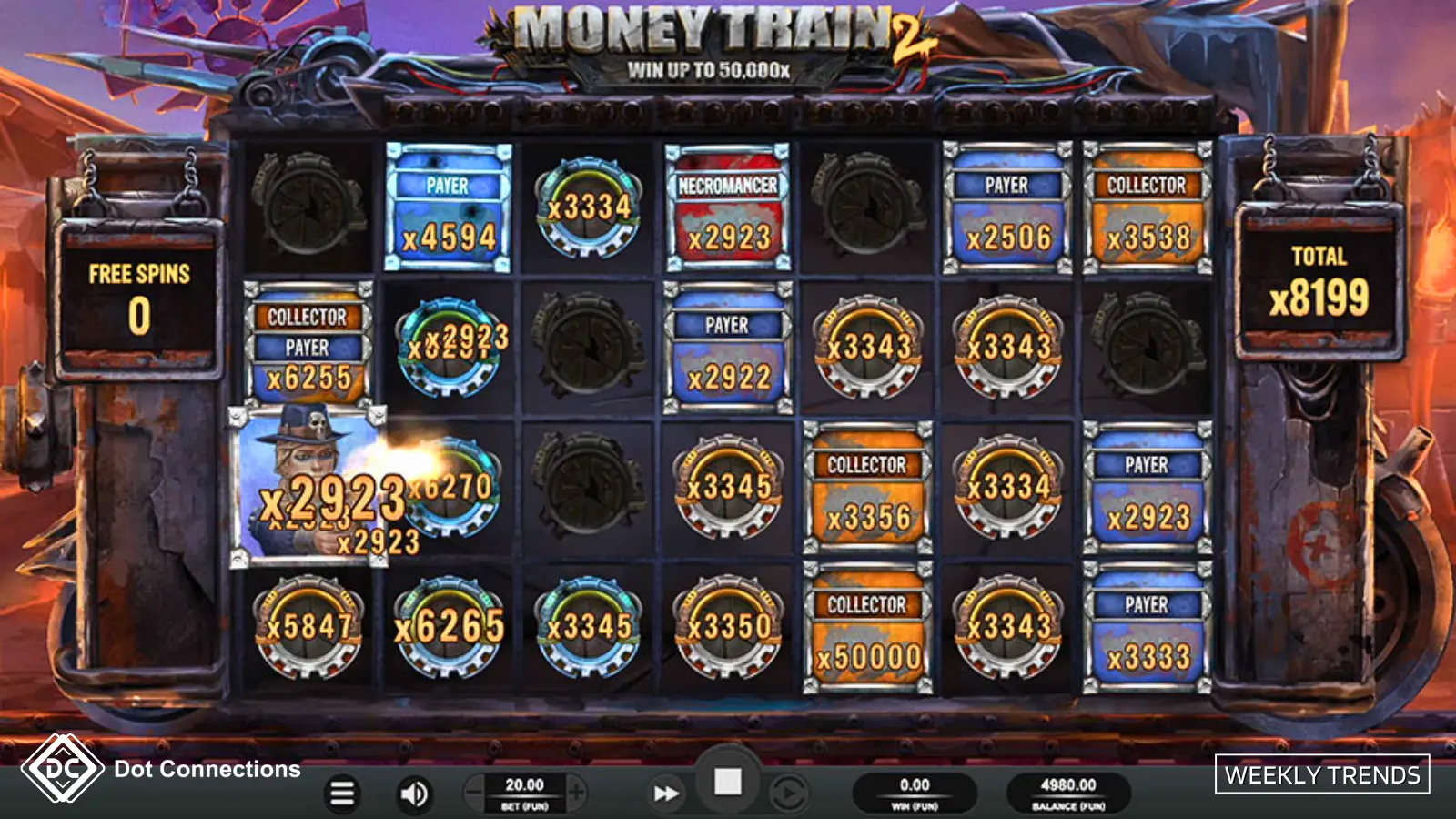

Royal Potato 2 slot game trending promotion via Dot Connections and Relax Gaming.

Royal Potato Series Is Back on Top — Exclusive August Promotion

The Royal Potato series by Print Studios, distributed via Relax Gaming, has recently seen a surge in popularity across online casino platforms. With its uniquely charming theme, high volatility, and unpredictable mechanics, Royal Potato 2 and its predecessor are once again gaining strong traction among players globally.

Recognized for its playful yet engaging gameplay and sticky bonus features, the Royal Potato series continues to deliver standout performance for operators.

Dot Connections August Promotion — Exclusive to Our Partners

To align with this renewed momentum, Dot Connections is offering an exclusive promotion this August for partners featuring the Royal Potato series. This limited-time campaign includes tailored marketing support and promotional tools to help partners maximize player engagement and game visibility.

We invite our current and prospective partners to take advantage of this opportunity and elevate their August portfolio with a proven, player-favorite title.

Contact us today to reserve your promotion slot and learn more about campaign details.


Tags: Royal Potato, Relax Gaming, Print Studios, Game Promotion, Casino Trends, Dot Connections, iGaming Asia

Lanterns floating in the night sky above a traditional Thai temple, symbolizing Thailand’s cultural identity and heritage.

Thailand Casino Legalization Halted After PM Removal: What It Means for iGaming

Published: September 8, 2025

Key Takeaways

  • Prime Minister Paetongtarn Shinawatra was removed by the Constitutional Court on August 29, 2025.
  • The Entertainment Complex Bill, which aimed to legalize integrated resorts with casinos, has been officially withdrawn.
  • New Prime Minister Anutin Charnvirakul opposes casino legalization and focuses on constitutional reform and early elections.
  • Casino investors are expected to shift attention to other Asian markets such as Vietnam, the Philippines, and Japan.
  • The case highlights how politics and regulation strongly affect iGaming and casino opportunities in Southeast Asia.

Political Crisis: Why Prime Minister Paetongtarn Shinawatra Was Removed

Thailand’s Constitutional Court dismissed Prime Minister Paetongtarn Shinawatra on August 29, 2025, following an ethics scandal involving a leaked phone call with former Cambodian leader Hun Sen. In the call, Shinawatra was heard criticizing Thailand’s military during a border clash, which opponents claimed undermined national pride. The court voted 6–3 in favor of removal, marking the fifth time a Thai prime minister has been ousted in 17 years.

Entertainment Complex Bill: Thailand’s Casino Ambitions Withdrawn

The Entertainment Complex Bill proposed two integrated casino resorts in Bangkok and one each in Chon Buri, Chiang Mai, and Phuket. It aimed to attract international tourists and increase average spending per visitor. Major casino operators such as Las Vegas Sands, MGM, and Wynn had shown interest in Thailand. However, after Shinawatra’s suspension, the bill was removed from parliament’s agenda on July 7, 2025, effectively ending the legalization effort.

New Leadership: Anutin Charnvirakul and His Stance on Gambling

Anutin Charnvirakul, leader of the Bhumjaithai Party, has become Thailand’s new prime minister. Unlike Shinawatra, he has spoken against legal casinos, stating that gambling should not be forced on the Thai people. His administration now focuses on drafting a new constitution and preparing for early elections, with casino reform off the table.

New Thai Prime Minister Anutin Charnvirakul speaking, with casino chips and roulette wheel background, symbolizing Thailand’s casino bill cancellation

Impact on iGaming and Casino Investors in Asia

The cancellation of Thailand’s casino plan is a setback for international investors who saw the country as a potential gaming hub. Attention may now shift to markets such as Vietnam, the Philippines, and Japan, where regulatory environments are clearer. This case also serves as a reminder of how political events and regulatory frameworks can quickly reshape iGaming opportunities.

Regional Competition: Vietnam, Philippines, Japan vs. Thailand

Southeast Asia remains a competitive landscape for integrated resorts and iGaming. With Thailand out of the picture for now, countries like Vietnam and the Philippines are likely to benefit from increased investor interest. Japan’s upcoming integrated resort projects further add to the regional competition.

Thailand Gambling Law 2025 and Future Outlook

The removal of Paetongtarn Shinawatra and the withdrawal of the Entertainment Complex Bill mean Thailand’s casino legalization is paused indefinitely. While this is a disappointment for investors and operators, it highlights the importance of stable political and legal environments in shaping iGaming markets. For now, Southeast Asia’s iGaming growth will be led by other countries more willing to embrace regulated casinos.


At Dot Connections, we track policy shifts and disruptive trends shaping the iGaming and online entertainment landscape worldwide. From compliance challenges to new market entries, our team delivers the intelligence operators and providers need to stay competitive.

🌍 If you’re planning to expand into dynamic markets in Asia, Africa, or Europe, our experts are ready to support your journey.

Follow Dot Connections for regulatory updates, market analysis, and strategic guidance on the future of iGaming.

Colorful night view of a major Macau casino complex with Dot Connections branding, used to illustrate Macau market momentum in 2026.

Industry update • Macau • Published: April 13, 2026

Macau Market Update 2026: What March Gaming Growth Signals for Online Game Operators in Asia

The latest Macau market update 2026 is worth watching even for businesses focused on online gaming. While Macau is primarily known for land-based gaming, its March and Q1 results still offer useful context on regional gaming sentiment, leisure spending, and broader demand conditions across Asia.

In March 2026, Macau’s gross gaming revenue reached MOP 22.61 billion, up 15% year on year. For Q1 2026, gross gaming revenue totaled MOP 65.87 billion, up 14.3% from the same period in 2025. Macau also passed 10 million inbound visitors by March 21, 2026, reaching that milestone 12 days earlier than in 2025, with average daily arrivals reported at about 126,000, up 14.2% year on year.

For online game operators and aggregators, these figures should not be treated as a direct proxy for online performance. However, they can still function as a useful regional market signal when evaluating demand confidence, content strategy, and commercial momentum in Asia. This is an inference based on the reported market data.

Key takeaways

  • March 2026 Macau GGR reached MOP 22.61 billion, up 15% year on year.
  • Q1 2026 Macau GGR totaled MOP 65.87 billion, up 14.3% versus Q1 2025.
  • Macau crossed 10 million visitors by March 21, achieving the milestone 12 days earlier than last year.
  • Average daily arrivals were around 126,000, up 14.2% year on year.
  • Early-2026 analyst commentary remained broadly constructive on Macau’s full-year trajectory, though growth forecasts differed by firm.

Macau’s March 2026 Growth in Context

March Revenue Performance

A key reason this Macau market update 2026 matters is that March was not an isolated spike. The month delivered MOP 22.61 billion in gross gaming revenue, marking another strong result for the year and reinforcing the view that Macau entered Q2 with healthy momentum.

Q1 2026 Growth Snapshot

Across the first quarter, Macau generated MOP 65.87 billion in gaming revenue, up 14.3% year on year. That gives the market a strong opening to 2026 and supports the view that gaming demand in the city has remained resilient through the first three months of the year.

Night view of Macau’s casino district with illuminated hotel towers, neon lights, and waterfront reflections.

Tourism Momentum Adds Another Positive Signal

Visitor Arrivals Passed 10 Million Early

Tourism also strengthened the latest Macau market update 2026. Macau surpassed 10 million inbound visitor arrivals by the morning of March 21, 2026, which was 12 days earlier than in the previous year.

Why Tourism Still Matters for the Wider Gaming Ecosystem

Authorities reported average daily arrivals at around 126,000, up 14.2% year on year. For B2B gaming businesses, that does not prove anything about online gaming on its own, but it does add another positive signal around regional travel, entertainment activity, and spending appetite. This is contextual interpretation rather than a direct causal claim./p>

Why This Matters for Online Game Operators

Not a Direct Online Proxy, but a Useful Market Signal

For operators focused on web gaming, Macau’s data should be read as broader market context rather than a direct online KPI. Land-based revenue and online performance are shaped by different products, player journeys, and regulatory conditions. Even so, strong results from one of Asia’s biggest gaming hubs can still help inform how businesses read regional confidence and demand conditions. This is an inference based on the market data above.

What Aggregators and Operators Can Watch

From a game aggregator perspective, the value of this Macau market update 2026 lies in what it may signal for operator behavior. In stronger market conditions, operators may place greater emphasis on:

  • Refreshing lobbies more aggressively
  • Broadening content mix
  • Improving regional fit for Asian audiences
  • Moving faster on content and commercial planning

These are strategic implications inferred from broader market momentum, not direct findings stated in the source reports.

2026 Outlook Remains Constructive

Analyst Sentiment in Early 2026

Market expectations for Macau in 2026 remained broadly positive, although specific forecasts varied. S&P Global Ratings said weaker consumption in China and limited new capacity could temper growth, but still described demand as resilient. Other market commentary cited forecasts in roughly the 5% to 6% range from major banks, while one report summarized a more bullish 8.3% projection from CBRE.

What This Could Mean for Regional Planning

The takeaway is not that every part of Asian gaming will grow at the same pace. It is that Macau’s performance adds to a broader picture of continued activity and recovery in the region. For operators and aggregators, that can support planning discussions around content priorities, market timing, and portfolio positioning. This is a business interpretation based on the cited reporting.

Conclusion

This Macau market update 2026 is most useful for online game operators when read as a regional signal rather than a direct online benchmark. March delivered 15% year-on-year GGR growth, Q1 ended at MOP 65.87 billion, and visitor arrivals crossed 10 million earlier than last year. Together, these indicators point to continued momentum in one of Asia’s most important gaming markets.

For aggregators and web game operators, the bigger message is simple: even when the headline comes from the land-based side, it can still provide useful context for broader discussions around demand, content strategy, and commercial confidence across Asia.


At Dot Connections, we track policy shifts and disruptive trends shaping the iGaming and online entertainment landscape worldwide. From compliance challenges to new market entries, our team delivers the intelligence operators and providers need to stay competitive.

🌍 If you’re planning to expand into dynamic markets in Asia, Africa, or Europe, our experts are ready to support your journey.

Follow Dot Connections LinkedIn for regulatory updates, market analysis, and strategic guidance on the future of iGaming. Or Contact us here.
New Zealand iGaming market transition illustration with Auckland night skyline, casino symbols, slot machine, roulette wheel, cards, dice, and New Zealand flag

Industry update • Asia • Published: February 24, 2026

New Zealand Moves Toward Regulated Online Casino Market in 2026

New Zealand is preparing to formally regulate its online casino sector, marking a significant shift from offshore-led access toward a structured, tightly controlled licensing model. With the first stage of the licensing process expected to begin in July 2026, the market is quickly becoming one of the most closely watched iGaming opportunities in the Asia-Pacific region.

Table of Contents

Key takeaways

  • New Zealand is moving from offshore-led online casino access toward a regulated market model.
  • The country is expected to allow up to 15 online casino licences under a tightly controlled framework.
  • The licensing process is expected to start in July 2026.
  • Entry is expected to follow a three-stage process: Expression of Interest, auction, and full licence application.
  • The reform is focused on consumer protection, harm minimisation, and stronger regulatory oversight rather than unrestricted market expansion.
  • The shift could create new opportunities for operators, suppliers, aggregators, and compliance technology providers targeting APAC growth.
  •  

New Zealand’s Online Casino Market Is Entering a New Phase

New Zealand is preparing to formally regulate its online casino sector, marking a major shift for a market that has historically been served largely by offshore operators. The move is expected to create one of the most closely watched new regulated iGaming opportunities in the Asia-Pacific region.

For years, online casino activity in New Zealand has been accessible mainly through offshore platforms. That is now changing as policymakers move toward a system designed to bring the sector under domestic oversight.

Modern laptop bursting with casino symbols and data visuals — iGaming tech and AI.

A Controlled Licensing Model Is Taking Shape

Up to 15 licences expected

Under the proposed framework, New Zealand plans to introduce a controlled licensing system for online casino gambling, with up to 15 licences available in the initial phase.

This is not expected to be an open-entry market. Instead, the government is taking a measured approach that prioritises oversight, accountability, and tighter control over market participation.

One brand per licence

The proposed structure also places clear limits on scale and concentration. Each licence is expected to apply to a single brand or platform, and licences are expected to be valid for a limited term with renewal options subject to regulatory review.

This approach is intended to prevent unrestricted expansion while ensuring operators remain accountable under a monitored framework.

Licensing Process Expected to Begin in July 2026

Three-stage entry process

New Zealand will begin the licensing process in July 2026 and structure it in three stages.

Operators will first submit an Expression of Interest, then compete in an auction stage, and finally file a full licence application if they succeed.

This model signals that New Zealand is aiming to tightly manage market entry rather than create an unlimited licensing environment.

Regulation Is Being Framed Around Protection, Not Expansion

Consumer protection and harm minimisation at the center

New Zealand officials have consistently positioned the reform as a regulatory and public-interest measure rather than a growth-first liberalisation of gambling.

The direction of the policy is centred on consumer protection, harm minimisation, tax collection, and stronger oversight of unlicensed gambling activity and advertising.

A more structured and transparent market

The broader goal is to move the market away from loosely supervised offshore access and toward a more transparent and enforceable model that gives authorities greater control over how online casino gambling is offered in the country.

What This Means for Operators, Suppliers, and Aggregators

A rare opportunity for operators

For operators, the emerging framework represents a rare opportunity to enter a newly regulated market in APAC. However, entry is expected to be competitive, selective, and heavily compliance-driven.

New demand for B2B infrastructure

For suppliers, aggregators, and platform providers, the shift could create future demand for licensed content, aggregation services, regulatory reporting, player-protection tools, and compliance-ready technology infrastructure.

As newly regulated markets typically require stronger technical and operational support, New Zealand could become an important opportunity not only for B2C operators, but also for B2B stakeholders looking to expand in the region.

Why New Zealand Matters in APAC iGaming

New Zealand is becoming increasingly relevant because it represents a transition from grey-market access to a rules-based model with controlled entry. That makes it a market worth monitoring closely for companies seeking long-term, regulation-friendly growth in Asia-Pacific.

With the first major licensing step expected in July 2026, the country is now entering a preparation phase that could shape the next wave of strategic moves across the iGaming value chain.

Conclusion

New Zealand’s move toward a regulated online casino framework marks an important turning point for the market. By shifting from offshore-led access to a structured licensing model, the country is laying the groundwork for a more controlled, transparent, and compliance-focused iGaming environment.

For operators, suppliers, and aggregators, the message is clear: New Zealand is no longer just a grey-market discussion. It is becoming a serious regulated opportunity in APAC.


At Dot Connections, we track policy shifts and disruptive trends shaping the iGaming and online entertainment landscape worldwide. From compliance challenges to new market entries, our team delivers the intelligence operators and providers need to stay competitive.

🌍 If you’re planning to expand into dynamic markets in Asia, Africa, or Europe, our experts are ready to support your journey.

Follow Dot Connections LinkedIn for regulatory updates, market analysis, and strategic guidance on the future of iGaming. Or Contact us here.

Illustration of the APAC iGaming market with Asian city skyline landmarks, roulette wheel, poker chips, dice, cards, and icons representing KYC, security, and advertising compliance.

Industry update • Asia • Published: February 24, 2026

Asia iGaming Market Update In Early Feb 2026

Early 2026 confirms a major shift in APAC iGaming: compliance is becoming a growth driver. Tighter KYC, ad scrutiny, AML monitoring, and enforcement pressure are reshaping how operators scale — while strong market signals (such as Macau) still point to opportunity for those with the right strategy.

Table of Contents

Key takeaways

  • APAC iGaming is entering a compliance-led growth phase in early 2026, with regulation directly impacting acquisition, payments, and partnership models.

  • The Philippines is a key market to watch, with tighter KYC requirements, potential advertising restrictions, and stronger AML/CTF focus likely to affect onboarding and marketing funnels.

  • Cambodia/Mekong enforcement developments are raising counterparty risk awareness, pushing operators and suppliers to strengthen due diligence on partners, affiliates, and payment channels.

  • Macau’s strong January 2026 performance signals healthy regional demand, but market strategy will increasingly depend on segmentation, retention, and execution quality rather than pure rebound momentum.

  • For operators and aggregators, the winning playbook in 2026 will combine compliance readiness, cleaner traffic sources, smarter retention, and market-fit content planning.

  •  

Philippines: tighter KYC, stricter advertising, bigger AML spotlight

KYC tightening: “verify before deposit”

In February 2026, PAGCOR reinforced stricter KYC expectations for online gambling—specifically addressing the loophole that allowed access or funding before initial identity checks were completed. The updated requirements emphasize identity details, valid government ID, and a real-time selfie holding the ID before deposits can be made.

Operator impact: This can raise friction at the top of the funnel (registration → first deposit). Winning operators will treat KYC as a product problem: reduce drop-offs, improve document capture UX, and optimize verification success rates.

Advertising: toward tougher broadcast restrictions

Philippine regulators and the Ad Standards Council discussed the possibility of expanding restrictions, including a potential full ban of online gambling ads on TV/radio (prime time is already restricted).

Operator impact: If broadcast becomes less accessible, growth strategies typically shift toward:

more controlled performance marketing (with stricter compliance review), stronger affiliate governance, and heavier reliance on CRM and retention mechanics.

AML/CTF 2026–2030 plan: casinos under increased monitoring

The Philippines is drafting a National AML/CTF plan for 2026–2030, with emphasis on monitoring high-risk sectors including casinos and enhanced cooperation to track illicit flows.

Operator impact: Expect more scrutiny on payments, source-of-funds patterns, and partner ecosystems—especially where traffic, conversion, or payment flows look anomalous.

Cambodia and the Mekong corridor: enforcement pressure raises counterparty risk

In February 2026, Cambodia’s regulator announced the revocation and suspension of multiple casino licenses connected to violations of gambling regulations, reported in the context of broader scrutiny around cyber-fraud networks.

This comes amid elevated international attention on scam networks operating in parts of the Mekong region (Cambodia/Myanmar/Laos), including high-profile enforcement and extradition developments.

Operator/aggregator takeaway: Raise your bar for enhanced due diligence:

verify ownership/UBO and licensing, strengthen PSP/merchant monitoring, tighten affiliate and brand-safety rules, and build clear “red flag” reporting + termination processes.

Modern laptop bursting with casino symbols and data visuals — iGaming tech and AI.

Macau: strong start to 2026, but expectations tilt to “steady” growth

Macau’s casino market started 2026 on a strong note. January 2026 GGR reached MOP 22.63 billion, up 24% year-on-year, and was reported as the highest January since 2019.

At the same time, some market commentary points to slower growth rates ahead versus the rebound phase—suggesting 2026 is more about operational efficiency, product mix, and premium mass experience than pure recovery momentum.

Implication for online strategy: Macau remains a key “market pulse” indicator for regional sentiment and seasonal demand patterns, especially around major holidays.

What trends are likely next in APAC (Q2 2026 onward)

Trend 1 — Compliance-led growth becomes the baseline

KYC tightening and AML focus are no longer “nice-to-have”—they influence who can scale marketing and payments safely. The Philippines is a clear 2026 example.

Trend 2 — Advertising & affiliate governance gets stricter

As regulators scrutinize broadcast and potentially broader ad channels, operators will need creative controls, claims substantiation, age-gating practices, and tighter affiliate oversight.

Trend 3 — AML/CTF scrutiny increases around casinos and payment flows

National AML plans and international evaluation cycles push regulators to demand stronger controls, especially where gaming intersects with payments and cross-border flows.

Trend 4 — “Responsible Gaming by design”

Expect continued emphasis on responsible gaming features and player protection in regulated markets—often tied to advertising and onboarding rules.

Trend 5 — Higher counterparty risk sensitivity in parts of Southeast Asia

Mekong enforcement stories increase the “cost of weak due diligence,” affecting PSPs, content distribution, and affiliate ecosystems.

Practical angle for a Europe-to-Asia game aggregator (how to position content)

If you’re a European content aggregator serving Asian operators, this narrative is highly publishable as industry news—because it answers what operators care about:

How regulation changes acquisition and conversion (KYC before deposit, ad restrictions)

How AML focus changes payments and partner selection

How enforcement risk shapes brand safety and expansion plans

Which markets show demand momentum (Macau pulse)

A strong CTA for your website post could be:

“Ask us for a market-fit EU game bundle for PH/APAC (compliance-first launch checklist + recommended mechanics for retention).”


At Dot Connections, we track policy shifts and disruptive trends shaping the iGaming and online entertainment landscape worldwide. From compliance challenges to new market entries, our team delivers the intelligence operators and providers need to stay competitive.

🌍 If you’re planning to expand into dynamic markets in Asia, Africa, or Europe, our experts are ready to support your journey.

Follow Dot Connections LinkedIn for regulatory updates, market analysis, and strategic guidance on the future of iGaming. Or Contact us here.

Modern laptop bursting with casino symbols and data visuals — iGaming tech and AI.

Industry update • Asia • Published: February 10, 2026

iGaming in Asia: Key market moves ahead of Lunar New Year 2026

With Lunar New Year traffic on the horizon, market watchers say Asia’s iGaming sector is entering a volatile period. This country-by-country briefing highlights the headlines operators, affiliates and suppliers are watching heading into the holiday.

Table of Contents

Key takeaways

  • Tightening ad rules and regulator actions are the immediate risk — review creatives and vendor accreditation now.
  • Macau and travel-linked markets offer short-term demand upside around the holiday, but competition for share is high.
  • Product and ops priorities: push mobile-first instant/live formats and scale AI-driven retention as paid acquisition gets tougher.
  •  

iGaming markets snapshot

China

Lottery sales reached a record (~628B CNY in 2025) but growth slowed (~0.7% YoY). Sports lotteries remain dominant while digital sales softened — signalling seasonal volatility and shifting player preferences that operators may wish to monitor..

Macau

Recovery is continuing into 2026. Analysts expect stronger GGR and potential share gains for large operators such as Las Vegas Sands and Wynn Resorts; Lunar New Year could act as a near-term demand catalyst.

Philippines

PAGCOR’s accreditation initiatives are increasing focus on local approvals for providers and affiliates. Operators may want to check vendor accreditation status and consider options for engagement.

India

Enforcement under evolving national online gaming rules has accelerated (large numbers of sites blocked); mirror sites and enforcement workarounds persist — a source of ongoing traffic volatility for real-money models.

Singapore

Live casino and premium resort demand appears resilient; operators could explore timing VIP and mass promotions around travel peaks.

Japan

IR/licensing timelines remain an important medium-to-long-term factor for tourism-driven demand — regulatory windows are worth tracking.

South Korea

Seollal (Lunar New Year) increases local leisure spend; real-money online gaming continues to be tightly regulated — social and entertainment-first products may be more appropriate in certain channels.

Southeast Asia (VN / MY / ID / TH)

Mobile-first casual and instant-win formats are gaining traction with younger players, while advertising and payment infrastructures vary significantly by market.

Row of slot machines on a casino floor — live gaming and mass market play.

Industry & platform themes (pan-Asia)

Ad policy attention

Major ad platforms have been reassessing sweepstakes ⁄ dual-currency social casino categories. This increases review risk for paid search ⁄ display creatives and landing pages – an area for operators to discuss internally with marketing and compliance.

Product & ops

AI for personalization, fraud detection and LTV management is moving from experimentation toward operational use. Live–dealer and instant social formats continue to attract audiences – potential levers for retention if acquisition channels shift.

Considerations for operators & affiliates

  • Review current ad creatives and landing-page messaging for sweepstakes/social formats — consider alternative wording or disclosure options where appropriate.
  • Confirm vendor accreditation status and explore contingency approaches for markets with active enforcement (e.g., Philippines, India).
  • Evaluate short-duration mobile-first pilots for holiday windows, and discuss how retention levers (including AI-driven flows) could complement any paid activity.
  • Reassess paid vs organic mix for the holiday window (e.g., SEO/content/native/influencer), given evolving ad platform risk.
  • Assemble documentation (product descriptions, mechanics, T&Cs) so internal reviewers or external partners can quickly verify product positioning if required.

At Dot Connections, we track policy shifts and disruptive trends shaping the iGaming and online entertainment landscape worldwide. From compliance challenges to new market entries, our team delivers the intelligence operators and providers need to stay competitive.

🌍 If you’re planning to expand into dynamic markets in Asia, Africa, or Europe, our experts are ready to support your journey.

Follow Dot Connections LinkedIn for regulatory updates, market analysis, and strategic guidance on the future of iGaming. Or Contact us here.

A national flag flying above classical government columns, hinting at state policy and regulatory authority.

Industry update • Philippines • Published: February 2, 2026

Philippines iGaming regulatory changes 2026: The future of iGaming in the Philippines

The Philippines iGaming regulatory changes 2026 are reshaping the regional online-gambling landscape. Regulators have moved to tighten commercial and payment rules, creating immediate disruption while accelerating industry maturation and likely consolidation.

Table of Contents

Key takeaways

  • Regulatory reset (MGF): PAGCOR’s new Minimum Guaranteed Fee (MGF) framework raises the fixed-cost floor for licensed operators, increasing the importance of scale and sustainable unit economics.

  • Payment friction (e-wallets): The Bangko Sentral order to remove in-app gambling links disrupted common payments flows (GCash, Maya), underscoring the role of payment rails in operator performance.

  • Market resilience + M&A: Despite payment friction, e-gaming grew +17.4% in Q3 2025, but the new fees and payment uncertainty make consolidation (Mergers & Acquisitions) a likely 2026 outcome.

  • Action agenda: Operators, studios and investors should stress-test MGF scenarios, diversify payments, and prepare M&A/compliance-ready packages.

What make Philippines iGaming regulatory changed

MGF introduced (PAGCOR memo, 15 Dec 2025; effective 1 Apr 2026)

The regulator published a phased fee framework that includes Minimum Guaranteed Fees tied to Gross Gaming Revenue (GGR) thresholds. Industry reporting lists phase-one examples such as GSAs offering electronic casino games with GGR thresholds of PHP30m, MGF ≈ PHP9m/month (and lower thresholds/fees for other product classes). The MGF is a fixed obligation that applies even if an operator’s actual revenues fluctuate.

BSP delinking (mid-Aug 2025)

The central bank ordered e-wallets and BSP-regulated payment apps to remove in-app links/shortcuts to online gambling with a short compliance window, aiming to reduce social risk and improve consumer protection. The move immediately affected conversion and deposit flows for many operators.

Market performance (Q3 2025)

PAGCOR’s published figures show e-gaming grew +17.4% in Q3 2025 — evidence that demand for iGaming remains strong even after payment-rail disruption.

Casino table with chips and cards in soft focus, representing the commercial side of gambling operations.

Why regulators acted

Regulators cite three main objectives behind this regulatory-change:

  • Consumer protection — limit frictionless paths to gambling via everyday payment apps
  • Fiscal transparency — ensure licensed operators contribute minimum fees and reduce under-reporting.
  • Market stability & AML risk reduction — reduce the population of lightly capitalized operators that create enforcement burdens.

Immediate impacts observed

  • Payment disruption: removal of wallet links reduced convenient deposit options and drove short-term transaction declines.
  • Margin compression: MGF introduces a new fixed cost that squeezes operators with volatile GGR, increasing liquidity risk for smaller players.
  • Strategic repricing and M&A talk: operators and investors are already re-pricing risk and consolidation conversations are becoming more frequent.

What this means for stakeholders (actionable playbook)

Operators ⁄ GSAs (platforms)

Stress-test unit economics for MGF scenarios — model margins, CAC, retention and the impact of partial or full wallet reinstatement.

Diversify payment rails (card acquiring, bank transfers, voucher top-ups, PSP integrations) to reduce dependence on any single e-wallet.

Optimize monetization — reduce churn, improve ARPU, renegotiate supplier fees.

Prepare M&A readiness — audit-ready compliance packs (KYC⁄AML logs, transactional audit trails), tidy data rooms and full retention/monetization metrics.

Studios & B2B providers

Offer compliance & integration bundles (fast on-boarding for large operators), and consider revenue-sharing or exclusivity with scaled partners to de-risk exposure.

Investors

Prioritize targets with diversified payments, strong retention, and clear compliance governance. These assets will command premiums in a consolidating market.

Outlook — scenarios to watch

Conditional reinstatement of e-wallet links

If BSP and wallets agree on safeguards (limits, stronger KYC), payment convenience could return gradually — a positive for conversion.

Gradual consolidation

If MGF pressure persists and wallet restrictions remain, expect continued M&A as larger operators acquire or white-label smaller assets.

Market professionalization

Long term, expect fewer but larger, compliance-ready operators and higher valuations for audit-ready assets.

Overall

The Philippines iGaming regulatory changes 2026 reset operator economics by combining payment-rail uncertainty with new fixed-fee obligations. Short-term volatility is likely; mid-term consolidation is probable. Stakeholders who act now — stress-testing scenarios, diversifying payments, and preparing compliance-ready M&A packages — will be best positioned to capture the next phase of growth.


At Dot Connections, we track policy shifts and disruptive trends shaping the iGaming and online entertainment landscape worldwide. From compliance challenges to new market entries, our team delivers the intelligence operators and providers need to stay competitive.

🌍 If you’re planning to expand into dynamic markets in Asia, Africa, or Europe, our experts are ready to support your journey.

Follow Dot Connections LinkedIn for regulatory updates, market analysis, and strategic guidance on the future of iGaming. Or Contact us here.

Alberta city skyline and arena in winter light, showing urban infrastructure and skyline.

Industry update • Canada • Published: January 26, 2026

Alberta (Canada) iGaming Launch 2026: Timeline, Tax, and What It Means for Operators

Alberta is moving quickly to establish a regulated multi-operator iGaming market with a targeted launch in Spring/Summer 2026. Regulatory building blocks — including a centralized self-exclusion system and operator registration rules — are being finalized, while tax and compliance frameworks are shaping operator entry strategies and potential market dynamics.

Table of Contents

Key takeaways

  • Launch target: Spring/Summer 2026.
  • Player protection: centralized self-exclusion via API is being prioritized.
  • Tax & fees: headline tax around 20% on 97% of GGR; application and registration fees in the mid-hundred-thousand CAD range.
  • Compliance burden: SOC-style security audits and related upgrades may raise initial costs substantially.
  • Market entrants: major operators likely to lead entry; smaller operators may evaluate partnerships or managed solutions to manage costs.

Alberta iGaming Launch 2026 — Full briefing

Timeline & official position

The provincial government has enacted an iGaming framework and set up an agency to manage and oversee the new market structure. Officials and industry stakeholders have signalled a clear intention to move quickly, with a Spring/Summer 2026 window repeatedly referenced in recent industry discussions. Operator registration pathways are being opened and key technical and contractual elements are in active development to meet that timeline.

What’s changing for players

Until now, residents had access primarily to a government-run online offering as the only regulated domestic option. The shift to a licensed multi-operator market is intended to provide Albertans with a broader range of licensed gaming options while centralizing protections such as a province-wide self-exclusion system. For players, this could mean more variety in game content and promotions from licensed providers, coupled with stronger cross-platform safeguards and standardized responsible-gambling tools.

Costs, fees and tax (figures to budget for)

The proposed commercial framework introduces several direct costs that operators should consider when assessing entry economics:

  • Application fee: a significant one-time application fee is expected as part of the registration process.
  • Annual registration fee: operators that secure licensing and registration will face recurring annual fees to maintain market access.
  • Taxation: headline tax rates have been presented around 20% applied to a defined portion of gross gaming revenue; the effective tax burden can change depending on permitted deductions and specific calculation methods.
  • Compliance and audit costs: independent security and control audits—frequently described in the industry as SOC-style examinations—are anticipated. Preparing for and passing such audits may require investments in systems, policies, and third-party assessments that can materially increase initial and ongoing costs.

Taken together, these items affect both the capital required to enter and the ongoing profitability of operating in the province. Operators are likely to model multiple taxation and compliance scenarios to understand breakeven and return-on-investment timelines.

Player protection: centralized self-exclusion

Centralized self-exclusion is a key regulatory priority. The approach being developed focuses on an API-driven system that allows operators to query and enforce self-exclusion records in real time. For regulators, the benefit is coordinated protection across all licensed operators; for operators, the technical and privacy requirements of such an integration will require attention during implementation planning.

Market scale & opportunity

Alberta represents a sizeable gaming market with material annual gaming revenues reported in recent fiscal periods. In addition to regulated demand, there is substantial activity in the unregulated or “gray” market where offshore operators currently capture online play. A licensed, well-executed multi-operator market could attract a portion of that volume back to domestic, regulated channels — offering commercial opportunity for operators that can meet compliance and product expectations.

Industry reaction & practical issues

Industry responses to the announced framework are mixed. Large international operators have both the scale and compliance budgets to plan for quick entry and to absorb setup costs. Smaller and medium-sized operators have expressed concerns that the combination of registration fees, ongoing taxation and the potential need for expensive security audits could raise barriers to entry. In practice, this may influence which operators prioritize Alberta in their rollouts and which choose partnership or platform-based arrangements instead of full direct entry.

Dan Keene, CEO of Alberta iGaming Corporation, pictured alongside the Canadian flag and a government building

What operators might consider beforehand

The following items are neutral considerations for operators evaluating market entry — they are presented as possible actions to evaluate, not as definitive advice.

  • Review registration timeline & readiness

    Operators might consider preparing application documentation and corporate disclosures early to align with registration windows and procurement timelines. Early readiness may reduce onboarding delays if the market opens on the planned schedule.

  • Assess SOC/security posture

    Operators could perform a security gap analysis to estimate the work and cost required to reach audit-ready status. Identifying critical deficits early helps prioritize investments in infrastructure, logging, incident response and policy documentation.

  • Model taxation scenarios

    Operators may want to run financial sensitivity analyses for headline tax rates and for variations in effective tax burden when accounting for deductions and levies. Scenario modeling can inform pricing, product mix and promotion strategies.

  • Plan self-exclusion integration

    Teams might evaluate the technical effort to integrate with a centralized self-exclusion API, including data flows for enrollment, identity matching, real-time blocking and appeals or case management workflows.

  • Evaluate payment & KYC flows

    Operators could assess whether current payment rails, KYC vendors and AML controls meet provincial expectations; local payment options and efficient KYC processes can materially shorten time to market and improve conversion.

  • Explore platform or partnership options

    Smaller operators may consider managed platforms, white-label providers or local partnerships to reduce upfront capital and compliance burdens while still reaching Alberta players quickly.

  • Engage local counsel & compliance advisors

    Operators might consult regulatory counsel who are familiar with the province’s legislative framework to clarify contractual obligations, consumer protections, and reporting requirements so that commercial agreements reflect regulatory duties.

  • Prioritize vendor sourcing

    Operators could pre-screen vendors for SOC readiness, accredited testing facilities, and API integration experience to speed up procurement and implementation if they decide to enter the market.

  • Implications for the broader ecosystem

  • Vendors & service providers

    Demand may increase for compliance-oriented services — security auditors, testing labs, payment integrators and API specialists — as operators seek audit-ready partners and rapid integration paths.

  • Players

    A licensed multi-operator environment could expand regulated product choices for residents while delivering standardized responsible-gambling tools and cross-platform protections.

  • Smaller operators

    Higher upfront costs and compliance requirements may push some smaller operators to consider partnerships, managed platforms, or delayed entry until market economics become clearer.

  • Conclusion

    Alberta’s planned transition to a regulated iGaming market targeted for Spring/Summer 2026 represents a major regional development. Centralized player protections and robust security expectations, combined with registration fees and a structured tax framework, will shape who is able to enter immediately and how operators structure their commercial and compliance strategies. Stakeholders monitoring the rollout may wish to evaluate technical readiness, financial models and vendor options now to ensure they are prepared for the market opening.


    At Dot Connections, we track policy shifts and disruptive trends shaping the iGaming and online entertainment landscape worldwide. From compliance challenges to new market entries, our team delivers the intelligence operators and providers need to stay competitive.

    🌍 If you’re planning to expand into dynamic markets in Asia, Africa, or Europe, our experts are ready to support your journey.

    Follow Dot Connections LinkedIn for regulatory updates, market analysis, and strategic guidance on the future of iGaming. Or Contact us here.

    Contact us

    Blue and green tech-inspired icons surrounding the word "Recruit" in the center – Dot Connections visual style

    Integration Manager 串接專案管理師 (Fully Remote)

    About Dot Connections

    Founded in Europe in 2018, Dot Connections is a fast-growing game distributor focused on emerging markets. Since setting up our Asia headquarters in 2019, we’ve quickly earned a reputation for delivering top-tier technical services. As one of the few award-winning service agents in Europe, we bring exceptional quality and reliability to our Asian partners—including several global industry leaders. Join us to be part of a team that delivers first-class, on-time solutions across the gaming industry.

    Our Core Value

    • Mutual Growth Strategy (Win-win mindset)
    • Trust and Integrity
    • Collaborative Partnership Management
    • Work-Life Balance

    Requirements

    • 具備良好溝通技巧和客戶服務技巧 Excellent communication and customer service skills.
    • 具備英文聽、說、讀、寫的溝通能力,能理解技術文件並與國際團隊協作 (多益 700+) English proficiency (listening, speaking, reading, writing); able to understand technical documents and collaborate with international teams (TOEIC 700+).
    • 中文精通 Fluent in Chinese.
    • 具備獨立作業與解決問題的能力,能在壓力下有效處理技術問題 Ability to work independently, solve problems, and effectively handle technical issues under pressure.

    Job Description

    • 主要負責客戶系統對接上線以及即時反應客戶端的技術支援服務,以提供優質的客戶服務。
    • 上班時間:中班 (15:00 - 23:00)
    • 培訓期:3-6 個月後可居家辦公,須定期回公司參加培訓。
    • 處理客戶提出的技術問題 Address and resolve technical issues raised by clients.
    • 維護和改善內部流程和工具 (如追蹤、歸納整理客戶各類型問題),並回饋給相關人員 Maintain and improve internal processes and tools, such as tracking, categorizing, and summarizing various client issues, and providing feedback to relevant teams.
    • 技術支援文檔之更新維護 Update and maintain technical support documentation.
    • 客戶相關資料建置以及管理 Establish and manage client-related data.
    • 客戶產品上線專案管理 Oversee and manage client product deployment projects.
    • 跨部門溝通協調 Facilitate cross-departmental communication and coordination.
    • 主管交辦事項 Handle tasks assigned by supervisors.

    Or send your resume and a brief introduction to: marketing@dotconnections.co.im

    Blue and green tech-inspired icons surrounding the word "Recruit" in the center – Dot Connections visual style

    Partner Manager 國際供應商管理師

    About Dot Connections

    Founded in Europe in 2018, Dot Connections is a fast-growing game distributor focused on emerging markets. Since setting up our Asia headquarters in 2019, we’ve quickly earned a reputation for delivering top-tier technical services. As one of the few award-winning service agents in Europe, we bring exceptional quality and reliability to our Asian partners—including several global industry leaders. Join us to be part of a team that delivers first-class, on-time solutions across the gaming industry.

    Our Core Value

    • Mutual Growth Strategy (Win-win mindset)
    • Trust and Integrity
    • Collaborative Partnership Management
    • Work-Life Balance

    Requirements

    Must Have

    • Good command of English and Chinese to a professional level (TOEIC 800+).
    • Excellent communication skills to support business partners.
    • Strong time management ability.

    Good to Have

    • At least 1 year of experience in a similar position.
    • iGaming industry experience.

    Job Description

    • Gather business requirements for analytics: drill-down analysis, dashboards, reporting, visualization, and data mining.
    • Collect and analyze client and market insights and competitor strategies; make recommendations to the direct manager and providers.
    • Translate market requirements into product requirements for providers.
    • Plan go-to-market strategy with the marketing team and providers.
    • Create and optimize ongoing campaigns.
    • Work out the basic technical concept in cooperation with providers.
    • Present product proposals and features to developers, stakeholders, and the commercial team.
    • Organize and support joint teams for customer visits or technical promotion.
    • Implement new launches and maintain growth in pillar products.
    • Create and deliver product training materials to enable services and support teams.
    • Maintain and develop product list documents (external/internal).
    • Develop and implement B2B branding strategies to position Dot Connections as the gateway to Asia and beyond for game studios.
    • Work with iGaming media to generate positive coverage for Dot Connections.

    Or send your resume and a brief introduction to: marketing@dotconnections.co.im

    South Korea flag overlay with casino elements including dice, roulette, and playing cards.

    South Korea Casino & Integrated Resort Industry 2025: Record Revenues, Jeju Dream Tower Leads

    Published: September 1, 2025

    Key Takeaways

    • The South Korea casino industry 2025 achieved record revenues, led by Jeju Dream Tower with KRW 43.4B in July.
    • Grand Korea Leisure (GKL) reported July revenue of KRW 39B, up 103% YoY, reflecting strong recovery from Japanese and Chinese VIP demand.
    • Paradise City casino Korea maintained solid growth, with Q2 net profit up 43.5% YoY and new luxury hotel investment planned for 2028.
    • Kangwon Land delayed its second resort opening to 2028 but is adopting an Integrated Resort (IR) strategy inspired by MGM Osaka.
    • Korea faces increasing pressure from Japan’s Integrated Resort market, with MGM Osaka expected to attract millions of Korean visitors annually.
    • For operators: regulatory reforms will be crucial to sustain competitiveness in Asia’s gaming and IR landscape.

    South Korea Casino Industry 2025 Overview

    The South Korea casino and integrated resort industry is undergoing a period of historic growth in 2025. Driven by surging international tourism, record-breaking revenues, and shifting regulatory debates, the market is redefining its position in Asia’s gaming race. In July and August 2025, Jeju Dream Tower, Grand Korea Leisure (GKL), Paradise City, and Kangwon Land all posted significant developments, while the looming MGM Osaka Integrated Resort in Japan is reshaping strategic priorities.

    Jeju Dream Tower casino hotel in South Korea illuminated at night.

    Jeju Dream Tower Overtakes Paradise City

    In July 2025, Jeju Dream Tower revenue soared to KRW 43.4 billion (~US$31M), up 90.1% YoY and 21.3% MoM, with visitor counts hitting a record 56,691. This milestone made Jeju the new leader in the South Korea casino industry 2025. Year-to-date (Jan–Jul) casino revenue rose 49.3% YoY, although hotel revenue dropped 10.7%. Lotte Tour’s stock surged by 37% in one month, reflecting strong investor confidence.

    Grand Korea Leisure’s Strong Recovery

    Grand Korea Leisure (GKL) posted July revenue of KRW 39B, marking a 103% YoY increase. Table games generated KRW 35.3B (+113% YoY), while machine games reached KRW 3.65B (+37% YoY). In Q2 2025, GKL’s net profit rose to KRW 16.96B (~US$12.3M), a 50% jump YoY. This recovery reflects a robust return of Japanese and Chinese VIP customers to the Korean gaming market.

    Paradise City Maintains Solid Growth

    Paradise City casino Korea reported July casino revenue of KRW 75.7B (~US$55M), up 23% YoY. In Q2 2025, group revenue climbed 4.1% YoY to KRW 284.5B, with net profit rising 43.5% YoY. The Incheon-based integrated resort also announced plans for a new 200-suite luxury hotel in Seoul by 2028, with an investment of KRW 500–550B, positioning itself for long-term IR expansion.

    Kangwon Land Delays Expansion

    Kangwon Land, Korea’s only locals-permitted casino, postponed the opening of its second resort to 2028 (from 2027). The expansion project, worth KRW 2.5 trillion (~US$1.9B), will add 50 tables, 250 machines, and full IR amenities. Inspired by MGM Osaka, Kangwon Land is evolving toward a broader IR model to attract more international visitors.

    Policy and Regional Competition

    Policymakers in Seoul are debating reforms to the Korea integrated resort industry to maintain competitiveness. With MGM Osaka expected to attract over 20 million visitors annually, including many Koreans, there is mounting pressure on Korea to modernize its IR framework, streamline visa policies, and strengthen its tourism strategy.

    South Korea Casino Industry 2025 Outlook

    The South Korea casino industry 2025 is thriving, with record revenues and ambitious expansion projects. However, Japan’s IR boom presents serious competition. To secure long-term leadership in Asia’s gaming and integrated resort sector, Korea must accelerate reforms, expand its IR offerings, and adapt to a fast-changing regional landscape.


    At Dot Connections, we track policy shifts and disruptive trends shaping the iGaming and online entertainment landscape worldwide. From compliance challenges to new market entries, our team delivers the intelligence operators and providers need to stay competitive.

    🌍 If you’re planning to expand into dynamic markets in Asia, Africa, or Europe, our experts are ready to support your journey.

    Follow Dot Connections for regulatory updates, market analysis, and strategic guidance on the future of iGaming.

    Colorful night view of a major Macau casino complex with Dot Connections branding, used to illustrate Macau market momentum in 2026.

    Industry update • Macau • Published: April 13, 2026

    Macau Market Update 2026: What March Gaming Growth Signals for Online Game Operators in Asia

    The latest Macau market update 2026 is worth watching even for businesses focused on online gaming. While Macau is primarily known for land-based gaming, its March and Q1 results still offer useful context on regional gaming sentiment, leisure spending, and broader demand conditions across Asia.

    In March 2026, Macau’s gross gaming revenue reached MOP 22.61 billion, up 15% year on year. For Q1 2026, gross gaming revenue totaled MOP 65.87 billion, up 14.3% from the same period in 2025. Macau also passed 10 million inbound visitors by March 21, 2026, reaching that milestone 12 days earlier than in 2025, with average daily arrivals reported at about 126,000, up 14.2% year on year.

    For online game operators and aggregators, these figures should not be treated as a direct proxy for online performance. However, they can still function as a useful regional market signal when evaluating demand confidence, content strategy, and commercial momentum in Asia. This is an inference based on the reported market data.

    Key takeaways

    • March 2026 Macau GGR reached MOP 22.61 billion, up 15% year on year.
    • Q1 2026 Macau GGR totaled MOP 65.87 billion, up 14.3% versus Q1 2025.
    • Macau crossed 10 million visitors by March 21, achieving the milestone 12 days earlier than last year.
    • Average daily arrivals were around 126,000, up 14.2% year on year.
    • Early-2026 analyst commentary remained broadly constructive on Macau’s full-year trajectory, though growth forecasts differed by firm.

    Macau’s March 2026 Growth in Context

    March Revenue Performance

    A key reason this Macau market update 2026 matters is that March was not an isolated spike. The month delivered MOP 22.61 billion in gross gaming revenue, marking another strong result for the year and reinforcing the view that Macau entered Q2 with healthy momentum.

    Q1 2026 Growth Snapshot

    Across the first quarter, Macau generated MOP 65.87 billion in gaming revenue, up 14.3% year on year. That gives the market a strong opening to 2026 and supports the view that gaming demand in the city has remained resilient through the first three months of the year.

    Night view of Macau’s casino district with illuminated hotel towers, neon lights, and waterfront reflections.

    Tourism Momentum Adds Another Positive Signal

    Visitor Arrivals Passed 10 Million Early

    Tourism also strengthened the latest Macau market update 2026. Macau surpassed 10 million inbound visitor arrivals by the morning of March 21, 2026, which was 12 days earlier than in the previous year.

    Why Tourism Still Matters for the Wider Gaming Ecosystem

    Authorities reported average daily arrivals at around 126,000, up 14.2% year on year. For B2B gaming businesses, that does not prove anything about online gaming on its own, but it does add another positive signal around regional travel, entertainment activity, and spending appetite. This is contextual interpretation rather than a direct causal claim./p>

    Why This Matters for Online Game Operators

    Not a Direct Online Proxy, but a Useful Market Signal

    For operators focused on web gaming, Macau’s data should be read as broader market context rather than a direct online KPI. Land-based revenue and online performance are shaped by different products, player journeys, and regulatory conditions. Even so, strong results from one of Asia’s biggest gaming hubs can still help inform how businesses read regional confidence and demand conditions. This is an inference based on the market data above.

    What Aggregators and Operators Can Watch

    From a game aggregator perspective, the value of this Macau market update 2026 lies in what it may signal for operator behavior. In stronger market conditions, operators may place greater emphasis on:

    • Refreshing lobbies more aggressively
    • Broadening content mix
    • Improving regional fit for Asian audiences
    • Moving faster on content and commercial planning

    These are strategic implications inferred from broader market momentum, not direct findings stated in the source reports.

    2026 Outlook Remains Constructive

    Analyst Sentiment in Early 2026

    Market expectations for Macau in 2026 remained broadly positive, although specific forecasts varied. S&P Global Ratings said weaker consumption in China and limited new capacity could temper growth, but still described demand as resilient. Other market commentary cited forecasts in roughly the 5% to 6% range from major banks, while one report summarized a more bullish 8.3% projection from CBRE.

    What This Could Mean for Regional Planning

    The takeaway is not that every part of Asian gaming will grow at the same pace. It is that Macau’s performance adds to a broader picture of continued activity and recovery in the region. For operators and aggregators, that can support planning discussions around content priorities, market timing, and portfolio positioning. This is a business interpretation based on the cited reporting.

    Conclusion

    This Macau market update 2026 is most useful for online game operators when read as a regional signal rather than a direct online benchmark. March delivered 15% year-on-year GGR growth, Q1 ended at MOP 65.87 billion, and visitor arrivals crossed 10 million earlier than last year. Together, these indicators point to continued momentum in one of Asia’s most important gaming markets.

    For aggregators and web game operators, the bigger message is simple: even when the headline comes from the land-based side, it can still provide useful context for broader discussions around demand, content strategy, and commercial confidence across Asia.


    At Dot Connections, we track policy shifts and disruptive trends shaping the iGaming and online entertainment landscape worldwide. From compliance challenges to new market entries, our team delivers the intelligence operators and providers need to stay competitive.

    🌍 If you’re planning to expand into dynamic markets in Asia, Africa, or Europe, our experts are ready to support your journey.

    Follow Dot Connections LinkedIn for regulatory updates, market analysis, and strategic guidance on the future of iGaming. Or Contact us here.

    New Zealand iGaming market transition illustration with Auckland night skyline, casino symbols, slot machine, roulette wheel, cards, dice, and New Zealand flag

    Industry update • Asia • Published: February 24, 2026

    New Zealand Moves Toward Regulated Online Casino Market in 2026

    New Zealand is preparing to formally regulate its online casino sector, marking a significant shift from offshore-led access toward a structured, tightly controlled licensing model. With the first stage of the licensing process expected to begin in July 2026, the market is quickly becoming one of the most closely watched iGaming opportunities in the Asia-Pacific region.

    Table of Contents

    Key takeaways

    • New Zealand is moving from offshore-led online casino access toward a regulated market model.
    • The country is expected to allow up to 15 online casino licences under a tightly controlled framework.
    • The licensing process is expected to start in July 2026.
    • Entry is expected to follow a three-stage process: Expression of Interest, auction, and full licence application.
    • The reform is focused on consumer protection, harm minimisation, and stronger regulatory oversight rather than unrestricted market expansion.
    • The shift could create new opportunities for operators, suppliers, aggregators, and compliance technology providers targeting APAC growth.
    •  

    New Zealand’s Online Casino Market Is Entering a New Phase

    New Zealand is preparing to formally regulate its online casino sector, marking a major shift for a market that has historically been served largely by offshore operators. The move is expected to create one of the most closely watched new regulated iGaming opportunities in the Asia-Pacific region.

    For years, online casino activity in New Zealand has been accessible mainly through offshore platforms. That is now changing as policymakers move toward a system designed to bring the sector under domestic oversight.

    Modern laptop bursting with casino symbols and data visuals — iGaming tech and AI.

    A Controlled Licensing Model Is Taking Shape

    Up to 15 licences expected

    Under the proposed framework, New Zealand plans to introduce a controlled licensing system for online casino gambling, with up to 15 licences available in the initial phase.

    This is not expected to be an open-entry market. Instead, the government is taking a measured approach that prioritises oversight, accountability, and tighter control over market participation.

    One brand per licence

    The proposed structure also places clear limits on scale and concentration. Each licence is expected to apply to a single brand or platform, and licences are expected to be valid for a limited term with renewal options subject to regulatory review.

    This approach is intended to prevent unrestricted expansion while ensuring operators remain accountable under a monitored framework.

    Licensing Process Expected to Begin in July 2026

    Three-stage entry process

    New Zealand will begin the licensing process in July 2026 and structure it in three stages.

    Operators will first submit an Expression of Interest, then compete in an auction stage, and finally file a full licence application if they succeed.

    This model signals that New Zealand is aiming to tightly manage market entry rather than create an unlimited licensing environment.

    Regulation Is Being Framed Around Protection, Not Expansion

    Consumer protection and harm minimisation at the center

    New Zealand officials have consistently positioned the reform as a regulatory and public-interest measure rather than a growth-first liberalisation of gambling.

    The direction of the policy is centred on consumer protection, harm minimisation, tax collection, and stronger oversight of unlicensed gambling activity and advertising.

    A more structured and transparent market

    The broader goal is to move the market away from loosely supervised offshore access and toward a more transparent and enforceable model that gives authorities greater control over how online casino gambling is offered in the country.

    What This Means for Operators, Suppliers, and Aggregators

    A rare opportunity for operators

    For operators, the emerging framework represents a rare opportunity to enter a newly regulated market in APAC. However, entry is expected to be competitive, selective, and heavily compliance-driven.

    New demand for B2B infrastructure

    For suppliers, aggregators, and platform providers, the shift could create future demand for licensed content, aggregation services, regulatory reporting, player-protection tools, and compliance-ready technology infrastructure.

    As newly regulated markets typically require stronger technical and operational support, New Zealand could become an important opportunity not only for B2C operators, but also for B2B stakeholders looking to expand in the region.

    Why New Zealand Matters in APAC iGaming

    New Zealand is becoming increasingly relevant because it represents a transition from grey-market access to a rules-based model with controlled entry. That makes it a market worth monitoring closely for companies seeking long-term, regulation-friendly growth in Asia-Pacific.

    With the first major licensing step expected in July 2026, the country is now entering a preparation phase that could shape the next wave of strategic moves across the iGaming value chain.

    Conclusion

    New Zealand’s move toward a regulated online casino framework marks an important turning point for the market. By shifting from offshore-led access to a structured licensing model, the country is laying the groundwork for a more controlled, transparent, and compliance-focused iGaming environment.

    For operators, suppliers, and aggregators, the message is clear: New Zealand is no longer just a grey-market discussion. It is becoming a serious regulated opportunity in APAC.


    At Dot Connections, we track policy shifts and disruptive trends shaping the iGaming and online entertainment landscape worldwide. From compliance challenges to new market entries, our team delivers the intelligence operators and providers need to stay competitive.

    🌍 If you’re planning to expand into dynamic markets in Asia, Africa, or Europe, our experts are ready to support your journey.

    Follow Dot Connections LinkedIn for regulatory updates, market analysis, and strategic guidance on the future of iGaming. Or Contact us here.

    Illustration of the APAC iGaming market with Asian city skyline landmarks, roulette wheel, poker chips, dice, cards, and icons representing KYC, security, and advertising compliance.

    Industry update • Asia • Published: February 24, 2026

    Asia iGaming Market Update In Early Feb 2026

    Early 2026 confirms a major shift in APAC iGaming: compliance is becoming a growth driver. Tighter KYC, ad scrutiny, AML monitoring, and enforcement pressure are reshaping how operators scale — while strong market signals (such as Macau) still point to opportunity for those with the right strategy.

    Table of Contents

    Key takeaways

    • APAC iGaming is entering a compliance-led growth phase in early 2026, with regulation directly impacting acquisition, payments, and partnership models.

    • The Philippines is a key market to watch, with tighter KYC requirements, potential advertising restrictions, and stronger AML/CTF focus likely to affect onboarding and marketing funnels.

    • Cambodia/Mekong enforcement developments are raising counterparty risk awareness, pushing operators and suppliers to strengthen due diligence on partners, affiliates, and payment channels.

    • Macau’s strong January 2026 performance signals healthy regional demand, but market strategy will increasingly depend on segmentation, retention, and execution quality rather than pure rebound momentum.

    • For operators and aggregators, the winning playbook in 2026 will combine compliance readiness, cleaner traffic sources, smarter retention, and market-fit content planning.

    •  

    Philippines: tighter KYC, stricter advertising, bigger AML spotlight

    KYC tightening: “verify before deposit”

    In February 2026, PAGCOR reinforced stricter KYC expectations for online gambling—specifically addressing the loophole that allowed access or funding before initial identity checks were completed. The updated requirements emphasize identity details, valid government ID, and a real-time selfie holding the ID before deposits can be made.

    Operator impact: This can raise friction at the top of the funnel (registration → first deposit). Winning operators will treat KYC as a product problem: reduce drop-offs, improve document capture UX, and optimize verification success rates.

    Advertising: toward tougher broadcast restrictions

    Philippine regulators and the Ad Standards Council discussed the possibility of expanding restrictions, including a potential full ban of online gambling ads on TV/radio (prime time is already restricted).

    Operator impact: If broadcast becomes less accessible, growth strategies typically shift toward:

    more controlled performance marketing (with stricter compliance review), stronger affiliate governance, and heavier reliance on CRM and retention mechanics.

    AML/CTF 2026–2030 plan: casinos under increased monitoring

    The Philippines is drafting a National AML/CTF plan for 2026–2030, with emphasis on monitoring high-risk sectors including casinos and enhanced cooperation to track illicit flows.

    Operator impact: Expect more scrutiny on payments, source-of-funds patterns, and partner ecosystems—especially where traffic, conversion, or payment flows look anomalous.

    Cambodia and the Mekong corridor: enforcement pressure raises counterparty risk

    In February 2026, Cambodia’s regulator announced the revocation and suspension of multiple casino licenses connected to violations of gambling regulations, reported in the context of broader scrutiny around cyber-fraud networks.

    This comes amid elevated international attention on scam networks operating in parts of the Mekong region (Cambodia/Myanmar/Laos), including high-profile enforcement and extradition developments.

    Operator/aggregator takeaway: Raise your bar for enhanced due diligence:

    verify ownership/UBO and licensing, strengthen PSP/merchant monitoring, tighten affiliate and brand-safety rules, and build clear “red flag” reporting + termination processes.

    Modern laptop bursting with casino symbols and data visuals — iGaming tech and AI.

    Macau: strong start to 2026, but expectations tilt to “steady” growth

    Macau’s casino market started 2026 on a strong note. January 2026 GGR reached MOP 22.63 billion, up 24% year-on-year, and was reported as the highest January since 2019.

    At the same time, some market commentary points to slower growth rates ahead versus the rebound phase—suggesting 2026 is more about operational efficiency, product mix, and premium mass experience than pure recovery momentum.

    Implication for online strategy: Macau remains a key “market pulse” indicator for regional sentiment and seasonal demand patterns, especially around major holidays.

    What trends are likely next in APAC (Q2 2026 onward)

    Trend 1 — Compliance-led growth becomes the baseline

    KYC tightening and AML focus are no longer “nice-to-have”—they influence who can scale marketing and payments safely. The Philippines is a clear 2026 example.

    Trend 2 — Advertising & affiliate governance gets stricter

    As regulators scrutinize broadcast and potentially broader ad channels, operators will need creative controls, claims substantiation, age-gating practices, and tighter affiliate oversight.

    Trend 3 — AML/CTF scrutiny increases around casinos and payment flows

    National AML plans and international evaluation cycles push regulators to demand stronger controls, especially where gaming intersects with payments and cross-border flows.

    Trend 4 — “Responsible Gaming by design”

    Expect continued emphasis on responsible gaming features and player protection in regulated markets—often tied to advertising and onboarding rules.

    Trend 5 — Higher counterparty risk sensitivity in parts of Southeast Asia

    Mekong enforcement stories increase the “cost of weak due diligence,” affecting PSPs, content distribution, and affiliate ecosystems.

    Practical angle for a Europe-to-Asia game aggregator (how to position content)

    If you’re a European content aggregator serving Asian operators, this narrative is highly publishable as industry news—because it answers what operators care about:

    How regulation changes acquisition and conversion (KYC before deposit, ad restrictions)

    How AML focus changes payments and partner selection

    How enforcement risk shapes brand safety and expansion plans

    Which markets show demand momentum (Macau pulse)

    A strong CTA for your website post could be:

    “Ask us for a market-fit EU game bundle for PH/APAC (compliance-first launch checklist + recommended mechanics for retention).”


    At Dot Connections, we track policy shifts and disruptive trends shaping the iGaming and online entertainment landscape worldwide. From compliance challenges to new market entries, our team delivers the intelligence operators and providers need to stay competitive.

    🌍 If you’re planning to expand into dynamic markets in Asia, Africa, or Europe, our experts are ready to support your journey.

    Follow Dot Connections LinkedIn for regulatory updates, market analysis, and strategic guidance on the future of iGaming. Or Contact us here.

    Modern laptop bursting with casino symbols and data visuals — iGaming tech and AI.

    Industry update • Asia • Published: February 10, 2026

    iGaming in Asia: Key market moves ahead of Lunar New Year 2026

    With Lunar New Year traffic on the horizon, market watchers say Asia’s iGaming sector is entering a volatile period. This country-by-country briefing highlights the headlines operators, affiliates and suppliers are watching heading into the holiday.

    Table of Contents

    Key takeaways

    • Tightening ad rules and regulator actions are the immediate risk — review creatives and vendor accreditation now.
    • Macau and travel-linked markets offer short-term demand upside around the holiday, but competition for share is high.
    • Product and ops priorities: push mobile-first instant/live formats and scale AI-driven retention as paid acquisition gets tougher.
    •  

    iGaming markets snapshot

    China

    Lottery sales reached a record (~628B CNY in 2025) but growth slowed (~0.7% YoY). Sports lotteries remain dominant while digital sales softened — signalling seasonal volatility and shifting player preferences that operators may wish to monitor..

    Macau

    Recovery is continuing into 2026. Analysts expect stronger GGR and potential share gains for large operators such as Las Vegas Sands and Wynn Resorts; Lunar New Year could act as a near-term demand catalyst.

    Philippines

    PAGCOR’s accreditation initiatives are increasing focus on local approvals for providers and affiliates. Operators may want to check vendor accreditation status and consider options for engagement.

    India

    Enforcement under evolving national online gaming rules has accelerated (large numbers of sites blocked); mirror sites and enforcement workarounds persist — a source of ongoing traffic volatility for real-money models.

    Singapore

    Live casino and premium resort demand appears resilient; operators could explore timing VIP and mass promotions around travel peaks.

    Japan

    IR/licensing timelines remain an important medium-to-long-term factor for tourism-driven demand — regulatory windows are worth tracking.

    South Korea

    Seollal (Lunar New Year) increases local leisure spend; real-money online gaming continues to be tightly regulated — social and entertainment-first products may be more appropriate in certain channels.

    Southeast Asia (VN / MY / ID / TH)

    Mobile-first casual and instant-win formats are gaining traction with younger players, while advertising and payment infrastructures vary significantly by market.

    Row of slot machines on a casino floor — live gaming and mass market play.

    Industry & platform themes (pan-Asia)

    Ad policy attention

    Major ad platforms have been reassessing sweepstakes ⁄ dual-currency social casino categories. This increases review risk for paid search ⁄ display creatives and landing pages – an area for operators to discuss internally with marketing and compliance.

    Product & ops

    AI for personalization, fraud detection and LTV management is moving from experimentation toward operational use. Live–dealer and instant social formats continue to attract audiences – potential levers for retention if acquisition channels shift.

    Considerations for operators & affiliates

    • Review current ad creatives and landing-page messaging for sweepstakes/social formats — consider alternative wording or disclosure options where appropriate.
    • Confirm vendor accreditation status and explore contingency approaches for markets with active enforcement (e.g., Philippines, India).
    • Evaluate short-duration mobile-first pilots for holiday windows, and discuss how retention levers (including AI-driven flows) could complement any paid activity.
    • Reassess paid vs organic mix for the holiday window (e.g., SEO/content/native/influencer), given evolving ad platform risk.
    • Assemble documentation (product descriptions, mechanics, T&Cs) so internal reviewers or external partners can quickly verify product positioning if required.

    At Dot Connections, we track policy shifts and disruptive trends shaping the iGaming and online entertainment landscape worldwide. From compliance challenges to new market entries, our team delivers the intelligence operators and providers need to stay competitive.

    🌍 If you’re planning to expand into dynamic markets in Asia, Africa, or Europe, our experts are ready to support your journey.

    Follow Dot Connections LinkedIn for regulatory updates, market analysis, and strategic guidance on the future of iGaming. Or Contact us here.

    A national flag flying above classical government columns, hinting at state policy and regulatory authority.

    Industry update • Philippines • Published: February 2, 2026

    Philippines iGaming regulatory changes 2026: The future of iGaming in the Philippines

    The Philippines iGaming regulatory changes 2026 are reshaping the regional online-gambling landscape. Regulators have moved to tighten commercial and payment rules, creating immediate disruption while accelerating industry maturation and likely consolidation.

    Table of Contents

    Key takeaways

    • Regulatory reset (MGF): PAGCOR’s new Minimum Guaranteed Fee (MGF) framework raises the fixed-cost floor for licensed operators, increasing the importance of scale and sustainable unit economics.

    • Payment friction (e-wallets): The Bangko Sentral order to remove in-app gambling links disrupted common payments flows (GCash, Maya), underscoring the role of payment rails in operator performance.

    • Market resilience + M&A: Despite payment friction, e-gaming grew +17.4% in Q3 2025, but the new fees and payment uncertainty make consolidation (Mergers & Acquisitions) a likely 2026 outcome.

    • Action agenda: Operators, studios and investors should stress-test MGF scenarios, diversify payments, and prepare M&A/compliance-ready packages.

    What make Philippines iGaming regulatory changed

    MGF introduced (PAGCOR memo, 15 Dec 2025; effective 1 Apr 2026)

    The regulator published a phased fee framework that includes Minimum Guaranteed Fees tied to Gross Gaming Revenue (GGR) thresholds. Industry reporting lists phase-one examples such as GSAs offering electronic casino games with GGR thresholds of PHP30m, MGF ≈ PHP9m/month (and lower thresholds/fees for other product classes). The MGF is a fixed obligation that applies even if an operator’s actual revenues fluctuate.

    BSP delinking (mid-Aug 2025)

    The central bank ordered e-wallets and BSP-regulated payment apps to remove in-app links/shortcuts to online gambling with a short compliance window, aiming to reduce social risk and improve consumer protection. The move immediately affected conversion and deposit flows for many operators.

    Market performance (Q3 2025)

    PAGCOR’s published figures show e-gaming grew +17.4% in Q3 2025 — evidence that demand for iGaming remains strong even after payment-rail disruption.

    Casino table with chips and cards in soft focus, representing the commercial side of gambling operations.

    Why regulators acted

    Regulators cite three main objectives behind this regulatory-change:

    • Consumer protection — limit frictionless paths to gambling via everyday payment apps
    • Fiscal transparency — ensure licensed operators contribute minimum fees and reduce under-reporting.
    • Market stability & AML risk reduction — reduce the population of lightly capitalized operators that create enforcement burdens.

    Immediate impacts observed

    • Payment disruption: removal of wallet links reduced convenient deposit options and drove short-term transaction declines.
    • Margin compression: MGF introduces a new fixed cost that squeezes operators with volatile GGR, increasing liquidity risk for smaller players.
    • Strategic repricing and M&A talk: operators and investors are already re-pricing risk and consolidation conversations are becoming more frequent.

    What this means for stakeholders (actionable playbook)

    Operators ⁄ GSAs (platforms)

    Stress-test unit economics for MGF scenarios — model margins, CAC, retention and the impact of partial or full wallet reinstatement.

    Diversify payment rails (card acquiring, bank transfers, voucher top-ups, PSP integrations) to reduce dependence on any single e-wallet.

    Optimize monetization — reduce churn, improve ARPU, renegotiate supplier fees.

    Prepare M&A readiness — audit-ready compliance packs (KYC⁄AML logs, transactional audit trails), tidy data rooms and full retention/monetization metrics.

    Studios & B2B providers

    Offer compliance & integration bundles (fast on-boarding for large operators), and consider revenue-sharing or exclusivity with scaled partners to de-risk exposure.

    Investors

    Prioritize targets with diversified payments, strong retention, and clear compliance governance. These assets will command premiums in a consolidating market.

    Outlook — scenarios to watch

    Conditional reinstatement of e-wallet links

    If BSP and wallets agree on safeguards (limits, stronger KYC), payment convenience could return gradually — a positive for conversion.

    Gradual consolidation

    If MGF pressure persists and wallet restrictions remain, expect continued M&A as larger operators acquire or white-label smaller assets.

    Market professionalization

    Long term, expect fewer but larger, compliance-ready operators and higher valuations for audit-ready assets.

    Overall

    The Philippines iGaming regulatory changes 2026 reset operator economics by combining payment-rail uncertainty with new fixed-fee obligations. Short-term volatility is likely; mid-term consolidation is probable. Stakeholders who act now — stress-testing scenarios, diversifying payments, and preparing compliance-ready M&A packages — will be best positioned to capture the next phase of growth.


    At Dot Connections, we track policy shifts and disruptive trends shaping the iGaming and online entertainment landscape worldwide. From compliance challenges to new market entries, our team delivers the intelligence operators and providers need to stay competitive.

    🌍 If you’re planning to expand into dynamic markets in Asia, Africa, or Europe, our experts are ready to support your journey.

    Follow Dot Connections LinkedIn for regulatory updates, market analysis, and strategic guidance on the future of iGaming. Or Contact us here.

    Alberta city skyline and arena in winter light, showing urban infrastructure and skyline.

    Industry update • Canada • Published: January 26, 2026

    Alberta (Canada) iGaming Launch 2026: Timeline, Tax, and What It Means for Operators

    Alberta is moving quickly to establish a regulated multi-operator iGaming market with a targeted launch in Spring/Summer 2026. Regulatory building blocks — including a centralized self-exclusion system and operator registration rules — are being finalized, while tax and compliance frameworks are shaping operator entry strategies and potential market dynamics.

    Table of Contents

    Key takeaways

    • Launch target: Spring/Summer 2026.
    • Player protection: centralized self-exclusion via API is being prioritized.
    • Tax & fees: headline tax around 20% on 97% of GGR; application and registration fees in the mid-hundred-thousand CAD range.
    • Compliance burden: SOC-style security audits and related upgrades may raise initial costs substantially.
    • Market entrants: major operators likely to lead entry; smaller operators may evaluate partnerships or managed solutions to manage costs.

    Alberta iGaming Launch 2026 — Full briefing

    Timeline & official position

    The provincial government has enacted an iGaming framework and set up an agency to manage and oversee the new market structure. Officials and industry stakeholders have signalled a clear intention to move quickly, with a Spring/Summer 2026 window repeatedly referenced in recent industry discussions. Operator registration pathways are being opened and key technical and contractual elements are in active development to meet that timeline.

    What’s changing for players

    Until now, residents had access primarily to a government-run online offering as the only regulated domestic option. The shift to a licensed multi-operator market is intended to provide Albertans with a broader range of licensed gaming options while centralizing protections such as a province-wide self-exclusion system. For players, this could mean more variety in game content and promotions from licensed providers, coupled with stronger cross-platform safeguards and standardized responsible-gambling tools.

    Costs, fees and tax (figures to budget for)

    The proposed commercial framework introduces several direct costs that operators should consider when assessing entry economics:

    • Application fee: a significant one-time application fee is expected as part of the registration process.
    • Annual registration fee: operators that secure licensing and registration will face recurring annual fees to maintain market access.
    • Taxation: headline tax rates have been presented around 20% applied to a defined portion of gross gaming revenue; the effective tax burden can change depending on permitted deductions and specific calculation methods.
    • Compliance and audit costs: independent security and control audits—frequently described in the industry as SOC-style examinations—are anticipated. Preparing for and passing such audits may require investments in systems, policies, and third-party assessments that can materially increase initial and ongoing costs.

    Taken together, these items affect both the capital required to enter and the ongoing profitability of operating in the province. Operators are likely to model multiple taxation and compliance scenarios to understand breakeven and return-on-investment timelines.

    Player protection: centralized self-exclusion

    Centralized self-exclusion is a key regulatory priority. The approach being developed focuses on an API-driven system that allows operators to query and enforce self-exclusion records in real time. For regulators, the benefit is coordinated protection across all licensed operators; for operators, the technical and privacy requirements of such an integration will require attention during implementation planning.

    Market scale & opportunity

    Alberta represents a sizeable gaming market with material annual gaming revenues reported in recent fiscal periods. In addition to regulated demand, there is substantial activity in the unregulated or “gray” market where offshore operators currently capture online play. A licensed, well-executed multi-operator market could attract a portion of that volume back to domestic, regulated channels — offering commercial opportunity for operators that can meet compliance and product expectations.

    Industry reaction & practical issues

    Industry responses to the announced framework are mixed. Large international operators have both the scale and compliance budgets to plan for quick entry and to absorb setup costs. Smaller and medium-sized operators have expressed concerns that the combination of registration fees, ongoing taxation and the potential need for expensive security audits could raise barriers to entry. In practice, this may influence which operators prioritize Alberta in their rollouts and which choose partnership or platform-based arrangements instead of full direct entry.

    Dan Keene, CEO of Alberta iGaming Corporation, pictured alongside the Canadian flag and a government building

    What operators might consider beforehand

    The following items are neutral considerations for operators evaluating market entry — they are presented as possible actions to evaluate, not as definitive advice.

  • Review registration timeline & readiness

    Operators might consider preparing application documentation and corporate disclosures early to align with registration windows and procurement timelines. Early readiness may reduce onboarding delays if the market opens on the planned schedule.

  • Assess SOC/security posture

    Operators could perform a security gap analysis to estimate the work and cost required to reach audit-ready status. Identifying critical deficits early helps prioritize investments in infrastructure, logging, incident response and policy documentation.

  • Model taxation scenarios

    Operators may want to run financial sensitivity analyses for headline tax rates and for variations in effective tax burden when accounting for deductions and levies. Scenario modeling can inform pricing, product mix and promotion strategies.

  • Plan self-exclusion integration

    Teams might evaluate the technical effort to integrate with a centralized self-exclusion API, including data flows for enrollment, identity matching, real-time blocking and appeals or case management workflows.

  • Evaluate payment & KYC flows

    Operators could assess whether current payment rails, KYC vendors and AML controls meet provincial expectations; local payment options and efficient KYC processes can materially shorten time to market and improve conversion.

  • Explore platform or partnership options

    Smaller operators may consider managed platforms, white-label providers or local partnerships to reduce upfront capital and compliance burdens while still reaching Alberta players quickly.

  • Engage local counsel & compliance advisors

    Operators might consult regulatory counsel who are familiar with the province’s legislative framework to clarify contractual obligations, consumer protections, and reporting requirements so that commercial agreements reflect regulatory duties.

  • Prioritize vendor sourcing

    Operators could pre-screen vendors for SOC readiness, accredited testing facilities, and API integration experience to speed up procurement and implementation if they decide to enter the market.

  • Implications for the broader ecosystem

  • Vendors & service providers

    Demand may increase for compliance-oriented services — security auditors, testing labs, payment integrators and API specialists — as operators seek audit-ready partners and rapid integration paths.

  • Players

    A licensed multi-operator environment could expand regulated product choices for residents while delivering standardized responsible-gambling tools and cross-platform protections.

  • Smaller operators

    Higher upfront costs and compliance requirements may push some smaller operators to consider partnerships, managed platforms, or delayed entry until market economics become clearer.

  • Conclusion

    Alberta’s planned transition to a regulated iGaming market targeted for Spring/Summer 2026 represents a major regional development. Centralized player protections and robust security expectations, combined with registration fees and a structured tax framework, will shape who is able to enter immediately and how operators structure their commercial and compliance strategies. Stakeholders monitoring the rollout may wish to evaluate technical readiness, financial models and vendor options now to ensure they are prepared for the market opening.


    At Dot Connections, we track policy shifts and disruptive trends shaping the iGaming and online entertainment landscape worldwide. From compliance challenges to new market entries, our team delivers the intelligence operators and providers need to stay competitive.

    🌍 If you’re planning to expand into dynamic markets in Asia, Africa, or Europe, our experts are ready to support your journey.

    Follow Dot Connections LinkedIn for regulatory updates, market analysis, and strategic guidance on the future of iGaming. Or Contact us here.

    Contact us

    Philippines iGaming payments regulation: 2025 update

    India Bans Real-Money Gaming: What It Means for the iGaming Industry in 2025

    Published: August 25, 2025

    Key Takeaways

    • Parliament passed the Promotion and Regulation of Online Gaming Bill, 2025, introducing a blanket ban on online money games (skill, chance, or hybrid), and prohibiting related advertising and financial facilitation.
    • Authorities can establish a national Online Gaming Authority and block unlawful platforms; offenses are treated as serious crimes.
    • Indicative penalties: up to 3 years’ imprisonment and fines (higher for repeat offenses).
    • Major apps (e.g., Dream11, MPL) have halted money-based games; Dream11 is negotiating to exit its ₹358 crore BCCI jersey sponsorship.
    • Government frames the move as protecting public health and financial integrity; critics warn of migration to offshore markets and investment slowdown.
    • For operators: legal risks in India are now significant, but non-monetized formats (eSports, social, educational games) may remain viable.

    Introduction

    In a dramatic shift for one of the world’s fastest-growing gaming markets, The India ban on real-money gaming 2025, passed under the Promotion and Regulation of Online Gaming Bill, 2025. The legislation cleared both houses of Parliament in late August and has been welcomed by the government as a step toward promoting esports and safer social gaming while eliminating money-based games.

    What Exactly Is Banned?

    The law prohibits any online game—skill-based, chance-based, or hybrid—where users pay a fee, deposit money, or place a stake in expectation of monetary or valuable returns. It also bans advertising and financial transactions that enable such services. In other words: fantasy sports, poker, rummy, betting exchanges, and similar formats are within scope.

    Enforcement & Governance

    The Act empowers the Centre to set up an Online Gaming Authority (or designate a national commission) to classify games, issue directions, and coordinate enforcement. Authorities can block access to unlawful platforms and direct payment intermediaries to halt transactions. The text of the bill makes clear the ban applies across India and to offshore operators serving Indian users.

    Penalties

    As reported by multiple outlets and reflected in the bill’s briefings, offering money-based games after the law comes into force can attract up to three years’ imprisonment and fines, with harsher penalties for repeat offenders.

    Immediate Industry Impact

    Key operators swiftly moved to comply. Mobile Premier League (MPL) suspended all money-based titles, and Dream11 halted real-money play while entering talks to exit its ₹358 crore jersey sponsorship with the BCCI, a high-visibility deal for Team India.

    Why the Government Says It Acted

    Officials pointed to risks around addiction, debt-related harms, financial fraud, money laundering, and even terror financing. Government communications also framed the policy as a two-track approach: encourage esports and social/educational games, while prohibiting money games.

    Reactions, Risks & Investment Outlook

    Industry leaders and investors warn the ban could push users to offshore grey-market platforms and freeze venture funding amid regulatory uncertainty. Analysts note a likely near-term slowdown in domestic gaming investment until the new authority issues clarifications and implementation rules.

    Legal & Constitutional Challenges

    The bill’s blanket treatment of money games runs counter to prior Indian jurisprudence distinguishing games of skill from games of chance—a line that historically protected formats such as rummy and fantasy sports. Stakeholders are expected to test the law in court on grounds including Article 19(1)(g) (freedom to practise any profession, or to carry on any occupation, trade or business), arguing that a total prohibition on skill-based real-money formats is a disproportionate restriction.

    Civil liberties groups also highlight search-and-seizure powers without warrant and broad blocking directions to platforms and payment intermediaries, warning of privacy and due-process concerns in digital spaces. Several state–centre coordination issues may emerge as enforcement touches state police powers and local cyber cells.

    Global Perspectives

    International experience suggests two diverging models. Prohibition-heavy regimes (e.g., China’s stringent controls) often witness the rise of black-market intermediaries, account-rental rings, and consumer harm migrating to unregulated channels. Licensing-led regimes (e.g., the United States’ state-by-state approach) typically separate skill and chance, define permitted formats, and rely on licensing, geofencing, KYC/AML, responsible-gaming tools, marketing codes, and taxation to balance consumer protection with innovation.

    For India’s ecosystem, a pragmatic path—clear definitions, licensure, and strong compliance tooling—could channel demand into supervised environments, preserve jobs and tax revenue, and reduce incentives to use offshore sites.

    Suggested Strategic for Operators

    Assess compliance risks: Operators targeting India should carefully evaluate exposure under the new Bill. Real-money formats face high legal and financial risks, while eSports, social, or educational games appear to remain permissible.

    Diversification options: Some companies may pivot toward ad-based or skill-development gaming to retain user engagement without monetary stakes.

    Monitor legal landscape: Constitutional challenges (e.g., the “skill vs. chance” debate) could reshape how the law is applied. Keeping close track of court rulings and authority guidelines will be crucial.

    Regional strategy: Consider balancing India exposure with expansion into markets where licensing regimes are clearer (e.g., certain Asian, African, or European jurisdictions).

    What’s Next?

    The Act envisages a national authority and follow-on rules to guide classification, oversight, and coordination with states. Esports and social/educational games are expected to see more policy support, but the market will remain cautious until there is clarity on enforcement timelines and the scope of permissible monetization.

    FAQ

    Which apps are affected?

    Any platform offering real-money games—fantasy sports, rummy, poker, betting—falls within scope. Major brands have already suspended money-based play.

    Does the ban cover “games of skill” as well?

    Yes. The law explicitly covers online money games whether skill-based, chance-based, or hybrid, if users stake money for a chance at monetary rewards.

    Who will enforce the law?

    The Centre will establish or designate an Online Gaming Authority to coordinate classification, enforcement, and directions to agencies and intermediaries, including potential blocking orders.


    At Dot Connections, we track policy shifts and disruptive trends shaping the iGaming and online entertainment landscape worldwide. From compliance challenges to new market entries, our team delivers the intelligence operators and providers need to stay competitive.

    🌍 If you’re planning to expand into dynamic markets in Asia, Africa, or Europe, our experts are ready to support your journey.

    Follow Dot Connections for regulatory updates, market analysis, and strategic guidance on the future of iGaming.

    Colorful night view of a major Macau casino complex with Dot Connections branding, used to illustrate Macau market momentum in 2026.

    Industry update • Macau • Published: April 13, 2026

    Macau Market Update 2026: What March Gaming Growth Signals for Online Game Operators in Asia

    The latest Macau market update 2026 is worth watching even for businesses focused on online gaming. While Macau is primarily known for land-based gaming, its March and Q1 results still offer useful context on regional gaming sentiment, leisure spending, and broader demand conditions across Asia.

    In March 2026, Macau’s gross gaming revenue reached MOP 22.61 billion, up 15% year on year. For Q1 2026, gross gaming revenue totaled MOP 65.87 billion, up 14.3% from the same period in 2025. Macau also passed 10 million inbound visitors by March 21, 2026, reaching that milestone 12 days earlier than in 2025, with average daily arrivals reported at about 126,000, up 14.2% year on year.

    For online game operators and aggregators, these figures should not be treated as a direct proxy for online performance. However, they can still function as a useful regional market signal when evaluating demand confidence, content strategy, and commercial momentum in Asia. This is an inference based on the reported market data.

    Key takeaways

    • March 2026 Macau GGR reached MOP 22.61 billion, up 15% year on year.
    • Q1 2026 Macau GGR totaled MOP 65.87 billion, up 14.3% versus Q1 2025.
    • Macau crossed 10 million visitors by March 21, achieving the milestone 12 days earlier than last year.
    • Average daily arrivals were around 126,000, up 14.2% year on year.
    • Early-2026 analyst commentary remained broadly constructive on Macau’s full-year trajectory, though growth forecasts differed by firm.

    Macau’s March 2026 Growth in Context

    March Revenue Performance

    A key reason this Macau market update 2026 matters is that March was not an isolated spike. The month delivered MOP 22.61 billion in gross gaming revenue, marking another strong result for the year and reinforcing the view that Macau entered Q2 with healthy momentum.

    Q1 2026 Growth Snapshot

    Across the first quarter, Macau generated MOP 65.87 billion in gaming revenue, up 14.3% year on year. That gives the market a strong opening to 2026 and supports the view that gaming demand in the city has remained resilient through the first three months of the year.

    Night view of Macau’s casino district with illuminated hotel towers, neon lights, and waterfront reflections.

    Tourism Momentum Adds Another Positive Signal

    Visitor Arrivals Passed 10 Million Early

    Tourism also strengthened the latest Macau market update 2026. Macau surpassed 10 million inbound visitor arrivals by the morning of March 21, 2026, which was 12 days earlier than in the previous year.

    Why Tourism Still Matters for the Wider Gaming Ecosystem

    Authorities reported average daily arrivals at around 126,000, up 14.2% year on year. For B2B gaming businesses, that does not prove anything about online gaming on its own, but it does add another positive signal around regional travel, entertainment activity, and spending appetite. This is contextual interpretation rather than a direct causal claim./p>

    Why This Matters for Online Game Operators

    Not a Direct Online Proxy, but a Useful Market Signal

    For operators focused on web gaming, Macau’s data should be read as broader market context rather than a direct online KPI. Land-based revenue and online performance are shaped by different products, player journeys, and regulatory conditions. Even so, strong results from one of Asia’s biggest gaming hubs can still help inform how businesses read regional confidence and demand conditions. This is an inference based on the market data above.

    What Aggregators and Operators Can Watch

    From a game aggregator perspective, the value of this Macau market update 2026 lies in what it may signal for operator behavior. In stronger market conditions, operators may place greater emphasis on:

    • Refreshing lobbies more aggressively
    • Broadening content mix
    • Improving regional fit for Asian audiences
    • Moving faster on content and commercial planning

    These are strategic implications inferred from broader market momentum, not direct findings stated in the source reports.

    2026 Outlook Remains Constructive

    Analyst Sentiment in Early 2026

    Market expectations for Macau in 2026 remained broadly positive, although specific forecasts varied. S&P Global Ratings said weaker consumption in China and limited new capacity could temper growth, but still described demand as resilient. Other market commentary cited forecasts in roughly the 5% to 6% range from major banks, while one report summarized a more bullish 8.3% projection from CBRE.

    What This Could Mean for Regional Planning

    The takeaway is not that every part of Asian gaming will grow at the same pace. It is that Macau’s performance adds to a broader picture of continued activity and recovery in the region. For operators and aggregators, that can support planning discussions around content priorities, market timing, and portfolio positioning. This is a business interpretation based on the cited reporting.

    Conclusion

    This Macau market update 2026 is most useful for online game operators when read as a regional signal rather than a direct online benchmark. March delivered 15% year-on-year GGR growth, Q1 ended at MOP 65.87 billion, and visitor arrivals crossed 10 million earlier than last year. Together, these indicators point to continued momentum in one of Asia’s most important gaming markets.

    For aggregators and web game operators, the bigger message is simple: even when the headline comes from the land-based side, it can still provide useful context for broader discussions around demand, content strategy, and commercial confidence across Asia.


    At Dot Connections, we track policy shifts and disruptive trends shaping the iGaming and online entertainment landscape worldwide. From compliance challenges to new market entries, our team delivers the intelligence operators and providers need to stay competitive.

    🌍 If you’re planning to expand into dynamic markets in Asia, Africa, or Europe, our experts are ready to support your journey.

    Follow Dot Connections LinkedIn for regulatory updates, market analysis, and strategic guidance on the future of iGaming. Or Contact us here.

    New Zealand iGaming market transition illustration with Auckland night skyline, casino symbols, slot machine, roulette wheel, cards, dice, and New Zealand flag

    Industry update • Asia • Published: February 24, 2026

    New Zealand Moves Toward Regulated Online Casino Market in 2026

    New Zealand is preparing to formally regulate its online casino sector, marking a significant shift from offshore-led access toward a structured, tightly controlled licensing model. With the first stage of the licensing process expected to begin in July 2026, the market is quickly becoming one of the most closely watched iGaming opportunities in the Asia-Pacific region.

    Table of Contents

    Key takeaways

    • New Zealand is moving from offshore-led online casino access toward a regulated market model.
    • The country is expected to allow up to 15 online casino licences under a tightly controlled framework.
    • The licensing process is expected to start in July 2026.
    • Entry is expected to follow a three-stage process: Expression of Interest, auction, and full licence application.
    • The reform is focused on consumer protection, harm minimisation, and stronger regulatory oversight rather than unrestricted market expansion.
    • The shift could create new opportunities for operators, suppliers, aggregators, and compliance technology providers targeting APAC growth.
    •  

    New Zealand’s Online Casino Market Is Entering a New Phase

    New Zealand is preparing to formally regulate its online casino sector, marking a major shift for a market that has historically been served largely by offshore operators. The move is expected to create one of the most closely watched new regulated iGaming opportunities in the Asia-Pacific region.

    For years, online casino activity in New Zealand has been accessible mainly through offshore platforms. That is now changing as policymakers move toward a system designed to bring the sector under domestic oversight.

    Modern laptop bursting with casino symbols and data visuals — iGaming tech and AI.

    A Controlled Licensing Model Is Taking Shape

    Up to 15 licences expected

    Under the proposed framework, New Zealand plans to introduce a controlled licensing system for online casino gambling, with up to 15 licences available in the initial phase.

    This is not expected to be an open-entry market. Instead, the government is taking a measured approach that prioritises oversight, accountability, and tighter control over market participation.

    One brand per licence

    The proposed structure also places clear limits on scale and concentration. Each licence is expected to apply to a single brand or platform, and licences are expected to be valid for a limited term with renewal options subject to regulatory review.

    This approach is intended to prevent unrestricted expansion while ensuring operators remain accountable under a monitored framework.

    Licensing Process Expected to Begin in July 2026

    Three-stage entry process

    New Zealand will begin the licensing process in July 2026 and structure it in three stages.

    Operators will first submit an Expression of Interest, then compete in an auction stage, and finally file a full licence application if they succeed.

    This model signals that New Zealand is aiming to tightly manage market entry rather than create an unlimited licensing environment.

    Regulation Is Being Framed Around Protection, Not Expansion

    Consumer protection and harm minimisation at the center

    New Zealand officials have consistently positioned the reform as a regulatory and public-interest measure rather than a growth-first liberalisation of gambling.

    The direction of the policy is centred on consumer protection, harm minimisation, tax collection, and stronger oversight of unlicensed gambling activity and advertising.

    A more structured and transparent market

    The broader goal is to move the market away from loosely supervised offshore access and toward a more transparent and enforceable model that gives authorities greater control over how online casino gambling is offered in the country.

    What This Means for Operators, Suppliers, and Aggregators

    A rare opportunity for operators

    For operators, the emerging framework represents a rare opportunity to enter a newly regulated market in APAC. However, entry is expected to be competitive, selective, and heavily compliance-driven.

    New demand for B2B infrastructure

    For suppliers, aggregators, and platform providers, the shift could create future demand for licensed content, aggregation services, regulatory reporting, player-protection tools, and compliance-ready technology infrastructure.

    As newly regulated markets typically require stronger technical and operational support, New Zealand could become an important opportunity not only for B2C operators, but also for B2B stakeholders looking to expand in the region.

    Why New Zealand Matters in APAC iGaming

    New Zealand is becoming increasingly relevant because it represents a transition from grey-market access to a rules-based model with controlled entry. That makes it a market worth monitoring closely for companies seeking long-term, regulation-friendly growth in Asia-Pacific.

    With the first major licensing step expected in July 2026, the country is now entering a preparation phase that could shape the next wave of strategic moves across the iGaming value chain.

    Conclusion

    New Zealand’s move toward a regulated online casino framework marks an important turning point for the market. By shifting from offshore-led access to a structured licensing model, the country is laying the groundwork for a more controlled, transparent, and compliance-focused iGaming environment.

    For operators, suppliers, and aggregators, the message is clear: New Zealand is no longer just a grey-market discussion. It is becoming a serious regulated opportunity in APAC.


    At Dot Connections, we track policy shifts and disruptive trends shaping the iGaming and online entertainment landscape worldwide. From compliance challenges to new market entries, our team delivers the intelligence operators and providers need to stay competitive.

    🌍 If you’re planning to expand into dynamic markets in Asia, Africa, or Europe, our experts are ready to support your journey.

    Follow Dot Connections LinkedIn for regulatory updates, market analysis, and strategic guidance on the future of iGaming. Or Contact us here.

    Illustration of the APAC iGaming market with Asian city skyline landmarks, roulette wheel, poker chips, dice, cards, and icons representing KYC, security, and advertising compliance.

    Industry update • Asia • Published: February 24, 2026

    Asia iGaming Market Update In Early Feb 2026

    Early 2026 confirms a major shift in APAC iGaming: compliance is becoming a growth driver. Tighter KYC, ad scrutiny, AML monitoring, and enforcement pressure are reshaping how operators scale — while strong market signals (such as Macau) still point to opportunity for those with the right strategy.

    Table of Contents

    Key takeaways

    • APAC iGaming is entering a compliance-led growth phase in early 2026, with regulation directly impacting acquisition, payments, and partnership models.

    • The Philippines is a key market to watch, with tighter KYC requirements, potential advertising restrictions, and stronger AML/CTF focus likely to affect onboarding and marketing funnels.

    • Cambodia/Mekong enforcement developments are raising counterparty risk awareness, pushing operators and suppliers to strengthen due diligence on partners, affiliates, and payment channels.

    • Macau’s strong January 2026 performance signals healthy regional demand, but market strategy will increasingly depend on segmentation, retention, and execution quality rather than pure rebound momentum.

    • For operators and aggregators, the winning playbook in 2026 will combine compliance readiness, cleaner traffic sources, smarter retention, and market-fit content planning.

    •  

    Philippines: tighter KYC, stricter advertising, bigger AML spotlight

    KYC tightening: “verify before deposit”

    In February 2026, PAGCOR reinforced stricter KYC expectations for online gambling—specifically addressing the loophole that allowed access or funding before initial identity checks were completed. The updated requirements emphasize identity details, valid government ID, and a real-time selfie holding the ID before deposits can be made.

    Operator impact: This can raise friction at the top of the funnel (registration → first deposit). Winning operators will treat KYC as a product problem: reduce drop-offs, improve document capture UX, and optimize verification success rates.

    Advertising: toward tougher broadcast restrictions

    Philippine regulators and the Ad Standards Council discussed the possibility of expanding restrictions, including a potential full ban of online gambling ads on TV/radio (prime time is already restricted).

    Operator impact: If broadcast becomes less accessible, growth strategies typically shift toward:

    more controlled performance marketing (with stricter compliance review), stronger affiliate governance, and heavier reliance on CRM and retention mechanics.

    AML/CTF 2026–2030 plan: casinos under increased monitoring

    The Philippines is drafting a National AML/CTF plan for 2026–2030, with emphasis on monitoring high-risk sectors including casinos and enhanced cooperation to track illicit flows.

    Operator impact: Expect more scrutiny on payments, source-of-funds patterns, and partner ecosystems—especially where traffic, conversion, or payment flows look anomalous.

    Cambodia and the Mekong corridor: enforcement pressure raises counterparty risk

    In February 2026, Cambodia’s regulator announced the revocation and suspension of multiple casino licenses connected to violations of gambling regulations, reported in the context of broader scrutiny around cyber-fraud networks.

    This comes amid elevated international attention on scam networks operating in parts of the Mekong region (Cambodia/Myanmar/Laos), including high-profile enforcement and extradition developments.

    Operator/aggregator takeaway: Raise your bar for enhanced due diligence:

    verify ownership/UBO and licensing, strengthen PSP/merchant monitoring, tighten affiliate and brand-safety rules, and build clear “red flag” reporting + termination processes.

    Modern laptop bursting with casino symbols and data visuals — iGaming tech and AI.

    Macau: strong start to 2026, but expectations tilt to “steady” growth

    Macau’s casino market started 2026 on a strong note. January 2026 GGR reached MOP 22.63 billion, up 24% year-on-year, and was reported as the highest January since 2019.

    At the same time, some market commentary points to slower growth rates ahead versus the rebound phase—suggesting 2026 is more about operational efficiency, product mix, and premium mass experience than pure recovery momentum.

    Implication for online strategy: Macau remains a key “market pulse” indicator for regional sentiment and seasonal demand patterns, especially around major holidays.

    What trends are likely next in APAC (Q2 2026 onward)

    Trend 1 — Compliance-led growth becomes the baseline

    KYC tightening and AML focus are no longer “nice-to-have”—they influence who can scale marketing and payments safely. The Philippines is a clear 2026 example.

    Trend 2 — Advertising & affiliate governance gets stricter

    As regulators scrutinize broadcast and potentially broader ad channels, operators will need creative controls, claims substantiation, age-gating practices, and tighter affiliate oversight.

    Trend 3 — AML/CTF scrutiny increases around casinos and payment flows

    National AML plans and international evaluation cycles push regulators to demand stronger controls, especially where gaming intersects with payments and cross-border flows.

    Trend 4 — “Responsible Gaming by design”

    Expect continued emphasis on responsible gaming features and player protection in regulated markets—often tied to advertising and onboarding rules.

    Trend 5 — Higher counterparty risk sensitivity in parts of Southeast Asia

    Mekong enforcement stories increase the “cost of weak due diligence,” affecting PSPs, content distribution, and affiliate ecosystems.

    Practical angle for a Europe-to-Asia game aggregator (how to position content)

    If you’re a European content aggregator serving Asian operators, this narrative is highly publishable as industry news—because it answers what operators care about:

    How regulation changes acquisition and conversion (KYC before deposit, ad restrictions)

    How AML focus changes payments and partner selection

    How enforcement risk shapes brand safety and expansion plans

    Which markets show demand momentum (Macau pulse)

    A strong CTA for your website post could be:

    “Ask us for a market-fit EU game bundle for PH/APAC (compliance-first launch checklist + recommended mechanics for retention).”


    At Dot Connections, we track policy shifts and disruptive trends shaping the iGaming and online entertainment landscape worldwide. From compliance challenges to new market entries, our team delivers the intelligence operators and providers need to stay competitive.

    🌍 If you’re planning to expand into dynamic markets in Asia, Africa, or Europe, our experts are ready to support your journey.

    Follow Dot Connections LinkedIn for regulatory updates, market analysis, and strategic guidance on the future of iGaming. Or Contact us here.

    Modern laptop bursting with casino symbols and data visuals — iGaming tech and AI.

    Industry update • Asia • Published: February 10, 2026

    iGaming in Asia: Key market moves ahead of Lunar New Year 2026

    With Lunar New Year traffic on the horizon, market watchers say Asia’s iGaming sector is entering a volatile period. This country-by-country briefing highlights the headlines operators, affiliates and suppliers are watching heading into the holiday.

    Table of Contents

    Key takeaways

    • Tightening ad rules and regulator actions are the immediate risk — review creatives and vendor accreditation now.
    • Macau and travel-linked markets offer short-term demand upside around the holiday, but competition for share is high.
    • Product and ops priorities: push mobile-first instant/live formats and scale AI-driven retention as paid acquisition gets tougher.
    •  

    iGaming markets snapshot

    China

    Lottery sales reached a record (~628B CNY in 2025) but growth slowed (~0.7% YoY). Sports lotteries remain dominant while digital sales softened — signalling seasonal volatility and shifting player preferences that operators may wish to monitor..

    Macau

    Recovery is continuing into 2026. Analysts expect stronger GGR and potential share gains for large operators such as Las Vegas Sands and Wynn Resorts; Lunar New Year could act as a near-term demand catalyst.

    Philippines

    PAGCOR’s accreditation initiatives are increasing focus on local approvals for providers and affiliates. Operators may want to check vendor accreditation status and consider options for engagement.

    India

    Enforcement under evolving national online gaming rules has accelerated (large numbers of sites blocked); mirror sites and enforcement workarounds persist — a source of ongoing traffic volatility for real-money models.

    Singapore

    Live casino and premium resort demand appears resilient; operators could explore timing VIP and mass promotions around travel peaks.

    Japan

    IR/licensing timelines remain an important medium-to-long-term factor for tourism-driven demand — regulatory windows are worth tracking.

    South Korea

    Seollal (Lunar New Year) increases local leisure spend; real-money online gaming continues to be tightly regulated — social and entertainment-first products may be more appropriate in certain channels.

    Southeast Asia (VN / MY / ID / TH)

    Mobile-first casual and instant-win formats are gaining traction with younger players, while advertising and payment infrastructures vary significantly by market.

    Row of slot machines on a casino floor — live gaming and mass market play.

    Industry & platform themes (pan-Asia)

    Ad policy attention

    Major ad platforms have been reassessing sweepstakes ⁄ dual-currency social casino categories. This increases review risk for paid search ⁄ display creatives and landing pages – an area for operators to discuss internally with marketing and compliance.

    Product & ops

    AI for personalization, fraud detection and LTV management is moving from experimentation toward operational use. Live–dealer and instant social formats continue to attract audiences – potential levers for retention if acquisition channels shift.

    Considerations for operators & affiliates

    • Review current ad creatives and landing-page messaging for sweepstakes/social formats — consider alternative wording or disclosure options where appropriate.
    • Confirm vendor accreditation status and explore contingency approaches for markets with active enforcement (e.g., Philippines, India).
    • Evaluate short-duration mobile-first pilots for holiday windows, and discuss how retention levers (including AI-driven flows) could complement any paid activity.
    • Reassess paid vs organic mix for the holiday window (e.g., SEO/content/native/influencer), given evolving ad platform risk.
    • Assemble documentation (product descriptions, mechanics, T&Cs) so internal reviewers or external partners can quickly verify product positioning if required.

    At Dot Connections, we track policy shifts and disruptive trends shaping the iGaming and online entertainment landscape worldwide. From compliance challenges to new market entries, our team delivers the intelligence operators and providers need to stay competitive.

    🌍 If you’re planning to expand into dynamic markets in Asia, Africa, or Europe, our experts are ready to support your journey.

    Follow Dot Connections LinkedIn for regulatory updates, market analysis, and strategic guidance on the future of iGaming. Or Contact us here.

    A national flag flying above classical government columns, hinting at state policy and regulatory authority.

    Industry update • Philippines • Published: February 2, 2026

    Philippines iGaming regulatory changes 2026: The future of iGaming in the Philippines

    The Philippines iGaming regulatory changes 2026 are reshaping the regional online-gambling landscape. Regulators have moved to tighten commercial and payment rules, creating immediate disruption while accelerating industry maturation and likely consolidation.

    Table of Contents

    Key takeaways

    • Regulatory reset (MGF): PAGCOR’s new Minimum Guaranteed Fee (MGF) framework raises the fixed-cost floor for licensed operators, increasing the importance of scale and sustainable unit economics.

    • Payment friction (e-wallets): The Bangko Sentral order to remove in-app gambling links disrupted common payments flows (GCash, Maya), underscoring the role of payment rails in operator performance.

    • Market resilience + M&A: Despite payment friction, e-gaming grew +17.4% in Q3 2025, but the new fees and payment uncertainty make consolidation (Mergers & Acquisitions) a likely 2026 outcome.

    • Action agenda: Operators, studios and investors should stress-test MGF scenarios, diversify payments, and prepare M&A/compliance-ready packages.

    What make Philippines iGaming regulatory changed

    MGF introduced (PAGCOR memo, 15 Dec 2025; effective 1 Apr 2026)

    The regulator published a phased fee framework that includes Minimum Guaranteed Fees tied to Gross Gaming Revenue (GGR) thresholds. Industry reporting lists phase-one examples such as GSAs offering electronic casino games with GGR thresholds of PHP30m, MGF ≈ PHP9m/month (and lower thresholds/fees for other product classes). The MGF is a fixed obligation that applies even if an operator’s actual revenues fluctuate.

    BSP delinking (mid-Aug 2025)

    The central bank ordered e-wallets and BSP-regulated payment apps to remove in-app links/shortcuts to online gambling with a short compliance window, aiming to reduce social risk and improve consumer protection. The move immediately affected conversion and deposit flows for many operators.

    Market performance (Q3 2025)

    PAGCOR’s published figures show e-gaming grew +17.4% in Q3 2025 — evidence that demand for iGaming remains strong even after payment-rail disruption.

    Casino table with chips and cards in soft focus, representing the commercial side of gambling operations.

    Why regulators acted

    Regulators cite three main objectives behind this regulatory-change:

    • Consumer protection — limit frictionless paths to gambling via everyday payment apps
    • Fiscal transparency — ensure licensed operators contribute minimum fees and reduce under-reporting.
    • Market stability & AML risk reduction — reduce the population of lightly capitalized operators that create enforcement burdens.

    Immediate impacts observed

    • Payment disruption: removal of wallet links reduced convenient deposit options and drove short-term transaction declines.
    • Margin compression: MGF introduces a new fixed cost that squeezes operators with volatile GGR, increasing liquidity risk for smaller players.
    • Strategic repricing and M&A talk: operators and investors are already re-pricing risk and consolidation conversations are becoming more frequent.

    What this means for stakeholders (actionable playbook)

    Operators ⁄ GSAs (platforms)

    Stress-test unit economics for MGF scenarios — model margins, CAC, retention and the impact of partial or full wallet reinstatement.

    Diversify payment rails (card acquiring, bank transfers, voucher top-ups, PSP integrations) to reduce dependence on any single e-wallet.

    Optimize monetization — reduce churn, improve ARPU, renegotiate supplier fees.

    Prepare M&A readiness — audit-ready compliance packs (KYC⁄AML logs, transactional audit trails), tidy data rooms and full retention/monetization metrics.

    Studios & B2B providers

    Offer compliance & integration bundles (fast on-boarding for large operators), and consider revenue-sharing or exclusivity with scaled partners to de-risk exposure.

    Investors

    Prioritize targets with diversified payments, strong retention, and clear compliance governance. These assets will command premiums in a consolidating market.

    Outlook — scenarios to watch

    Conditional reinstatement of e-wallet links

    If BSP and wallets agree on safeguards (limits, stronger KYC), payment convenience could return gradually — a positive for conversion.

    Gradual consolidation

    If MGF pressure persists and wallet restrictions remain, expect continued M&A as larger operators acquire or white-label smaller assets.

    Market professionalization

    Long term, expect fewer but larger, compliance-ready operators and higher valuations for audit-ready assets.

    Overall

    The Philippines iGaming regulatory changes 2026 reset operator economics by combining payment-rail uncertainty with new fixed-fee obligations. Short-term volatility is likely; mid-term consolidation is probable. Stakeholders who act now — stress-testing scenarios, diversifying payments, and preparing compliance-ready M&A packages — will be best positioned to capture the next phase of growth.


    At Dot Connections, we track policy shifts and disruptive trends shaping the iGaming and online entertainment landscape worldwide. From compliance challenges to new market entries, our team delivers the intelligence operators and providers need to stay competitive.

    🌍 If you’re planning to expand into dynamic markets in Asia, Africa, or Europe, our experts are ready to support your journey.

    Follow Dot Connections LinkedIn for regulatory updates, market analysis, and strategic guidance on the future of iGaming. Or Contact us here.

    Alberta city skyline and arena in winter light, showing urban infrastructure and skyline.

    Industry update • Canada • Published: January 26, 2026

    Alberta (Canada) iGaming Launch 2026: Timeline, Tax, and What It Means for Operators

    Alberta is moving quickly to establish a regulated multi-operator iGaming market with a targeted launch in Spring/Summer 2026. Regulatory building blocks — including a centralized self-exclusion system and operator registration rules — are being finalized, while tax and compliance frameworks are shaping operator entry strategies and potential market dynamics.

    Table of Contents

    Key takeaways

    • Launch target: Spring/Summer 2026.
    • Player protection: centralized self-exclusion via API is being prioritized.
    • Tax & fees: headline tax around 20% on 97% of GGR; application and registration fees in the mid-hundred-thousand CAD range.
    • Compliance burden: SOC-style security audits and related upgrades may raise initial costs substantially.
    • Market entrants: major operators likely to lead entry; smaller operators may evaluate partnerships or managed solutions to manage costs.

    Alberta iGaming Launch 2026 — Full briefing

    Timeline & official position

    The provincial government has enacted an iGaming framework and set up an agency to manage and oversee the new market structure. Officials and industry stakeholders have signalled a clear intention to move quickly, with a Spring/Summer 2026 window repeatedly referenced in recent industry discussions. Operator registration pathways are being opened and key technical and contractual elements are in active development to meet that timeline.

    What’s changing for players

    Until now, residents had access primarily to a government-run online offering as the only regulated domestic option. The shift to a licensed multi-operator market is intended to provide Albertans with a broader range of licensed gaming options while centralizing protections such as a province-wide self-exclusion system. For players, this could mean more variety in game content and promotions from licensed providers, coupled with stronger cross-platform safeguards and standardized responsible-gambling tools.

    Costs, fees and tax (figures to budget for)

    The proposed commercial framework introduces several direct costs that operators should consider when assessing entry economics:

    • Application fee: a significant one-time application fee is expected as part of the registration process.
    • Annual registration fee: operators that secure licensing and registration will face recurring annual fees to maintain market access.
    • Taxation: headline tax rates have been presented around 20% applied to a defined portion of gross gaming revenue; the effective tax burden can change depending on permitted deductions and specific calculation methods.
    • Compliance and audit costs: independent security and control audits—frequently described in the industry as SOC-style examinations—are anticipated. Preparing for and passing such audits may require investments in systems, policies, and third-party assessments that can materially increase initial and ongoing costs.

    Taken together, these items affect both the capital required to enter and the ongoing profitability of operating in the province. Operators are likely to model multiple taxation and compliance scenarios to understand breakeven and return-on-investment timelines.

    Player protection: centralized self-exclusion

    Centralized self-exclusion is a key regulatory priority. The approach being developed focuses on an API-driven system that allows operators to query and enforce self-exclusion records in real time. For regulators, the benefit is coordinated protection across all licensed operators; for operators, the technical and privacy requirements of such an integration will require attention during implementation planning.

    Market scale & opportunity

    Alberta represents a sizeable gaming market with material annual gaming revenues reported in recent fiscal periods. In addition to regulated demand, there is substantial activity in the unregulated or “gray” market where offshore operators currently capture online play. A licensed, well-executed multi-operator market could attract a portion of that volume back to domestic, regulated channels — offering commercial opportunity for operators that can meet compliance and product expectations.

    Industry reaction & practical issues

    Industry responses to the announced framework are mixed. Large international operators have both the scale and compliance budgets to plan for quick entry and to absorb setup costs. Smaller and medium-sized operators have expressed concerns that the combination of registration fees, ongoing taxation and the potential need for expensive security audits could raise barriers to entry. In practice, this may influence which operators prioritize Alberta in their rollouts and which choose partnership or platform-based arrangements instead of full direct entry.

    Dan Keene, CEO of Alberta iGaming Corporation, pictured alongside the Canadian flag and a government building

    What operators might consider beforehand

    The following items are neutral considerations for operators evaluating market entry — they are presented as possible actions to evaluate, not as definitive advice.

  • Review registration timeline & readiness

    Operators might consider preparing application documentation and corporate disclosures early to align with registration windows and procurement timelines. Early readiness may reduce onboarding delays if the market opens on the planned schedule.

  • Assess SOC/security posture

    Operators could perform a security gap analysis to estimate the work and cost required to reach audit-ready status. Identifying critical deficits early helps prioritize investments in infrastructure, logging, incident response and policy documentation.

  • Model taxation scenarios

    Operators may want to run financial sensitivity analyses for headline tax rates and for variations in effective tax burden when accounting for deductions and levies. Scenario modeling can inform pricing, product mix and promotion strategies.

  • Plan self-exclusion integration

    Teams might evaluate the technical effort to integrate with a centralized self-exclusion API, including data flows for enrollment, identity matching, real-time blocking and appeals or case management workflows.

  • Evaluate payment & KYC flows

    Operators could assess whether current payment rails, KYC vendors and AML controls meet provincial expectations; local payment options and efficient KYC processes can materially shorten time to market and improve conversion.

  • Explore platform or partnership options

    Smaller operators may consider managed platforms, white-label providers or local partnerships to reduce upfront capital and compliance burdens while still reaching Alberta players quickly.

  • Engage local counsel & compliance advisors

    Operators might consult regulatory counsel who are familiar with the province’s legislative framework to clarify contractual obligations, consumer protections, and reporting requirements so that commercial agreements reflect regulatory duties.

  • Prioritize vendor sourcing

    Operators could pre-screen vendors for SOC readiness, accredited testing facilities, and API integration experience to speed up procurement and implementation if they decide to enter the market.

  • Implications for the broader ecosystem

  • Vendors & service providers

    Demand may increase for compliance-oriented services — security auditors, testing labs, payment integrators and API specialists — as operators seek audit-ready partners and rapid integration paths.

  • Players

    A licensed multi-operator environment could expand regulated product choices for residents while delivering standardized responsible-gambling tools and cross-platform protections.

  • Smaller operators

    Higher upfront costs and compliance requirements may push some smaller operators to consider partnerships, managed platforms, or delayed entry until market economics become clearer.

  • Conclusion

    Alberta’s planned transition to a regulated iGaming market targeted for Spring/Summer 2026 represents a major regional development. Centralized player protections and robust security expectations, combined with registration fees and a structured tax framework, will shape who is able to enter immediately and how operators structure their commercial and compliance strategies. Stakeholders monitoring the rollout may wish to evaluate technical readiness, financial models and vendor options now to ensure they are prepared for the market opening.


    At Dot Connections, we track policy shifts and disruptive trends shaping the iGaming and online entertainment landscape worldwide. From compliance challenges to new market entries, our team delivers the intelligence operators and providers need to stay competitive.

    🌍 If you’re planning to expand into dynamic markets in Asia, Africa, or Europe, our experts are ready to support your journey.

    Follow Dot Connections LinkedIn for regulatory updates, market analysis, and strategic guidance on the future of iGaming. Or Contact us here.

    Contact us

    Money Train 2 slot gameplay with massive multipliers and bonus features showcased on screen.

    Money Train 2 by Relax Gaming: Full Slot Review & Exclusive Campaign

    Since its launch, Money Train 2 by Relax Gaming has become one of the most talked-about slots in the industry. From early August until now, it has consistently trended across operators worldwide, delivering strong engagement and impressive growth. One of our partners even recorded +99% growth and 50%+ new players in just 7 days.

    Why Players Love Money Train 2

    Money Train 2 builds on the success of the original with higher volatility, stunning visuals, and bigger win potential. Its steampunk Wild West setting combined with cinematic sound design makes every spin immersive and thrilling.

    • 50,000x max win potential
    • Money Cart Bonus Round with special modifiers (Collector, Sniper, Necromancer, etc.)
    • Respins feature with growing multipliers when 2 scatters land
    • 5 reels, 40 paylines, extremely high volatility
    • RTP up to 98% with Bonus Buy feature

    Signature Features That Drive Engagement

    Respins
    Triggered when 2 scatters appear. Multipliers are revealed, then respins continue until a win lands, with the multiplier increasing after each losing spin.

    Money Cart Bonus Round
    The highlight of the game, unlocked with 3+ scatters. Special symbols like Payer, Collector, Sniper, and Necromancer can drastically boost multipliers. Fill a reel to unlock an extra reel, up to 2 additional reels for massive win potential.

    Bonus Buy Option
    For 100x the stake, players can jump directly into the Money Cart Bonus Round — a feature that attracts high-value sessions.

    Performance Across Operators

    Since early August, Money Train 2 has been a consistent top performer across our network. Its mix of volatility and excitement keeps players engaged while driving strong retention. The standout case is one operator achieving +99% overall growth and 50%+ unique players in just one week.

    October Exclusive Campaign with Relax Gaming

    This October, Dot Connections will launch the first-ever Exclusive Campaign with Relax Gaming. This milestone campaign will give operators exclusive promotional access to Money Train 2, ensuring they stay ahead of market trends.

    • Tailored strategies to match the right games with your market
    • Exclusive promotions to maximize player acquisition and retention
    • Early access benefits to strengthen your competitive edge

    Expand Into the Asian Market with Viral Hits Like Money Train Series

    At Dot Connections, we help operators choose the right games for their market, ensuring maximum growth and long-term engagement. With our expertise, trending hits like Money Train 2 become more than just games — they become growth drivers.

    👉 Connect with us today to secure your advantage and join the upcoming exclusive campaign with Relax Gaming.


    Tags: Money Train 2, Relax Gaming, Slot Review, Money Train 2 Bonus, Money Cart Bonus Round, 50,000x Max Win, iGaming, Casino Operators, Exclusive Campaign, Dot Connections

    Colorful night view of a major Macau casino complex with Dot Connections branding, used to illustrate Macau market momentum in 2026.

    Industry update • Macau • Published: April 13, 2026

    Macau Market Update 2026: What March Gaming Growth Signals for Online Game Operators in Asia

    The latest Macau market update 2026 is worth watching even for businesses focused on online gaming. While Macau is primarily known for land-based gaming, its March and Q1 results still offer useful context on regional gaming sentiment, leisure spending, and broader demand conditions across Asia.

    In March 2026, Macau’s gross gaming revenue reached MOP 22.61 billion, up 15% year on year. For Q1 2026, gross gaming revenue totaled MOP 65.87 billion, up 14.3% from the same period in 2025. Macau also passed 10 million inbound visitors by March 21, 2026, reaching that milestone 12 days earlier than in 2025, with average daily arrivals reported at about 126,000, up 14.2% year on year.

    For online game operators and aggregators, these figures should not be treated as a direct proxy for online performance. However, they can still function as a useful regional market signal when evaluating demand confidence, content strategy, and commercial momentum in Asia. This is an inference based on the reported market data.

    Key takeaways

    • March 2026 Macau GGR reached MOP 22.61 billion, up 15% year on year.
    • Q1 2026 Macau GGR totaled MOP 65.87 billion, up 14.3% versus Q1 2025.
    • Macau crossed 10 million visitors by March 21, achieving the milestone 12 days earlier than last year.
    • Average daily arrivals were around 126,000, up 14.2% year on year.
    • Early-2026 analyst commentary remained broadly constructive on Macau’s full-year trajectory, though growth forecasts differed by firm.

    Macau’s March 2026 Growth in Context

    March Revenue Performance

    A key reason this Macau market update 2026 matters is that March was not an isolated spike. The month delivered MOP 22.61 billion in gross gaming revenue, marking another strong result for the year and reinforcing the view that Macau entered Q2 with healthy momentum.

    Q1 2026 Growth Snapshot

    Across the first quarter, Macau generated MOP 65.87 billion in gaming revenue, up 14.3% year on year. That gives the market a strong opening to 2026 and supports the view that gaming demand in the city has remained resilient through the first three months of the year.

    Night view of Macau’s casino district with illuminated hotel towers, neon lights, and waterfront reflections.

    Tourism Momentum Adds Another Positive Signal

    Visitor Arrivals Passed 10 Million Early

    Tourism also strengthened the latest Macau market update 2026. Macau surpassed 10 million inbound visitor arrivals by the morning of March 21, 2026, which was 12 days earlier than in the previous year.

    Why Tourism Still Matters for the Wider Gaming Ecosystem

    Authorities reported average daily arrivals at around 126,000, up 14.2% year on year. For B2B gaming businesses, that does not prove anything about online gaming on its own, but it does add another positive signal around regional travel, entertainment activity, and spending appetite. This is contextual interpretation rather than a direct causal claim./p>

    Why This Matters for Online Game Operators

    Not a Direct Online Proxy, but a Useful Market Signal

    For operators focused on web gaming, Macau’s data should be read as broader market context rather than a direct online KPI. Land-based revenue and online performance are shaped by different products, player journeys, and regulatory conditions. Even so, strong results from one of Asia’s biggest gaming hubs can still help inform how businesses read regional confidence and demand conditions. This is an inference based on the market data above.

    What Aggregators and Operators Can Watch

    From a game aggregator perspective, the value of this Macau market update 2026 lies in what it may signal for operator behavior. In stronger market conditions, operators may place greater emphasis on:

    • Refreshing lobbies more aggressively
    • Broadening content mix
    • Improving regional fit for Asian audiences
    • Moving faster on content and commercial planning

    These are strategic implications inferred from broader market momentum, not direct findings stated in the source reports.

    2026 Outlook Remains Constructive

    Analyst Sentiment in Early 2026

    Market expectations for Macau in 2026 remained broadly positive, although specific forecasts varied. S&P Global Ratings said weaker consumption in China and limited new capacity could temper growth, but still described demand as resilient. Other market commentary cited forecasts in roughly the 5% to 6% range from major banks, while one report summarized a more bullish 8.3% projection from CBRE.

    What This Could Mean for Regional Planning

    The takeaway is not that every part of Asian gaming will grow at the same pace. It is that Macau’s performance adds to a broader picture of continued activity and recovery in the region. For operators and aggregators, that can support planning discussions around content priorities, market timing, and portfolio positioning. This is a business interpretation based on the cited reporting.

    Conclusion

    This Macau market update 2026 is most useful for online game operators when read as a regional signal rather than a direct online benchmark. March delivered 15% year-on-year GGR growth, Q1 ended at MOP 65.87 billion, and visitor arrivals crossed 10 million earlier than last year. Together, these indicators point to continued momentum in one of Asia’s most important gaming markets.

    For aggregators and web game operators, the bigger message is simple: even when the headline comes from the land-based side, it can still provide useful context for broader discussions around demand, content strategy, and commercial confidence across Asia.


    At Dot Connections, we track policy shifts and disruptive trends shaping the iGaming and online entertainment landscape worldwide. From compliance challenges to new market entries, our team delivers the intelligence operators and providers need to stay competitive.

    🌍 If you’re planning to expand into dynamic markets in Asia, Africa, or Europe, our experts are ready to support your journey.

    Follow Dot Connections LinkedIn for regulatory updates, market analysis, and strategic guidance on the future of iGaming. Or Contact us here.

    New Zealand iGaming market transition illustration with Auckland night skyline, casino symbols, slot machine, roulette wheel, cards, dice, and New Zealand flag

    Industry update • Asia • Published: February 24, 2026

    New Zealand Moves Toward Regulated Online Casino Market in 2026

    New Zealand is preparing to formally regulate its online casino sector, marking a significant shift from offshore-led access toward a structured, tightly controlled licensing model. With the first stage of the licensing process expected to begin in July 2026, the market is quickly becoming one of the most closely watched iGaming opportunities in the Asia-Pacific region.

    Table of Contents

    Key takeaways

    • New Zealand is moving from offshore-led online casino access toward a regulated market model.
    • The country is expected to allow up to 15 online casino licences under a tightly controlled framework.
    • The licensing process is expected to start in July 2026.
    • Entry is expected to follow a three-stage process: Expression of Interest, auction, and full licence application.
    • The reform is focused on consumer protection, harm minimisation, and stronger regulatory oversight rather than unrestricted market expansion.
    • The shift could create new opportunities for operators, suppliers, aggregators, and compliance technology providers targeting APAC growth.
    •  

    New Zealand’s Online Casino Market Is Entering a New Phase

    New Zealand is preparing to formally regulate its online casino sector, marking a major shift for a market that has historically been served largely by offshore operators. The move is expected to create one of the most closely watched new regulated iGaming opportunities in the Asia-Pacific region.

    For years, online casino activity in New Zealand has been accessible mainly through offshore platforms. That is now changing as policymakers move toward a system designed to bring the sector under domestic oversight.

    Modern laptop bursting with casino symbols and data visuals — iGaming tech and AI.

    A Controlled Licensing Model Is Taking Shape

    Up to 15 licences expected

    Under the proposed framework, New Zealand plans to introduce a controlled licensing system for online casino gambling, with up to 15 licences available in the initial phase.

    This is not expected to be an open-entry market. Instead, the government is taking a measured approach that prioritises oversight, accountability, and tighter control over market participation.

    One brand per licence

    The proposed structure also places clear limits on scale and concentration. Each licence is expected to apply to a single brand or platform, and licences are expected to be valid for a limited term with renewal options subject to regulatory review.

    This approach is intended to prevent unrestricted expansion while ensuring operators remain accountable under a monitored framework.

    Licensing Process Expected to Begin in July 2026

    Three-stage entry process

    New Zealand will begin the licensing process in July 2026 and structure it in three stages.

    Operators will first submit an Expression of Interest, then compete in an auction stage, and finally file a full licence application if they succeed.

    This model signals that New Zealand is aiming to tightly manage market entry rather than create an unlimited licensing environment.

    Regulation Is Being Framed Around Protection, Not Expansion

    Consumer protection and harm minimisation at the center

    New Zealand officials have consistently positioned the reform as a regulatory and public-interest measure rather than a growth-first liberalisation of gambling.

    The direction of the policy is centred on consumer protection, harm minimisation, tax collection, and stronger oversight of unlicensed gambling activity and advertising.

    A more structured and transparent market

    The broader goal is to move the market away from loosely supervised offshore access and toward a more transparent and enforceable model that gives authorities greater control over how online casino gambling is offered in the country.

    What This Means for Operators, Suppliers, and Aggregators

    A rare opportunity for operators

    For operators, the emerging framework represents a rare opportunity to enter a newly regulated market in APAC. However, entry is expected to be competitive, selective, and heavily compliance-driven.

    New demand for B2B infrastructure

    For suppliers, aggregators, and platform providers, the shift could create future demand for licensed content, aggregation services, regulatory reporting, player-protection tools, and compliance-ready technology infrastructure.

    As newly regulated markets typically require stronger technical and operational support, New Zealand could become an important opportunity not only for B2C operators, but also for B2B stakeholders looking to expand in the region.

    Why New Zealand Matters in APAC iGaming

    New Zealand is becoming increasingly relevant because it represents a transition from grey-market access to a rules-based model with controlled entry. That makes it a market worth monitoring closely for companies seeking long-term, regulation-friendly growth in Asia-Pacific.

    With the first major licensing step expected in July 2026, the country is now entering a preparation phase that could shape the next wave of strategic moves across the iGaming value chain.

    Conclusion

    New Zealand’s move toward a regulated online casino framework marks an important turning point for the market. By shifting from offshore-led access to a structured licensing model, the country is laying the groundwork for a more controlled, transparent, and compliance-focused iGaming environment.

    For operators, suppliers, and aggregators, the message is clear: New Zealand is no longer just a grey-market discussion. It is becoming a serious regulated opportunity in APAC.


    At Dot Connections, we track policy shifts and disruptive trends shaping the iGaming and online entertainment landscape worldwide. From compliance challenges to new market entries, our team delivers the intelligence operators and providers need to stay competitive.

    🌍 If you’re planning to expand into dynamic markets in Asia, Africa, or Europe, our experts are ready to support your journey.

    Follow Dot Connections LinkedIn for regulatory updates, market analysis, and strategic guidance on the future of iGaming. Or Contact us here.

    Illustration of the APAC iGaming market with Asian city skyline landmarks, roulette wheel, poker chips, dice, cards, and icons representing KYC, security, and advertising compliance.

    Industry update • Asia • Published: February 24, 2026

    Asia iGaming Market Update In Early Feb 2026

    Early 2026 confirms a major shift in APAC iGaming: compliance is becoming a growth driver. Tighter KYC, ad scrutiny, AML monitoring, and enforcement pressure are reshaping how operators scale — while strong market signals (such as Macau) still point to opportunity for those with the right strategy.

    Table of Contents

    Key takeaways

    • APAC iGaming is entering a compliance-led growth phase in early 2026, with regulation directly impacting acquisition, payments, and partnership models.

    • The Philippines is a key market to watch, with tighter KYC requirements, potential advertising restrictions, and stronger AML/CTF focus likely to affect onboarding and marketing funnels.

    • Cambodia/Mekong enforcement developments are raising counterparty risk awareness, pushing operators and suppliers to strengthen due diligence on partners, affiliates, and payment channels.

    • Macau’s strong January 2026 performance signals healthy regional demand, but market strategy will increasingly depend on segmentation, retention, and execution quality rather than pure rebound momentum.

    • For operators and aggregators, the winning playbook in 2026 will combine compliance readiness, cleaner traffic sources, smarter retention, and market-fit content planning.

    •  

    Philippines: tighter KYC, stricter advertising, bigger AML spotlight

    KYC tightening: “verify before deposit”

    In February 2026, PAGCOR reinforced stricter KYC expectations for online gambling—specifically addressing the loophole that allowed access or funding before initial identity checks were completed. The updated requirements emphasize identity details, valid government ID, and a real-time selfie holding the ID before deposits can be made.

    Operator impact: This can raise friction at the top of the funnel (registration → first deposit). Winning operators will treat KYC as a product problem: reduce drop-offs, improve document capture UX, and optimize verification success rates.

    Advertising: toward tougher broadcast restrictions

    Philippine regulators and the Ad Standards Council discussed the possibility of expanding restrictions, including a potential full ban of online gambling ads on TV/radio (prime time is already restricted).

    Operator impact: If broadcast becomes less accessible, growth strategies typically shift toward:

    more controlled performance marketing (with stricter compliance review), stronger affiliate governance, and heavier reliance on CRM and retention mechanics.

    AML/CTF 2026–2030 plan: casinos under increased monitoring

    The Philippines is drafting a National AML/CTF plan for 2026–2030, with emphasis on monitoring high-risk sectors including casinos and enhanced cooperation to track illicit flows.

    Operator impact: Expect more scrutiny on payments, source-of-funds patterns, and partner ecosystems—especially where traffic, conversion, or payment flows look anomalous.

    Cambodia and the Mekong corridor: enforcement pressure raises counterparty risk

    In February 2026, Cambodia’s regulator announced the revocation and suspension of multiple casino licenses connected to violations of gambling regulations, reported in the context of broader scrutiny around cyber-fraud networks.

    This comes amid elevated international attention on scam networks operating in parts of the Mekong region (Cambodia/Myanmar/Laos), including high-profile enforcement and extradition developments.

    Operator/aggregator takeaway: Raise your bar for enhanced due diligence:

    verify ownership/UBO and licensing, strengthen PSP/merchant monitoring, tighten affiliate and brand-safety rules, and build clear “red flag” reporting + termination processes.

    Modern laptop bursting with casino symbols and data visuals — iGaming tech and AI.

    Macau: strong start to 2026, but expectations tilt to “steady” growth

    Macau’s casino market started 2026 on a strong note. January 2026 GGR reached MOP 22.63 billion, up 24% year-on-year, and was reported as the highest January since 2019.

    At the same time, some market commentary points to slower growth rates ahead versus the rebound phase—suggesting 2026 is more about operational efficiency, product mix, and premium mass experience than pure recovery momentum.

    Implication for online strategy: Macau remains a key “market pulse” indicator for regional sentiment and seasonal demand patterns, especially around major holidays.

    What trends are likely next in APAC (Q2 2026 onward)

    Trend 1 — Compliance-led growth becomes the baseline

    KYC tightening and AML focus are no longer “nice-to-have”—they influence who can scale marketing and payments safely. The Philippines is a clear 2026 example.

    Trend 2 — Advertising & affiliate governance gets stricter

    As regulators scrutinize broadcast and potentially broader ad channels, operators will need creative controls, claims substantiation, age-gating practices, and tighter affiliate oversight.

    Trend 3 — AML/CTF scrutiny increases around casinos and payment flows

    National AML plans and international evaluation cycles push regulators to demand stronger controls, especially where gaming intersects with payments and cross-border flows.

    Trend 4 — “Responsible Gaming by design”

    Expect continued emphasis on responsible gaming features and player protection in regulated markets—often tied to advertising and onboarding rules.

    Trend 5 — Higher counterparty risk sensitivity in parts of Southeast Asia

    Mekong enforcement stories increase the “cost of weak due diligence,” affecting PSPs, content distribution, and affiliate ecosystems.

    Practical angle for a Europe-to-Asia game aggregator (how to position content)

    If you’re a European content aggregator serving Asian operators, this narrative is highly publishable as industry news—because it answers what operators care about:

    How regulation changes acquisition and conversion (KYC before deposit, ad restrictions)

    How AML focus changes payments and partner selection

    How enforcement risk shapes brand safety and expansion plans

    Which markets show demand momentum (Macau pulse)

    A strong CTA for your website post could be:

    “Ask us for a market-fit EU game bundle for PH/APAC (compliance-first launch checklist + recommended mechanics for retention).”


    At Dot Connections, we track policy shifts and disruptive trends shaping the iGaming and online entertainment landscape worldwide. From compliance challenges to new market entries, our team delivers the intelligence operators and providers need to stay competitive.

    🌍 If you’re planning to expand into dynamic markets in Asia, Africa, or Europe, our experts are ready to support your journey.

    Follow Dot Connections LinkedIn for regulatory updates, market analysis, and strategic guidance on the future of iGaming. Or Contact us here.

    Modern laptop bursting with casino symbols and data visuals — iGaming tech and AI.

    Industry update • Asia • Published: February 10, 2026

    iGaming in Asia: Key market moves ahead of Lunar New Year 2026

    With Lunar New Year traffic on the horizon, market watchers say Asia’s iGaming sector is entering a volatile period. This country-by-country briefing highlights the headlines operators, affiliates and suppliers are watching heading into the holiday.

    Table of Contents

    Key takeaways

    • Tightening ad rules and regulator actions are the immediate risk — review creatives and vendor accreditation now.
    • Macau and travel-linked markets offer short-term demand upside around the holiday, but competition for share is high.
    • Product and ops priorities: push mobile-first instant/live formats and scale AI-driven retention as paid acquisition gets tougher.
    •  

    iGaming markets snapshot

    China

    Lottery sales reached a record (~628B CNY in 2025) but growth slowed (~0.7% YoY). Sports lotteries remain dominant while digital sales softened — signalling seasonal volatility and shifting player preferences that operators may wish to monitor..

    Macau

    Recovery is continuing into 2026. Analysts expect stronger GGR and potential share gains for large operators such as Las Vegas Sands and Wynn Resorts; Lunar New Year could act as a near-term demand catalyst.

    Philippines

    PAGCOR’s accreditation initiatives are increasing focus on local approvals for providers and affiliates. Operators may want to check vendor accreditation status and consider options for engagement.

    India

    Enforcement under evolving national online gaming rules has accelerated (large numbers of sites blocked); mirror sites and enforcement workarounds persist — a source of ongoing traffic volatility for real-money models.

    Singapore

    Live casino and premium resort demand appears resilient; operators could explore timing VIP and mass promotions around travel peaks.

    Japan

    IR/licensing timelines remain an important medium-to-long-term factor for tourism-driven demand — regulatory windows are worth tracking.

    South Korea

    Seollal (Lunar New Year) increases local leisure spend; real-money online gaming continues to be tightly regulated — social and entertainment-first products may be more appropriate in certain channels.

    Southeast Asia (VN / MY / ID / TH)

    Mobile-first casual and instant-win formats are gaining traction with younger players, while advertising and payment infrastructures vary significantly by market.

    Row of slot machines on a casino floor — live gaming and mass market play.

    Industry & platform themes (pan-Asia)

    Ad policy attention

    Major ad platforms have been reassessing sweepstakes ⁄ dual-currency social casino categories. This increases review risk for paid search ⁄ display creatives and landing pages – an area for operators to discuss internally with marketing and compliance.

    Product & ops

    AI for personalization, fraud detection and LTV management is moving from experimentation toward operational use. Live–dealer and instant social formats continue to attract audiences – potential levers for retention if acquisition channels shift.

    Considerations for operators & affiliates

    • Review current ad creatives and landing-page messaging for sweepstakes/social formats — consider alternative wording or disclosure options where appropriate.
    • Confirm vendor accreditation status and explore contingency approaches for markets with active enforcement (e.g., Philippines, India).
    • Evaluate short-duration mobile-first pilots for holiday windows, and discuss how retention levers (including AI-driven flows) could complement any paid activity.
    • Reassess paid vs organic mix for the holiday window (e.g., SEO/content/native/influencer), given evolving ad platform risk.
    • Assemble documentation (product descriptions, mechanics, T&Cs) so internal reviewers or external partners can quickly verify product positioning if required.

    At Dot Connections, we track policy shifts and disruptive trends shaping the iGaming and online entertainment landscape worldwide. From compliance challenges to new market entries, our team delivers the intelligence operators and providers need to stay competitive.

    🌍 If you’re planning to expand into dynamic markets in Asia, Africa, or Europe, our experts are ready to support your journey.

    Follow Dot Connections LinkedIn for regulatory updates, market analysis, and strategic guidance on the future of iGaming. Or Contact us here.

    A national flag flying above classical government columns, hinting at state policy and regulatory authority.

    Industry update • Philippines • Published: February 2, 2026

    Philippines iGaming regulatory changes 2026: The future of iGaming in the Philippines

    The Philippines iGaming regulatory changes 2026 are reshaping the regional online-gambling landscape. Regulators have moved to tighten commercial and payment rules, creating immediate disruption while accelerating industry maturation and likely consolidation.

    Table of Contents

    Key takeaways

    • Regulatory reset (MGF): PAGCOR’s new Minimum Guaranteed Fee (MGF) framework raises the fixed-cost floor for licensed operators, increasing the importance of scale and sustainable unit economics.

    • Payment friction (e-wallets): The Bangko Sentral order to remove in-app gambling links disrupted common payments flows (GCash, Maya), underscoring the role of payment rails in operator performance.

    • Market resilience + M&A: Despite payment friction, e-gaming grew +17.4% in Q3 2025, but the new fees and payment uncertainty make consolidation (Mergers & Acquisitions) a likely 2026 outcome.

    • Action agenda: Operators, studios and investors should stress-test MGF scenarios, diversify payments, and prepare M&A/compliance-ready packages.

    What make Philippines iGaming regulatory changed

    MGF introduced (PAGCOR memo, 15 Dec 2025; effective 1 Apr 2026)

    The regulator published a phased fee framework that includes Minimum Guaranteed Fees tied to Gross Gaming Revenue (GGR) thresholds. Industry reporting lists phase-one examples such as GSAs offering electronic casino games with GGR thresholds of PHP30m, MGF ≈ PHP9m/month (and lower thresholds/fees for other product classes). The MGF is a fixed obligation that applies even if an operator’s actual revenues fluctuate.

    BSP delinking (mid-Aug 2025)

    The central bank ordered e-wallets and BSP-regulated payment apps to remove in-app links/shortcuts to online gambling with a short compliance window, aiming to reduce social risk and improve consumer protection. The move immediately affected conversion and deposit flows for many operators.

    Market performance (Q3 2025)

    PAGCOR’s published figures show e-gaming grew +17.4% in Q3 2025 — evidence that demand for iGaming remains strong even after payment-rail disruption.

    Casino table with chips and cards in soft focus, representing the commercial side of gambling operations.

    Why regulators acted

    Regulators cite three main objectives behind this regulatory-change:

    • Consumer protection — limit frictionless paths to gambling via everyday payment apps
    • Fiscal transparency — ensure licensed operators contribute minimum fees and reduce under-reporting.
    • Market stability & AML risk reduction — reduce the population of lightly capitalized operators that create enforcement burdens.

    Immediate impacts observed

    • Payment disruption: removal of wallet links reduced convenient deposit options and drove short-term transaction declines.
    • Margin compression: MGF introduces a new fixed cost that squeezes operators with volatile GGR, increasing liquidity risk for smaller players.
    • Strategic repricing and M&A talk: operators and investors are already re-pricing risk and consolidation conversations are becoming more frequent.

    What this means for stakeholders (actionable playbook)

    Operators ⁄ GSAs (platforms)

    Stress-test unit economics for MGF scenarios — model margins, CAC, retention and the impact of partial or full wallet reinstatement.

    Diversify payment rails (card acquiring, bank transfers, voucher top-ups, PSP integrations) to reduce dependence on any single e-wallet.

    Optimize monetization — reduce churn, improve ARPU, renegotiate supplier fees.

    Prepare M&A readiness — audit-ready compliance packs (KYC⁄AML logs, transactional audit trails), tidy data rooms and full retention/monetization metrics.

    Studios & B2B providers

    Offer compliance & integration bundles (fast on-boarding for large operators), and consider revenue-sharing or exclusivity with scaled partners to de-risk exposure.

    Investors

    Prioritize targets with diversified payments, strong retention, and clear compliance governance. These assets will command premiums in a consolidating market.

    Outlook — scenarios to watch

    Conditional reinstatement of e-wallet links

    If BSP and wallets agree on safeguards (limits, stronger KYC), payment convenience could return gradually — a positive for conversion.

    Gradual consolidation

    If MGF pressure persists and wallet restrictions remain, expect continued M&A as larger operators acquire or white-label smaller assets.

    Market professionalization

    Long term, expect fewer but larger, compliance-ready operators and higher valuations for audit-ready assets.

    Overall

    The Philippines iGaming regulatory changes 2026 reset operator economics by combining payment-rail uncertainty with new fixed-fee obligations. Short-term volatility is likely; mid-term consolidation is probable. Stakeholders who act now — stress-testing scenarios, diversifying payments, and preparing compliance-ready M&A packages — will be best positioned to capture the next phase of growth.


    At Dot Connections, we track policy shifts and disruptive trends shaping the iGaming and online entertainment landscape worldwide. From compliance challenges to new market entries, our team delivers the intelligence operators and providers need to stay competitive.

    🌍 If you’re planning to expand into dynamic markets in Asia, Africa, or Europe, our experts are ready to support your journey.

    Follow Dot Connections LinkedIn for regulatory updates, market analysis, and strategic guidance on the future of iGaming. Or Contact us here.

    Alberta city skyline and arena in winter light, showing urban infrastructure and skyline.

    Industry update • Canada • Published: January 26, 2026

    Alberta (Canada) iGaming Launch 2026: Timeline, Tax, and What It Means for Operators

    Alberta is moving quickly to establish a regulated multi-operator iGaming market with a targeted launch in Spring/Summer 2026. Regulatory building blocks — including a centralized self-exclusion system and operator registration rules — are being finalized, while tax and compliance frameworks are shaping operator entry strategies and potential market dynamics.

    Table of Contents

    Key takeaways

    • Launch target: Spring/Summer 2026.
    • Player protection: centralized self-exclusion via API is being prioritized.
    • Tax & fees: headline tax around 20% on 97% of GGR; application and registration fees in the mid-hundred-thousand CAD range.
    • Compliance burden: SOC-style security audits and related upgrades may raise initial costs substantially.
    • Market entrants: major operators likely to lead entry; smaller operators may evaluate partnerships or managed solutions to manage costs.

    Alberta iGaming Launch 2026 — Full briefing

    Timeline & official position

    The provincial government has enacted an iGaming framework and set up an agency to manage and oversee the new market structure. Officials and industry stakeholders have signalled a clear intention to move quickly, with a Spring/Summer 2026 window repeatedly referenced in recent industry discussions. Operator registration pathways are being opened and key technical and contractual elements are in active development to meet that timeline.

    What’s changing for players

    Until now, residents had access primarily to a government-run online offering as the only regulated domestic option. The shift to a licensed multi-operator market is intended to provide Albertans with a broader range of licensed gaming options while centralizing protections such as a province-wide self-exclusion system. For players, this could mean more variety in game content and promotions from licensed providers, coupled with stronger cross-platform safeguards and standardized responsible-gambling tools.

    Costs, fees and tax (figures to budget for)

    The proposed commercial framework introduces several direct costs that operators should consider when assessing entry economics:

    • Application fee: a significant one-time application fee is expected as part of the registration process.
    • Annual registration fee: operators that secure licensing and registration will face recurring annual fees to maintain market access.
    • Taxation: headline tax rates have been presented around 20% applied to a defined portion of gross gaming revenue; the effective tax burden can change depending on permitted deductions and specific calculation methods.
    • Compliance and audit costs: independent security and control audits—frequently described in the industry as SOC-style examinations—are anticipated. Preparing for and passing such audits may require investments in systems, policies, and third-party assessments that can materially increase initial and ongoing costs.

    Taken together, these items affect both the capital required to enter and the ongoing profitability of operating in the province. Operators are likely to model multiple taxation and compliance scenarios to understand breakeven and return-on-investment timelines.

    Player protection: centralized self-exclusion

    Centralized self-exclusion is a key regulatory priority. The approach being developed focuses on an API-driven system that allows operators to query and enforce self-exclusion records in real time. For regulators, the benefit is coordinated protection across all licensed operators; for operators, the technical and privacy requirements of such an integration will require attention during implementation planning.

    Market scale & opportunity

    Alberta represents a sizeable gaming market with material annual gaming revenues reported in recent fiscal periods. In addition to regulated demand, there is substantial activity in the unregulated or “gray” market where offshore operators currently capture online play. A licensed, well-executed multi-operator market could attract a portion of that volume back to domestic, regulated channels — offering commercial opportunity for operators that can meet compliance and product expectations.

    Industry reaction & practical issues

    Industry responses to the announced framework are mixed. Large international operators have both the scale and compliance budgets to plan for quick entry and to absorb setup costs. Smaller and medium-sized operators have expressed concerns that the combination of registration fees, ongoing taxation and the potential need for expensive security audits could raise barriers to entry. In practice, this may influence which operators prioritize Alberta in their rollouts and which choose partnership or platform-based arrangements instead of full direct entry.

    Dan Keene, CEO of Alberta iGaming Corporation, pictured alongside the Canadian flag and a government building

    What operators might consider beforehand

    The following items are neutral considerations for operators evaluating market entry — they are presented as possible actions to evaluate, not as definitive advice.

  • Review registration timeline & readiness

    Operators might consider preparing application documentation and corporate disclosures early to align with registration windows and procurement timelines. Early readiness may reduce onboarding delays if the market opens on the planned schedule.

  • Assess SOC/security posture

    Operators could perform a security gap analysis to estimate the work and cost required to reach audit-ready status. Identifying critical deficits early helps prioritize investments in infrastructure, logging, incident response and policy documentation.

  • Model taxation scenarios

    Operators may want to run financial sensitivity analyses for headline tax rates and for variations in effective tax burden when accounting for deductions and levies. Scenario modeling can inform pricing, product mix and promotion strategies.

  • Plan self-exclusion integration

    Teams might evaluate the technical effort to integrate with a centralized self-exclusion API, including data flows for enrollment, identity matching, real-time blocking and appeals or case management workflows.

  • Evaluate payment & KYC flows

    Operators could assess whether current payment rails, KYC vendors and AML controls meet provincial expectations; local payment options and efficient KYC processes can materially shorten time to market and improve conversion.

  • Explore platform or partnership options

    Smaller operators may consider managed platforms, white-label providers or local partnerships to reduce upfront capital and compliance burdens while still reaching Alberta players quickly.

  • Engage local counsel & compliance advisors

    Operators might consult regulatory counsel who are familiar with the province’s legislative framework to clarify contractual obligations, consumer protections, and reporting requirements so that commercial agreements reflect regulatory duties.

  • Prioritize vendor sourcing

    Operators could pre-screen vendors for SOC readiness, accredited testing facilities, and API integration experience to speed up procurement and implementation if they decide to enter the market.

  • Implications for the broader ecosystem

  • Vendors & service providers

    Demand may increase for compliance-oriented services — security auditors, testing labs, payment integrators and API specialists — as operators seek audit-ready partners and rapid integration paths.

  • Players

    A licensed multi-operator environment could expand regulated product choices for residents while delivering standardized responsible-gambling tools and cross-platform protections.

  • Smaller operators

    Higher upfront costs and compliance requirements may push some smaller operators to consider partnerships, managed platforms, or delayed entry until market economics become clearer.

  • Conclusion

    Alberta’s planned transition to a regulated iGaming market targeted for Spring/Summer 2026 represents a major regional development. Centralized player protections and robust security expectations, combined with registration fees and a structured tax framework, will shape who is able to enter immediately and how operators structure their commercial and compliance strategies. Stakeholders monitoring the rollout may wish to evaluate technical readiness, financial models and vendor options now to ensure they are prepared for the market opening.


    At Dot Connections, we track policy shifts and disruptive trends shaping the iGaming and online entertainment landscape worldwide. From compliance challenges to new market entries, our team delivers the intelligence operators and providers need to stay competitive.

    🌍 If you’re planning to expand into dynamic markets in Asia, Africa, or Europe, our experts are ready to support your journey.

    Follow Dot Connections LinkedIn for regulatory updates, market analysis, and strategic guidance on the future of iGaming. Or Contact us here.

    Contact us